
Thinking that an ‘eco-friendly’ label or a towel-reuse sign guarantees a sustainable hotel is the most common mistake conscious travelers make.
- Real sustainability is proven by operational transparency (energy audits, waste management reports, supply chain data), not marketing slogans.
- The most impactful choices involve scrutinizing a business’s real-world effects on the local economy, wildlife welfare, and resource consumption.
Recommendation: Start asking the tough, investigative questions provided in this guide before you book any “green” travel experience.
The desire to travel responsibly is stronger than ever. In fact, research shows that a staggering 93% of travelers consider sustainable travel choices when planning their trips. You want your vacation budget to support genuine conservation, protect wildlife, and empower local communities. Yet, the tourism industry has become a minefield of misleading marketing, where terms like “eco-friendly,” “green,” and “sustainable” are thrown around with little to back them up. This is greenwashing: a marketing spin designed to make a company seem more environmentally friendly than it actually is.
Most advice on this topic is superficial, focusing on platitudes like “reuse your towels” or “look for eco-labels.” But these are often just the tip of the iceberg, distracting from deeper, more systemic issues. A hotel can save money on laundry while still sourcing all its food from overseas, polluting local waters with untreated waste, and contributing to economic leakage that harms the very community it claims to support. To make a real difference, you must move beyond the brochure and adopt the mindset of a sustainable tourism auditor.
This guide will not give you a simple checklist of “good” and “bad” companies. Instead, it will equip you with something far more powerful: an investigative framework. You will learn to ask critical questions, demand operational transparency, and analyze the systems behind the marketing claims. We will deconstruct everything from elephant sanctuaries and carbon offsets to resort economics and waste management, empowering you to see past the performative gestures and verify true impact. It’s time to stop being a passive consumer and become an active investigator for the planet.
This article provides a detailed framework for auditing the sustainability claims you encounter. The following summary breaks down the key investigative areas we will cover, giving you the tools to make truly informed decisions.
Summary: Your Auditor’s Toolkit for Sustainable Travel
- Why Is a “Save the Towel” Sign Not Proof of Eco-Tourism?
- How to Know if an Elephant Sanctuary Is Truly Ethical?
- Local Guesthouse or Eco-Resort Chain: Which Helps the Village?
- The Offset Mistake: Why Planting Trees Doesn’t Erase Your Flight?
- How to Handle Your Trash on Islands With No Recycling?
- The Marketing Mistake That Gets Brands Sued for Greenwashing
- How to Design Safari Experiences in Rewilding Zones?
- How to Visit Venice Without Contributing to Its Destruction?
Why Is a “Save the Towel” Sign Not Proof of Eco-Tourism?
The small card on the hotel bathroom counter is perhaps the most ubiquitous symbol of “green” hospitality. It feels like a small, easy way to contribute. But from an auditor’s perspective, it’s a classic example of a performative action. While reducing laundry does save water and energy, it’s primarily a cost-saving measure for the hotel. It’s a low-effort, highly visible gesture that creates an illusion of environmental responsibility without requiring any deep, systemic changes to the hotel’s operations.
True sustainability is not found on a laminated card; it’s buried in utility bills, waste management reports, and procurement policies. A hotel that proudly displays a towel-reuse sign but has no water recycling system, sources its electricity from a coal-fired grid, and generates tons of single-use plastic waste is not sustainable. It’s simply using a marketing trick. To see past this, you must pivot the conversation from their marketing claims to their actual operational data. Don’t ask them *if* they are green; ask them to *prove* it with numbers and verifiable practices.
This requires a shift in how you interact with hospitality providers. Instead of accepting their claims, you must start asking for proof. The following questions are designed to cut through the marketing fluff and get to the heart of a hotel’s genuine commitment to sustainability.
Your Greenwashing Audit Checklist: Key Questions to Ask
- Operational Metrics: What percentage of your energy comes from renewable sources, and can you share your waste audit results from the last year?
- Water Systems: Beyond towel reuse, what specific water recycling or greywater systems have you installed on the property?
- Carbon Footprint: How do you measure and report your total carbon footprint annually, and what are your science-based targets for reduction?
- Third-Party Validation: Which accredited, independent third-party certifications (like B Corp or EarthCheck) validate your sustainability claims, beyond internal assessments?
- Supply Chain: What percentage of your food and beverage is sourced from local producers within a 100km radius?
How to Know if an Elephant Sanctuary Is Truly Ethical?
The desire to connect with majestic animals like elephants is powerful, but it has fueled an industry rife with exploitation disguised as conservation. A truly ethical sanctuary functions as a “retirement home” for rescued animals, prioritizing their welfare above all else. A fake sanctuary, by contrast, is a tourist attraction that uses animals as props for profit, often involving cruel training methods and unnatural interactions.
The most critical red flag is any form of direct human-elephant interaction for entertainment: riding, bathing, feeding for photo-ops, or performances. These activities require elephants to be “broken” through brutal training. An ethical facility will enforce a strict no-touch policy, allowing visitors to observe from a safe and respectful distance as elephants engage in their natural behaviors. The focus should be on their freedom, not your entertainment.
To distinguish a genuine refuge from a commercial enterprise, you must investigate their policies, accreditations, and an on-site philosophy. A true sanctuary’s mission is to end the cycle of captivity, not perpetuate it.
- No-Touch Policy: Visitors observe from a safe distance only. Direct interaction is a major red flag.
- No Breeding Programs: True sanctuaries do not breed more elephants into a life of captivity.
- Ethical Handling: Mahouts use positive reinforcement only. The presence of bullhooks or chains is unacceptable.
- Legitimate Endorsements: The facility should be endorsed by reputable organizations like World Animal Protection or the Global Federation of Animal Sanctuaries.
- No Performances: There are no guaranteed sighting times or scheduled shows. The animals’ schedule dictates the day.
- Focus on Natural Behaviors: The experience is about observing elephants foraging, socializing, and bathing on their own terms.
This visual below illustrates the ideal relationship: humans as respectful observers, and animals with the space to live naturally. Notice the distance and the lack of direct interaction, which are hallmarks of a truly ethical operation.
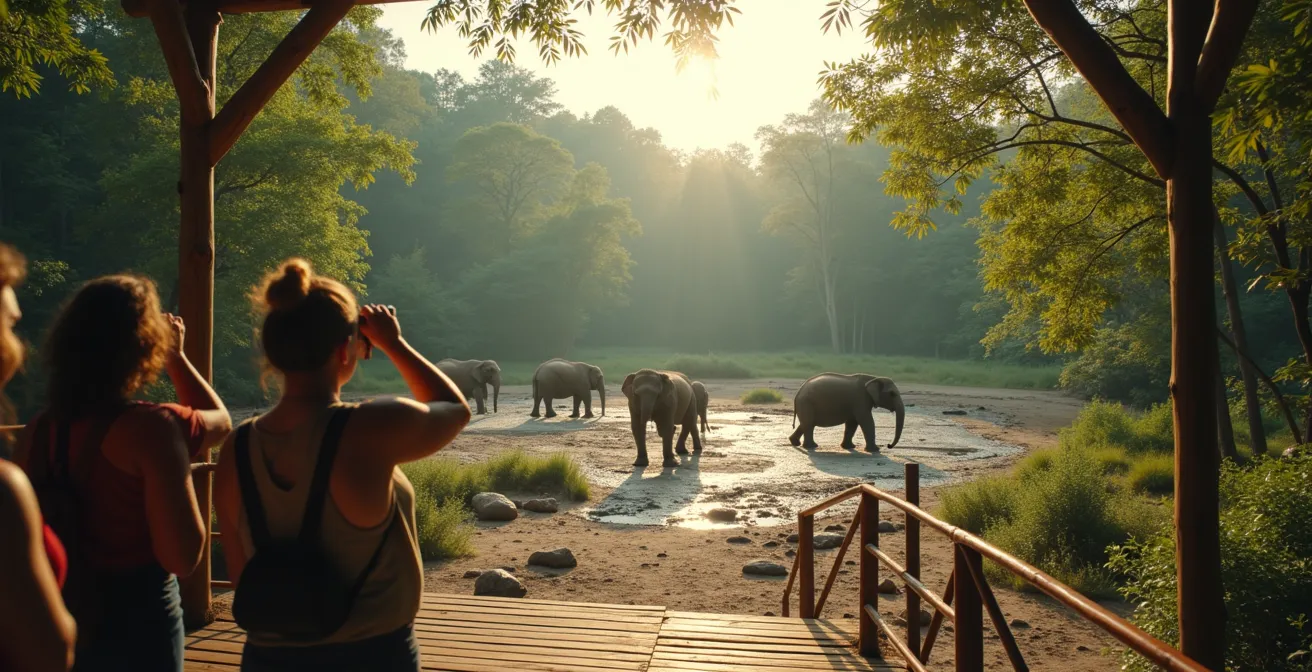
One of the pioneers setting this standard is the Elephant Nature Park in Chiang Mai, Thailand. It operates as a sanctuary for rescued elephants, maintaining strict no-riding and no-performance policies. Visitors observe elephants exhibiting natural behaviors in large, free-roaming areas, providing a model for what true, ethical elephant tourism looks like. This approach ensures the animals’ well-being is the absolute priority.
Local Guesthouse or Eco-Resort Chain: Which Helps the Village?
The conventional wisdom for sustainable travel is to “support local,” which often translates to choosing a small, family-owned guesthouse over a large international resort chain. While the intention is good, the reality is far more complex. The most critical factor is not the size or ownership of the establishment, but the degree of economic leakage—the percentage of tourist revenue that flows out of the local economy and back to international corporations.
A locally-owned business is not automatically better. As a leading voice in the field points out, the details of the supply chain are paramount.
A locally-owned guesthouse that imports all its food and furniture can ‘leak’ more than a chain resort with a strict local-sourcing policy
– Sustainable Travel International, Economic Leakage in Tourism Study
An auditor must look beyond the storefront and investigate the supply chain. Does the guesthouse buy produce from local farmers or a multinational distributor? Are the furnishings made by local artisans or imported? Conversely, a large resort might have the leverage and policies to implement robust local hiring programs, source a high percentage of its food from nearby farms, and fund community development projects. The key is to ask about their procurement policies and the percentage of management positions held by locals, not just entry-level staff.
The following table, based on industry analysis, breaks down the potential impacts. It highlights that ownership is just one piece of a much larger economic puzzle.
| Impact Factor | Local Guesthouse | Chain Resort |
|---|---|---|
| Management positions held by locals | 80-100% | 10-30% |
| Food sourced locally | Variable (20-80%) | Variable (5-60%) |
| Profit retained in community | 60-90% | 5-20% |
| Skills training programs | Informal mentorship | Formal but limited |
| Support for local entrepreneurs | Direct partnerships | Limited/controlled |
The Offset Mistake: Why Planting Trees Doesn’t Erase Your Flight?
Carbon offsetting feels like a perfect solution. You click a box, pay a few extra dollars, and a company plants trees on your behalf, magically erasing the carbon footprint of your flight. Unfortunately, it’s a deeply flawed concept that often serves more to alleviate guilt than to genuinely mitigate climate change. The tourism sector is a significant polluter; research reveals the tourism sector accounts for 8% of global carbon emissions, and aviation is a primary driver.
The problem with offsets is threefold. First, there’s the issue of permanence: a newly planted forest can take decades to capture the carbon emitted by your flight, and there’s no guarantee it won’t be destroyed by fire, disease, or deforestation before then. Second is additionality: would those trees have been planted anyway, without your money? If so, the offset has no additional benefit. Finally, there’s the problem of measurement and verification, which is notoriously difficult and opaque.
Many offset schemes are more marketing than science, providing a “license to pollute” for airlines and assuaging the conscience of travelers without leading to a real reduction in overall emissions. The priority must always be to first reduce emissions at the source—by flying less, choosing more efficient airlines, or opting for direct flights. Offsetting should be a last resort, and only through rigorously vetted, certified projects that guarantee permanence and additionality. Treating it as a simple “get out of jail free” card is a classic greenwashing trap.
How to Handle Your Trash on Islands With No Recycling?
Imagine a pristine tropical island, a paradise of white sand and turquoise water. Now, imagine the “back of house”—the hidden reality of what happens to every plastic bottle, food wrapper, and shipping container that arrives on its shores. On many small islands, waste management infrastructure is minimal or non-existent. There are no municipal recycling facilities or modern landfills. All that trash either gets burned in open pits, releasing toxic fumes, or piles up in a hidden corner of the island, leaching pollutants into the groundwater and ocean.
When a hotel on such an island claims to be “eco-friendly” because it has eliminated plastic straws, you must apply your auditor’s lens. This is a minor, performative gesture if the hotel still imports crates of single-use water bottles, serves condiments in individual plastic packets, and has no system for managing its operational waste. The real impact comes from systems thinking about the entire supply chain. A truly sustainable hotel on an island focuses on radical source reduction.
This means investing in advanced water filtration systems to provide safe, refillable drinking water for guests and staff. It means working with suppliers to deliver goods in reusable containers and buying local, unpackaged produce. It means having a plan to backhaul non-recyclable or hazardous waste to a mainland facility that can handle it properly. Before booking, ask these tough questions about what happens behind the scenes.
- What specific waste reduction strategies do you employ at the source, beyond guest-facing items?
- How do you handle organic waste without access to municipal composting?
- What percentage of your supplies arrive in reusable containers versus single-use packaging?
- Do you have a program to backhaul non-recyclable waste to mainland facilities?
- How do you manage and dispose of hazardous waste like batteries, electronics, and chemicals?
- What on-site water filtration systems have you installed to eliminate dependency on plastic bottles?
The Marketing Mistake That Gets Brands Sued for Greenwashing
For decades, greenwashing was a low-risk marketing strategy. Companies could use vague, positive-sounding language like “eco-friendly,” “natural,” or “green” without legal consequence. That era is over. Regulators and consumers are now holding companies accountable for their environmental claims, and the legal landscape is shifting rapidly. Vague or unsubstantiated claims are no longer just bad ethics; they are a significant legal liability.
The core principle being enforced is that environmental marketing must be backed by evidence. According to regulatory bodies, claims must be clear, specific, and scientifically verifiable. This is a direct challenge to the tourism industry’s reliance on aspirational imagery and ambiguous promises.
Environmental claims must be specific, truthful, and substantiated
– FTC Green Guides, Federal Trade Commission Environmental Marketing Guidelines
A company can’t just say it’s “carbon-neutral”; it must be able to produce credible, third-party-verified data showing how it calculated its footprint and prove that its offsets are real, permanent, and additional. Failure to do so can result in class-action lawsuits for false advertising, as major corporations are now discovering.
Case Study: The Delta Air Lines “Carbon-Neutral” Lawsuit
In 2023, Delta Air Lines faced a landmark lawsuit that challenged its “carbon-neutral” pledge as misleading advertising. The suit alleges that the airline relied on flawed and fabricated carbon offsets, effectively charging environmentally conscious travelers a premium for a phony promise rather than taking genuine steps to reduce its massive environmental impact. This case represents one of the first major legal challenges to a U.S. airline regarding its carbon neutrality claims, signaling a new era of accountability for corporate greenwashing.
How to Design Safari Experiences in Rewilding Zones?
Rewilding is one of the most exciting and hopeful movements in conservation. It’s about restoring ecosystems to a point where nature can take care of itself, reintroducing keystone species and removing human interventions like fences and artificial waterholes. However, the term “rewilding” is also ripe for greenwashing. Some safari operations may market themselves as being part of a rewilding project when, in reality, they operate more like a large, open-air zoo.
A true rewilding safari experience is fundamentally different from a traditional one. The focus shifts from simply ticking off a “Big 5” checklist to understanding the health and complexity of the entire ecosystem. Sightings are not guaranteed. The experience is about the search, the tracking, and appreciating the wildness of an environment that is not managed for tourist convenience. The presence of ecologists and researchers on staff is a strong positive indicator, as it shows a commitment to science over spectacle.
As an auditor, you must be wary of projects that offer a sanitized version of the wild. If the experience feels too predictable or controlled, it likely is. A genuine rewilding project is messy, unpredictable, and prioritizes ecological integrity over guaranteed photo opportunities. Be on the lookout for these red flags:
- Guaranteed wildlife sightings at specific times or locations.
- The use of supplemental feeding stations to attract animals for tourists.
- A lack of formal partnerships with scientific research institutions.
- Marketing that focuses exclusively on the “Big 5” rather than overall ecosystem health.
- The presence of fences that prevent natural migration patterns.
- An absence of publicly available ecological monitoring data.
- No clear, long-term timeline for reducing human intervention in the ecosystem.
Key Takeaways
- True sustainability is about operational proof, not marketing claims. Demand data on waste, water, and energy.
- Your economic power is crucial. Investigate where your money truly goes by questioning local sourcing and employment policies.
- Reject performative gestures. Question carbon offsets, animal interactions, and token efforts; focus on systemic change.
How to Visit Venice Without Contributing to Its Destruction?
Venice is the global poster child for overtourism, a fragile city sinking under the weight of its own popularity. For the conscious traveler, visiting can feel like an ethical dilemma: how can you experience its beauty without being part of the problem? The common advice—visit in the off-season, stay outside the city center—only nibbles at the edges of a systemic crisis. The issue isn’t just the number of people, but how and where they stay, spend their money, and impact the city’s living fabric.
The paradox is that while a reported 76% of travelers want to travel more sustainably, nearly half feel there aren’t enough reliable options. In a place like Venice, this means looking for models that actively work to counter the destructive force of mass tourism. The solution lies in supporting businesses that are fundamentally designed to preserve the city’s social and physical structure, rather than just extracting profit from it. This requires moving away from the mega-hotel model that concentrates impact and displaces residents.
One of the most innovative and effective solutions is a model that integrates tourism directly into the community, preserving its character and distributing economic benefits more equitably.
The Solution Model: Albergo Diffuso (“Scattered Hotel”)
The ‘albergo diffuso’ or “scattered hotel” model offers a powerful alternative to conventional tourism. Instead of building a single large hotel, this approach integrates guest rooms into multiple, beautifully restored apartments within existing historic buildings throughout a neighborhood. The reception might be in a former shop, and breakfast served at a local café. This model directly funds historic preservation, keeps neighborhoods alive with a mix of residents and visitors, and spreads economic benefits to a wider range of local businesses. It reduces the concentrated environmental footprint on fragile infrastructure and helps maintain the authentic, living fabric of the community.
By choosing an ‘albergo diffuso’ or similar community-integrated lodging, you are not just a tourist; you are a temporary resident participating in a living city and actively contributing to its preservation. It’s a powerful example of how thoughtful systems, not just individual actions, can create a truly sustainable travel experience.
Adopting an auditor’s mindset is not about cynicism; it is about empowerment. It transforms you from a passive consumer, susceptible to misleading marketing, into an active agent of change. By asking these critical questions and demanding operational transparency, you send a powerful market signal: that you will only invest your travel dollars in businesses that can prove their commitment to genuine environmental and social responsibility. Start applying this framework to your next trip, and you will not only have a more meaningful travel experience but also become a vital force in building a more truly sustainable tourism industry.