Despite the marketing, a premium Class A+ appliance is often NOT the smartest financial choice for a 2-person household.
- The official energy label is misleading; you must calculate your own real-world usage and costs.
- The true value is only revealed by calculating the Total Cost of Ownership (TCO), which factors in purchase price, actual energy use, and repairability.
Recommendation: Before buying, use a watt-meter on your old appliance and apply the TCO formula in this guide to make a decision based on math, not hype.
You stand in the appliance store, staring at two washing machines. One is reasonably priced. The other, boasting a “Class A+” energy rating, carries a significant premium. The salesperson assures you the savings on your electricity bill will make it worthwhile “in the long run.” This is the modern consumer’s dilemma: a vague promise of future savings versus a very real, immediate hit to your wallet. For a large family running laundry daily, the math might be simple. But for a 2-person household, the calculation is far more ambiguous.
The entire industry is built on the assumption that higher efficiency ratings are an automatic win. We’re told to trust the labels, look for the “smart” features, and believe in the eco-friendly marketing. But these broad recommendations often ignore the specific realities of smaller households, where appliance usage patterns are vastly different from the “average family” used in manufacturers’ projections. The truth is, the sticker on the front of the machine doesn’t tell the whole story.
This guide rejects those generic platitudes. We will adopt the skeptical mindset of a consumer advocate and focus on the one metric that truly matters: the Total Cost of Ownership (TCO). This isn’t about trusting a label; it’s about empowering you with the tools and formulas to calculate the genuine lifetime cost of an appliance for *your* specific situation. We’ll dismantle the myths around energy labels, equip you to measure your real consumption, and provide a framework to decide whether to repair or replace based on hard data, not just a 50% rule of thumb.
By the end of this article, you will be able to look past the marketing noise and confidently determine if that premium for a Class A+ appliance is a smart investment or just money down the drain. This guide provides a clear path to understanding the real-world costs and benefits, structured to help you make the most informed decision.
Summary: The Definitive Guide to Appliance TCO for Small Households
- Why Did Your “A++” Fridge Suddenly Become a “Class E”?
- How to Use a Watt-Meter to Catch Energy-Hogging Old Appliances?
- Repair or Replace: The 50% Rule for Broken Washing Machines
- The Eco-Mode Mistake That Actually Uses More Energy
- When to Run Your Dishwasher to Save on Time-of-Use Tariffs?
- Smart Thermostat or Habits: Which Saves More on Heating Bills?
- How to Design Products That Can Be Repaired in 5 Minutes?
- How Can Small Businesses Profit From Waste Streams?
Why Did Your “A++” Fridge Suddenly Become a “Class E”?
If you’ve shopped for appliances recently, you’ve likely noticed a confusing shift in the familiar A+++ to G energy rating scale. An appliance that was once proudly top-of-the-line might now be rated as a C, D, or even E. This isn’t because the appliance suddenly became less efficient; it’s because the system itself was overhauled in 2021 to make it more stringent. The change was necessary because technology had outpaced the old scale, with most new products clustering in the top A+, A++, and A+++ categories, making true differentiation impossible for consumers.
The new scale is designed to be tougher and leave room for future innovation. Under the revised criteria, what was once considered excellent is now merely average. For example, a refrigerator of the former A+++ class can be classified at best in class B under the new EU system. This “rescaling” means you can’t compare an old label to a new one directly. It also underscores a critical point: the label is a relative benchmark, not an absolute predictor of your energy bill.
The consumption figures listed on the label are based on standardized testing conditions that may not reflect your reality as a 2-person household. They assume a certain number of wash cycles, a specific refrigerator temperature, and an “average” family size. To get past these generic estimates, you must calculate your own, personalized energy cost. This is the first step in determining the true Total Cost of Ownership.
Action Plan: Calculate Your Real Annual Energy Cost
- Find the official consumption values on the new energy label (usually expressed in kWh per 100 cycles or per year).
- Estimate your actual frequency of use for your 2-person household (e.g., 3 wash cycles per week, not the 5 assumed by the manufacturer).
- Calculate your personalized annual electricity demand in kWh based on your true usage patterns.
- Multiply this kWh figure by your local electricity price (check your utility bill for the exact rate per kWh).
- Compare this personalized annual cost to the manufacturer’s rosier projections to see the real-world difference.
This simple calculation moves you from being a passive recipient of marketing data to an active analyst of your own consumption.
How to Use a Watt-Meter to Catch Energy-Hogging Old Appliances?
The most accurate way to calculate the TCO of a potential new appliance is to have a rock-solid baseline of your current one. Manufacturer specs for old models are often lost or inaccurate. The only way to know for sure how much energy an old appliance is consuming is to measure it yourself. This is where a simple, inexpensive tool becomes your best friend: the watt-hour meter (often sold as a “Kill A Watt” or similar device).
This device plugs into the wall, and your appliance plugs into it. It measures the exact amount of electricity (in kilowatt-hours, or kWh) the appliance consumes over time. For a refrigerator, let it run for 24-48 hours to get a reliable average. For a washing machine or dishwasher, run it through a typical cycle. This gives you the “Energy Use Delta” — the real, hard number you can use to compare against the advertised consumption of a new model.
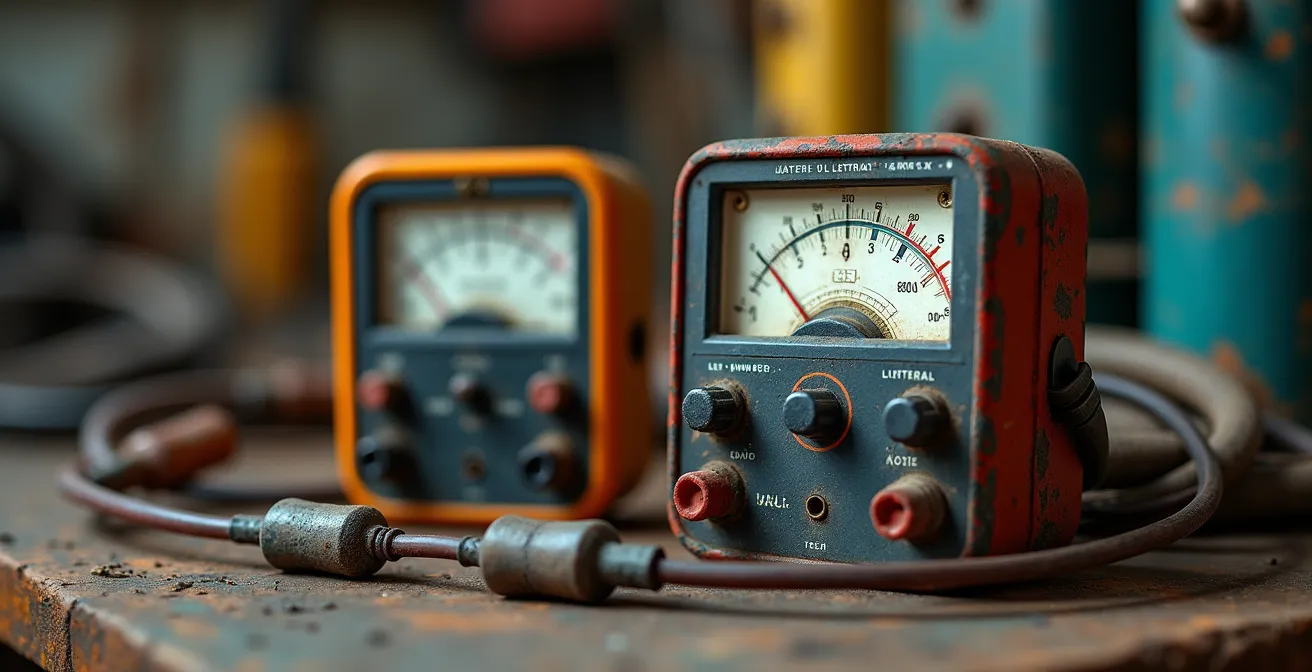
This measurement process often reveals a hidden energy vampire: phantom load. This is the electricity consumed by appliances even when they are turned “off.” Many modern devices with digital displays, clocks, or “instant-on” features are constantly drawing a small amount of power. While it may seem negligible, it adds up significantly over a year.
Small household appliances that require a direct current, like televisions and microwaves, can leak electricity even when they’re turned off. The average US house leaks 50 watts of power from these appliances, adding up to $3 billion in wasted energy costs annually.
Armed with this data, you can calculate the precise annual cost of running your old appliance and make a data-driven comparison, cutting through any marketing claims.
Repair or Replace: The 50% Rule for Broken Washing Machines
When an appliance breaks, the most common advice is the “50% Rule”: if the cost of repair is more than half the cost of a new machine, you should replace it. This rule is simple, quick, and dangerously incomplete. It’s a relic from an era that ignored two critical factors that are central to a modern TCO calculation: lifetime energy costs and embedded environmental costs.
The 50% Rule focuses solely on the immediate upfront expense, completely overlooking the potential for a new, more efficient model to save you hundreds of dollars in electricity over its lifespan. For a 2-person household, this calculation is crucial. A new machine might have a higher purchase price, but if its annual energy consumption is significantly lower than your old, repaired machine, the break-even point could be just a few years away. Furthermore, the rule ignores the significant environmental impact of manufacturing and shipping a new appliance.
As environmental impact studies reveal that up to 10,000 lbs of CO2 can be kept out of the atmosphere by properly repairing and recycling an old freezer, simply junking an appliance has a hidden environmental price tag. A true TCO analysis provides a much more sophisticated framework for this decision.
This is where the traditional rule falls apart and a TCO-based approach proves superior, as it provides a holistic view for long-term value. As shown by a comparative analysis of decision-making models, the TCO method is built for optimization.
| Decision Factor | Traditional 50% Rule | TCO Break-Even Method |
|---|---|---|
| Primary Metric | Repair cost vs. purchase price | (New Cost – Salvage Value) / Annual Energy Savings |
| Energy Consideration | Not included | Central to calculation |
| Embedded Energy | Ignored | Factored as environmental cost |
| Future Repair Risk | Not considered | Included in lifecycle analysis |
| Best For | Quick decisions | Long-term value optimization |
Instead of relying on a simplistic rule of thumb, use your watt-meter data to calculate the potential annual energy savings and determine the true payback period of a new appliance. This is the only way to know if you’re making a smart investment or just throwing money away on a premature replacement.
The Eco-Mode Mistake That Actually Uses More Energy
One of the most heavily marketed features on modern appliances is the “Eco-Mode.” The promise is simple: press this button to save energy and water. The reality, however, is a trade-off. Eco-modes typically save energy by using lower temperatures, which they compensate for by running for a much longer time. This delicate balance of time versus temperature can sometimes backfire, especially in a 2-person household.
The mistake is assuming Eco-Mode is always the most efficient choice. For a full, heavily soiled load in a dishwasher, the extended cycle at a lower temperature is indeed more efficient. But for a small, lightly soiled load, a “Quick Wash” or “Half Load” setting might use less total energy and water because the cycle is drastically shorter. The extended duration of Eco-Mode can become inefficient overkill.

Furthermore, lower water temperatures can be less effective at dissolving modern, concentrated detergent pods, sometimes requiring a second rinse or wash, which completely negates any potential savings. The key is to match the cycle to the load, not to blindly trust the “Eco” button. For many small households, this means avoiding the Eco-Mode in several common scenarios.
Here are situations where Eco-Mode might not be the best choice:
- When washing small loads where a ‘quick wash’ cycle uses less total energy than an extended eco-cycle.
- For lightly soiled items that do not require the intensive, prolonged washing of an eco-cycle.
- If you notice that lower temperatures are failing to dissolve detergents properly, leading to residue on clothes or dishes.
- On dishwashers that lack soil sensors and run a fixed, long cycle regardless of how dirty the dishes are.
- In time-sensitive situations where waiting three or four hours for a cycle to complete is simply not practical.
The lesson here is to think critically about an appliance’s features. The most “eco-friendly” option on the control panel isn’t always the most economical for your specific needs.
When to Run Your Dishwasher to Save on Time-of-Use Tariffs?
The latest frontier in appliance marketing is “smart” connectivity. Many new models can connect to your Wi-Fi, allowing you to control them from your phone. One of the key advertised benefits is the ability to schedule operation during off-peak hours to take advantage of Time-of-Use (TOU) electricity rates. These are variable pricing plans offered by some utilities where electricity is cheaper late at night and more expensive during peak demand in the afternoon.
The promise is automated savings. Your smart dishwasher communicates with the grid and automatically runs when electricity is cheapest. In theory, this is a great idea. In practice, the savings are highly conditional. First and foremost, you must actually be enrolled in a TOU plan with your utility. For many people on standard, flat-rate plans, there is absolutely zero financial benefit to running a dishwasher at 2 a.m. It’s a “smart” feature with no real-world impact.
Even for those on TOU plans, the actual dollar savings for a 2-person household might be minimal, potentially not enough to justify the premium price of the smart appliance in the first place. The difference between peak and off-peak rates may only be a few cents per kWh. Running a 2 kWh dishwasher cycle might save you 10 cents per run. While this adds up, it’s important to calculate if it will ever pay back the $200 extra you paid for the smart functionality.
Some manufacturers are now offering ‘smart’ appliances that can be connected to smart electric meters… If your utility charges lower rates for electricity when demand is lower… you could save on your utility bill. Such changes may be unnoticeable to you, but could add up to significant savings on your energy costs.
While the potential exists, it’s crucial to ground it in reality. The combination of a highly-efficient appliance with strategic scheduling can be powerful. For example, some analyses show that smart scheduling combined with efficient appliances can save up to $3,500 over the lifetime of a major appliance like a water heater. However, this represents an ideal scenario, not a guaranteed outcome.
The takeaway is to do your homework first. Call your utility provider, understand your rate plan, and do the math before paying a premium for a smart feature you may never benefit from.
Smart Thermostat or Habits: Which Saves More on Heating Bills?
The logic of TCO extends beyond kitchen and laundry appliances to the biggest energy user in most homes: heating and cooling. The market is flooded with smart thermostats that promise to learn your habits and optimize your HVAC system, saving you money without sacrificing comfort. For a large, busy family in a multi-story house, the convenience and zone control can offer significant returns. But for a 2-person household in a smaller home or apartment, the math is once again more nuanced.
The core function of a smart thermostat is to automatically lower the temperature when you’re away or asleep. This is something you can do manually for free. The primary benefit of the smart thermostat is convenience; it does it for you. The question is, is that convenience worth the $200-$300 price tag? Often, simple, zero-cost behavioral changes can yield similar or even greater savings. Putting on a sweater and lowering the thermostat by a few degrees yields immediate savings with a payback period of zero.
In smaller, more open-plan homes typical for one or two people, expensive systems with multiple sensors and granular zone control offer very little advantage over a basic programmable or even manual thermostat. The cost of the advanced system may never be recouped through energy savings in such a small space.
In a smaller home or apartment typical for a 2-person household, the granular zone control offered by expensive smart systems provides diminishing returns compared to a larger, multi-story house.
– Home Energy Efficiency Analysis, Ross and Witmer HVAC Specialists
The decision between investing in technology and adopting new habits comes down to a clear cost-benefit analysis. As this comparison shows, the “best” option is highly dependent on household size and priorities.
| Approach | Initial Cost | Annual Savings | Payback Period | Best for 2-Person Home |
|---|---|---|---|---|
| Smart Thermostat | $200-$300 | 4°F adjustment without comfort loss | 2-3 years | Hands-off convenience |
| Manual Habits | $0 (sweater cost) | Similar savings potential | Immediate | Budget-conscious households |
| Zone Control Systems | $500+ | Diminishing returns in small homes | 5+ years | Not recommended |
For a budget-conscious 2-person household, the conclusion is often clear: disciplined habits will always have a faster and more certain financial return than a costly gadget.
How to Design Products That Can Be Repaired in 5 Minutes?
A crucial and often overlooked component of an appliance’s Total Cost of Ownership is its repairability. An appliance that is cheap to buy but impossible or prohibitively expensive to fix is not a good long-term investment. The “Right to Repair” movement has brought this issue to the forefront, empowering consumers to demand products that are designed to last and be maintained.
When you’re evaluating a new appliance, you should be thinking like a repair technician. Is the machine assembled with standard Phillips head screws, or proprietary fasteners that require special tools? Are key components like pumps and belts modular and easily accessible, or are they sealed inside a plastic tub that must be replaced as a single, expensive unit? The answers to these questions will dramatically affect your long-term costs. A simple pump replacement might cost $50 in parts, but if it’s sealed in a drum, the repair could cost $500, pushing you to prematurely replace the entire machine.
This leads to the “disposable premium” trap, where even high-end, luxury appliances can be a poor TCO choice. Many achieve their sleek, minimalist aesthetic by sealing components away, making simple repairs impossible for the sake of design.
While luxury appliance brands come at a higher price point, they offer a level of craftsmanship and personalization… However, many achieve sleek designs by sealing components, making simple repairs impossible.
Before you buy, put on your consumer advocate hat and run through a repairability checklist. This simple due diligence can save you from a massive financial headache down the road.
- Check for modular components that can be easily swapped out.
- Look for QR codes on parts that link to online repair tutorials and diagrams.
- Verify the use of standard screws (like Phillips head) instead of proprietary fasteners.
- Confirm the manufacturer’s policy on the availability of spare parts for at least 10 years.
- Research the brand’s public stance and commitment to the Right to Repair movement.
- Check warranty terms to ensure that self-repair or third-party repair does not automatically void it.
Choosing an appliance designed for repair over a sealed, “disposable” model is one of the most effective ways to lower your TCO and ensure your investment lasts.
Key takeaways
- The official energy label is a poor guide for small households; you must calculate your own Total Cost of Ownership (TCO).
- Use a watt-meter to measure your old appliance’s actual energy use—this is the only number that matters for a true comparison.
- The “50% Rule” for repair-or-replace is flawed; a TCO calculation that includes energy savings and repairability is superior.
How Can Small Businesses Profit From Waste Streams?
The final step in mastering the TCO equation is to think like a small business and see your old appliance not as waste, but as an asset. When you upgrade, your old-but-functional appliance has residual value. By strategically managing your appliance lifecycle, you can create a self-funding “upgrade cascade” that minimizes your long-term costs.
The second-hand market for appliances is substantial. There are always people—students, landlords, first-time renters—looking for a reliable, low-cost machine. The scale of this opportunity is vast; the second-hand appliance market reveals that over 70 million Americans own refrigerators more than 10 years old, costing them billions in excess energy. This creates a constant demand for newer, even moderately more efficient used models.
The Upgrade Cascade Strategy is a systematic approach to leveraging this market. Instead of replacing appliances haphazardly, you identify the one with the worst TCO (highest energy use) and replace it first. You then sell the old appliance on a local marketplace and use the proceeds to help fund your next upgrade, moving down the list from the worst offender to the best.
Here is how the Upgrade Cascade Strategy works in practice for a 2-person household:
- Identify the appliance with the worst TCO using your watt-meter measurements (it’s often the refrigerator or a chest freezer).
- Replace it with a new, genuinely efficient model whose TCO you have calculated and justified.
- Sell the old-but-functional appliance on the second-hand market for a fair price. Don’t throw it away.
- Use the proceeds from the sale to create a dedicated “appliance fund” for your next upgrade.
- Repeat the cycle, targeting the next highest energy user in your home.
- Consider buying nearly-new (e.g., 3-year-old) B-rated appliances as a budget-friendly alternative to brand-new A-rated models.
By adopting this mindset, you transform the expensive chore of replacing appliances into a strategic, financially sound process that minimizes waste and maximizes value over the long term.