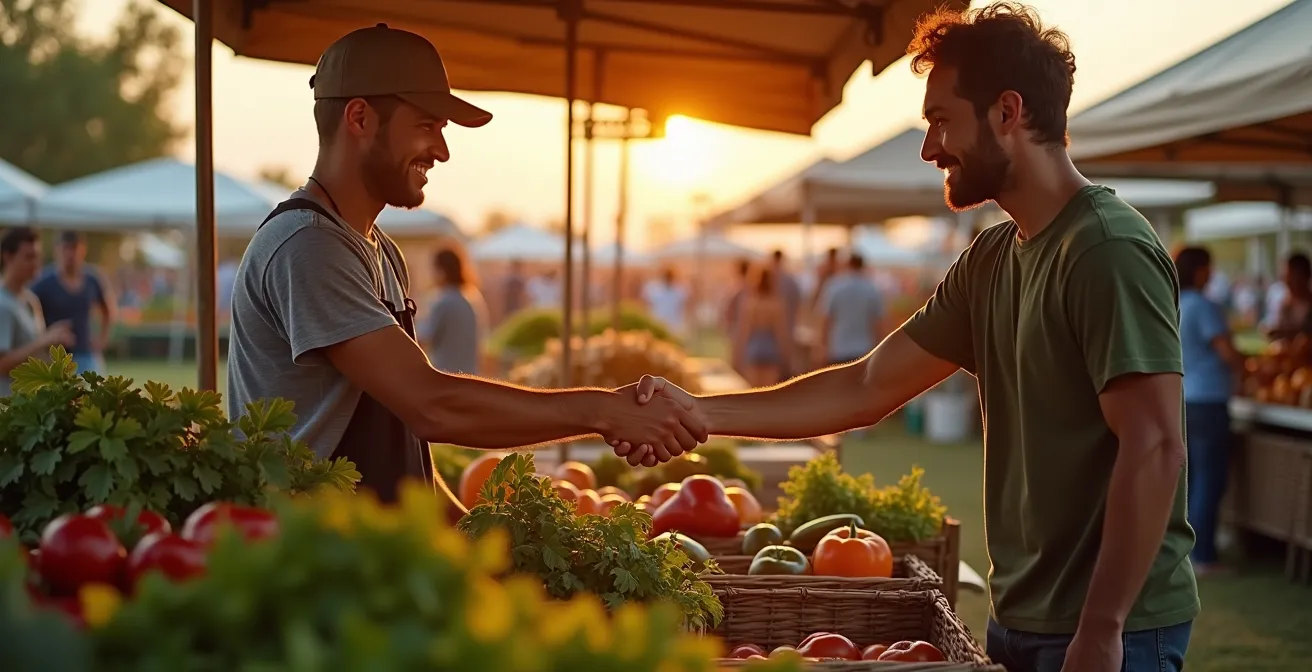
Buying direct from farmers isn’t just a feel-good gesture; it’s a strategic investment that generates more than double the local economic activity compared to supermarket purchases.
- It drastically shortens supply chains, making our food system less fragile and more resistant to external shocks.
- It ensures that up to 90% of your dollar goes directly to the producer, creating more local jobs and recirculating capital within the community.
Recommendation: Start by identifying one local farm, CSA, or farmers market and commit to one purchase a week. This simple shift is the most powerful first step toward strengthening your regional economy.
When a crisis hits and supermarket shelves go bare, it sends a clear and alarming signal: our modern food system is far more fragile than we imagine. For many community-minded citizens, the instinct is to “buy local” as a solution. This is often framed as a simple act of keeping money in the community, a valid but incomplete picture. The usual advice revolves around visiting a farmers’ market or joining a Community Supported Agriculture (CSA) program, focusing on the freshness of the food or the personal connection to the grower.
But what if the true power of buying direct from farmers wasn’t just about redirecting a single transaction? What if it was about fundamentally rewiring our local economic infrastructure? The real story of resilience lies not in simply ‘keeping money local,’ but in understanding the profound difference between a long, brittle, extractive supply chain and a short, robust, circulatory one. This is a shift from being a passive consumer at the end of a global network to an active co-investor in a local ecosystem.
This article moves beyond the platitudes to dissect the core mechanics of economic resilience. We will analyze why the conventional system fails, quantify the real financial impact of your purchasing choices, and provide a clear framework for how you can strategically participate in building a stronger, more shock-resistant local economy, one purchase at a time.
To understand the full scope of this economic transformation, this guide explores the critical weak points of our current system and the powerful, resilient alternatives available right in your community. The following sections break down exactly how and why your support for local farms is a direct investment in a more stable future.
Summary: Building a Resilient Local Food Economy
- Why Did Supermarket Shelves Empty So Fast During the Last Crisis?
- How to Choose the Right CSA Box for Your Cooking Habits?
- Supermarket “Local” vs Farm Stand: Who Really Gets Your Money?
- The Mistake of Assuming “Local” Always Means “Pesticide-Free”
- How to Process 20lbs of Tomatoes in One Weekend Without Stress?
- When to Buy What: A Monthly Calendar for Peak Nutrient Density
- Why Is a Street Tree Worth $50,000 in Services Over Its Lifetime?
- Which Fair Trade Certifications Actually Guarantee a Living Wage?
Why Did Supermarket Shelves Empty So Fast During the Last Crisis?
The phenomenon of empty supermarket shelves during the early days of the pandemic was not just a result of “panic buying.” It was a dramatic exposé of the inherent supply chain brittleness that defines our modern food system. These highly optimized, “just-in-time” networks are designed for maximum efficiency in a stable world, but they lack the redundancy and flexibility to handle sudden shocks. When a disruption occurs anywhere along this long chain—whether it’s a labor shortage, a transportation bottleneck, or a processing plant shutdown—the entire system falters.
This vulnerability was starkly highlighted by the sudden shift in consumer behavior. A Federal Trade Commission report found that consumers purchased up to a 56% increase in at-home food during those early weeks. The centralized system, with its handful of massive distribution centers and long-haul trucking routes, simply couldn’t pivot fast enough. The result was the jarring sight of bare shelves, a clear indicator that efficiency had been prioritized over resilience.

In contrast, local food systems, with their short, decentralized networks, demonstrated far greater robustness. While they also faced challenges, the direct connection between grower and consumer provided an agile alternative. Farmers could redirect produce intended for closed restaurants directly to households via CSAs or on-farm pickups. This adaptability is the first crucial pillar of economic resilience; it’s the system’s ability to bend without breaking when faced with the unexpected. The long supply chain is a rigid stick; the local food web is a resilient net.
How to Choose the Right CSA Box for Your Cooking Habits?
Shifting from a reactive supermarket shopper to a proactive member of a Community Supported Agriculture (CSA) program is one of the most direct ways to build local economic resilience. However, joining a CSA is more than just subscribing to a vegetable box; it’s entering into a partnership with a farm. As FarmstandApp notes, “When you join a CSA, you’re not just purchasing produce – you’re actively reshaping the food system.” Choosing the right one requires aligning the farm’s model with your household’s lifestyle.
First, honestly assess your cooking habits. Are you an adventurous cook who enjoys experimenting with unfamiliar vegetables like kohlrabi or celeriac? Or do you prefer staples for predictable weekly meals? Some CSAs offer “market-style” pickups where you choose your items, while traditional models provide a pre-packed box of what’s peaking at the farm. A mismatch here can lead to food waste and frustration. Also, consider share size. A full share might be perfect for a large family, while a half-share or bi-weekly pickup is better suited for a couple or single person.
Beyond the contents, view your membership as an investment. You are providing crucial upfront capital that a farmer needs for seeds, equipment, and labor at the beginning of the season. This direct financial relationship is the engine of the economic multiplier effect. Research shows that every CSA membership dollar generates $62 in additional local economic activity. By choosing a CSA, you are not just buying food; you are funding a more resilient and localized economic structure that benefits the entire community.
Supermarket “Local” vs Farm Stand: Who Really Gets Your Money?
The term “local” has become a popular marketing buzzword in large grocery chains, but the economic reality behind a supermarket’s “local” apple and a farm stand apple are worlds apart. The difference lies in value-capture and capital recirculation. When you buy directly from a farmer, you are fundamentally altering the flow of money, with profound impacts on the local economy. At a typical supermarket, the farmer who grew the produce is lucky to receive 15-20% of the retail price. The vast majority is absorbed by a long chain of intermediaries: distributors, packers, wholesalers, and the retailer itself.
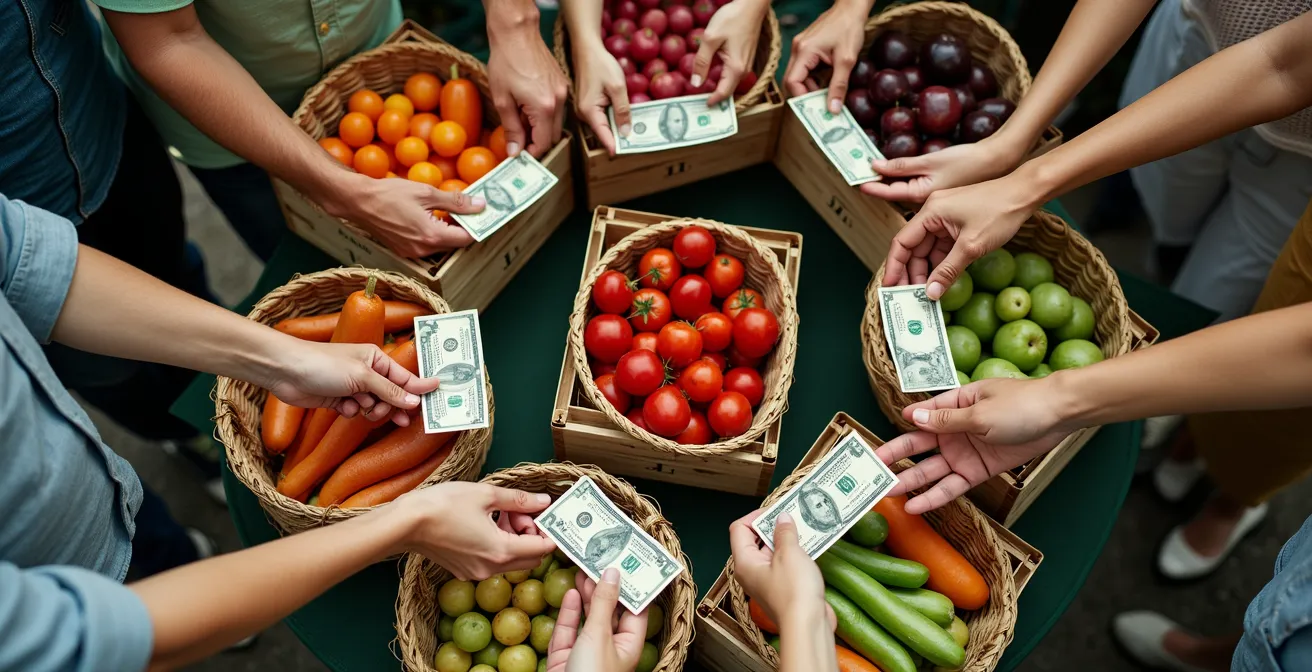
In a direct-to-consumer model, like a farmers’ market or farm stand, that dynamic is inverted. Studies show that through direct-to-consumer models, farmers keep 85-90% of the sale price. This massive increase in value-capture means the farm is more financially viable, can afford to pay its workers better, and is more likely to reinvest its profits locally. This recirculation of capital is the engine of community wealth. It creates a powerful ripple effect that is simply absent when the profits are extracted and sent to a distant corporate headquarters.
This difference in money flow has a direct and measurable impact on job creation. The following table, based on data from agricultural economic studies, starkly illustrates the disparity.
| Factor | Supermarket ‘Local’ | Farm Stand Direct |
|---|---|---|
| Economic Multiplier | $25 per $100 spent | $62 per $100 spent |
| Farmer’s Share | 15-20% of retail price | 85-90% of retail price |
| Local Job Creation | Low (corporate structure) | High (local labor) |
| Supply Chain Steps | 7-12 intermediaries | 0-1 intermediary |
The numbers are clear: direct purchasing isn’t just marginally better; it’s exponentially more powerful. Research from the Farmers Market Coalition confirms that direct-market farms create 32 local jobs per $1 million in revenue, compared to just 10.5 for farms selling through wholesale channels. When you choose the farm stand, you are voting for a system that builds local employment and community wealth.
The Mistake of Assuming “Local” Always Means “Pesticide-Free”
As we champion the shift to local purchasing, it’s crucial to approach it with clear eyes and avoid romanticized assumptions. One of the most common mistakes is equating “local” with “organic” or “pesticide-free.” “Local” is a geographic descriptor, not an agricultural certification. While many small-scale local farmers do use sustainable, organic, or regenerative practices, it is not a given. Some may use conventional farming methods, including synthetic pesticides and fertilizers, to manage pests and ensure a viable crop.
This is not a reason to dismiss local farms, but rather an invitation to engage. Unlike the anonymous produce at a supermarket, buying direct gives you a unique opportunity: you can talk to the person who grew your food. Ask them about their practices. Most farmers are proud of their work and happy to explain their methods for pest control, soil health, and fertilization. This conversation builds trust and deepens your understanding of the food system far more than a simple label ever could.
Furthermore, this engagement opens the door to understanding the complex economic realities farmers face. Organic certification can be an expensive and lengthy process that many small farms cannot afford, even if they follow organic principles. They may be “uncertified organic.” Others may be transitioning their land and using a mix of practices. As the Biodynamics Association points out, “The question of how to fund the future is being tackled by CSA growers and consumers through unique community funding and financing arrangements.” Your support can be part of that funding, helping a farm invest in more sustainable practices over time. The goal is progress, not perfection. Supporting a local conventional farmer is still a massive win for the local economy and supply chain resilience.
How to Process 20lbs of Tomatoes in One Weekend Without Stress?
One of the tangible benefits of a strong connection to a local farm is access to produce in bulk during peak season. A CSA share might suddenly include 20 pounds of ripe tomatoes, or a farmers’ market might offer a significant discount for a full case. This can feel overwhelming, but with the right mindset and strategy, it’s a powerful step toward household food resilience and economic savings. This is where you move from being a consumer to a home-level producer, extending the harvest and building a buffer against future price hikes or shortages.
The key to stress-free food preservation is creating an efficient system. Don’t just dive in. First, set up your workspace like an assembly line: a station for washing, a large pot for blanching, a bowl of ice water for cooling, and a cutting area for peeling and coring. Working in batches makes the task manageable. Rather than trying to do everything at once, focus on one step at a time for the entire quantity. This “batch processing” approach is far less chaotic and much faster.
Next, diversify your preservation methods to match your future cooking needs. Can some of the tomatoes as a basic sauce for winter pasta. Freeze a portion whole or chopped for adding to soups and stews. Dehydrate slices to make intensely flavored “sun-dried” tomatoes for salads and snacks. This diversification not only gives you culinary flexibility but also spreads the risk. By turning a seasonal glut into a year-round pantry, you are directly increasing your household’s resilience. The economic benefit is also significant; studies show that home preservation can yield 40-60% savings on winter produce costs compared to buying out-of-season equivalents at the supermarket.
When to Buy What: A Monthly Calendar for Peak Nutrient Density
True partnership with a local food system involves aligning your purchasing habits with the natural rhythms of the seasons. Buying produce when it is at its peak harvest is not just about getting the best flavor and nutrient density; it’s a strategic act that supports the economic viability of the farm. A farm’s production costs are lowest when a crop is naturally abundant. By purchasing strawberries in June and squash in October, you are buying a product at its most efficient point, allowing the farmer to achieve a better margin while offering you a fair price.
This seasonal alignment is particularly crucial during the “shoulder seasons” of early spring and late fall. During these times, farms often have fewer products to sell but still face significant operational costs for planting, soil preparation, or season extension infrastructure like high tunnels. Your consistent support during these leaner months provides critical cash flow that can be the difference between a farm’s success and failure. This is another way your role evolves from a simple consumer to a stabilizing economic partner.
Creating a simple mental or written calendar of what’s in season in your specific region is a powerful tool. In early spring, look for asparagus and rhubarb. In the height of summer, indulge in tomatoes, corn, and berries. As fall arrives, shift to root vegetables, apples, and winter squash. As the Farmers Shed highlights, “By supporting local farms, CSA helps build resilience into regional economies, as the money spent on local produce circulates within the community.” This circulation is most effective when it is consistent, following the natural ebbs and flows of the agricultural year. Your seasonal purchasing is a vote of confidence in the farm’s entire annual cycle.
Key Takeaways
- The fragility of long, centralized supermarket supply chains makes local economies vulnerable to shocks.
- Buying direct ensures farmers receive up to 90% of the sale price, dramatically increasing local capital recirculation.
- Direct farm sales create significantly more local jobs per dollar of revenue than sales through wholesale channels.
Why Is a Street Tree Worth $50,000 in Services Over Its Lifetime?
This question seems out of place, but it provides a powerful analogy for understanding the true value of local farms. A street tree isn’t just wood and leaves; it’s a piece of living infrastructure that provides quantifiable services like stormwater management, air purification, and heat island reduction, worth tens of thousands of dollars over its life. Similarly, a local farm is much more than a food factory. It is a cornerstone of the region’s ecological and economic infrastructure, providing a host of services that are often invisible in a supermarket transaction.
A well-managed farm provides critical “ecosystem services.” Its unpaved soil helps recharge groundwater aquifers. Its cover crops prevent soil erosion and nutrient runoff into local waterways. It provides a vital habitat for pollinators and other wildlife, which are essential for the entire regional ecosystem. The 4P Foods model, for instance, shows how a network of over 200 small farms can be coordinated to deliver these benefits at a landscape scale, all while creating measurable economic opportunity for rural communities.
This broader view of value is essential for understanding economic resilience. When you support a local farm, you are not just paying for a tomato. You are investing in the preservation of green space, the health of your local watershed, and the biodiversity of your region. These are public benefits that have real, long-term economic value. The money you spend circulates more effectively, too. Research consistently shows that locally directed spending generates 2x the economic activity within a region compared to spending at chain retailers. Just like the street tree, the local farm’s total value far exceeds the price of its individual products.
Which Fair Trade Certifications Actually Guarantee a Living Wage?
As we become more conscious of the economic impact of our food choices, questions of fairness and labor naturally arise. The discussion around certifications like “Fair Trade” often focuses on global commodities like coffee and chocolate, but the principles are just as relevant to the farm down the road. Ensuring that our quest for local resilience doesn’t come at the expense of the people who do the hard work of growing our food is a critical part of building a truly equitable and sustainable system.
The direct-to-consumer model inherently creates a more transparent and often more equitable labor dynamic. As a UC Davis study cited in Modern Farmer states, “For every dollar of sales, direct marketers are generating twice as much economic activity within the region.” A significant portion of this increased activity can and should be directed toward better wages for farm workers. Because the farmer captures a much larger share of the final price, they have more capacity to offer competitive wages and benefits compared to a farm squeezed by the razor-thin margins of the wholesale market.
However, as with agricultural practices, this is not a guarantee. True economic resilience must include the well-being of every person in the supply chain. This is another area where the power of direct relationships comes into play. You have the ability to ask respectful questions about a farm’s labor practices. This is not an accusation, but an act of responsible partnership. The following checklist provides a guide for what to look for and what questions to ask to ensure your dollars are supporting a farm that values its entire team.
Your Action Plan: Assessing Local Farm Labor Practices
- Ask what wages farm workers receive and how they compare to the local living wage.
- Inquire if workers are provided with benefits like health insurance or paid time off.
- Check what training and advancement opportunities exist for farm employees.
- Question how the farm ensures safe working conditions, especially during peak seasons and extreme weather.
- Determine if the farm employs year-round workers or relies solely on seasonal labor, which can indicate job stability.
Your support for farms that provide stable, well-paying jobs is a direct investment in the social fabric of your community. It ensures that the resilience we seek is built on a foundation of dignity and fairness for everyone involved.
Your next step is simple: locate one farmers market, CSA, or farm stand in your area and make it a part of your weekly routine. This single change is the first, most powerful step toward building the resilient community we all depend on.