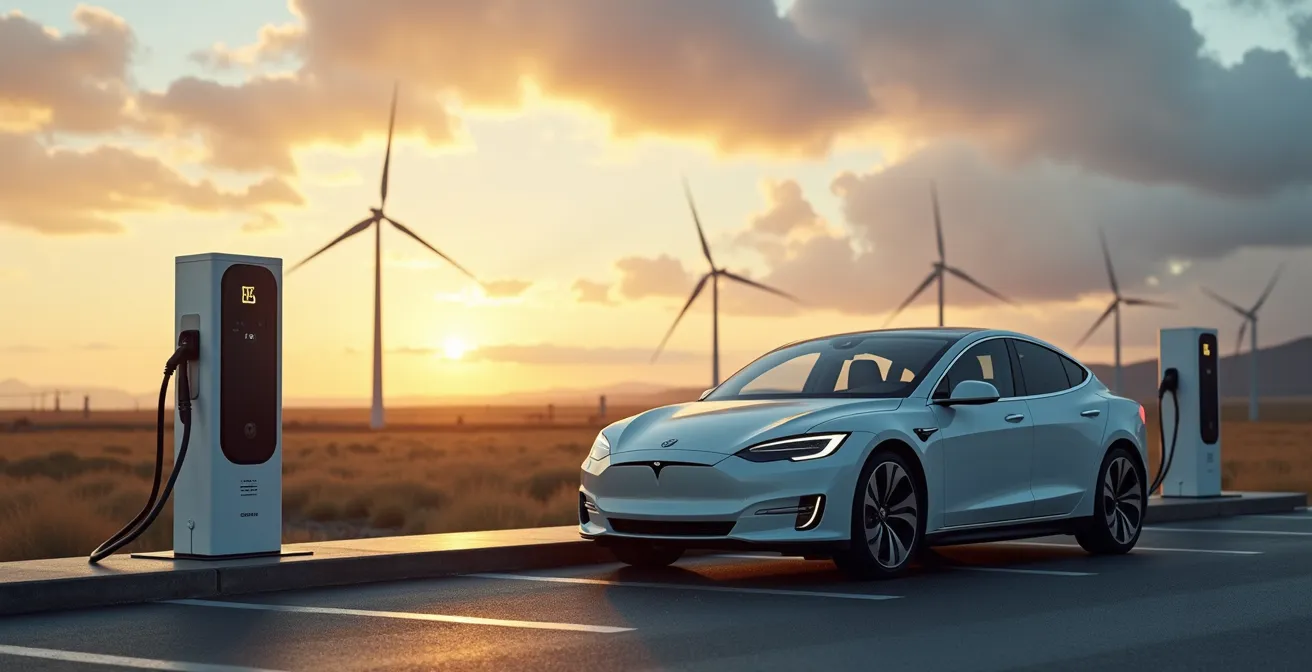
Stabilizing the power grid with Electric Vehicles is not a simple plug-and-play feature; it is a complex systems architecture challenge.
- The core issue isn’t just storing energy, but managing its flow through distributed intelligence, deciding whether the “brains” are at the edge (the vehicle) or the core (the substation).
- True resilience emerges from systemic symbiosis, where the EV fleet integrates with other urban systems like public transport and data center heat recovery to maximize efficiency.
Recommendation: Urban planners and grid operators must shift focus from individual V2G transactions to designing secure, integrated, and multi-layered energy ecosystems with EVs as dynamic, intelligent nodes.
The rise of renewable energy sources like solar and wind presents a paradox: at times, they produce more power than the grid can handle, while at others, they leave a critical void. The conventional wisdom suggests a simple solution: use the millions of Electric Vehicles (EVs) as a vast, distributed network of “batteries on wheels” to absorb the excess and discharge it during peak demand. This vision, known as Vehicle-to-Grid (V2G), is often portrayed as an elegant, almost automatic fix to the intermittency problem that plagues modern energy systems.
However, this simplistic view dangerously masks the profound architectural reality. Treating an EV fleet as a passive battery resource overlooks the intricate layers of communication, control, and security required to orchestrate it effectively. If the fundamental architecture is flawed, a system designed for stability could instead become a significant vector of vulnerability. The true key to leveraging EVs for grid stabilization lies not in their storage capacity alone, but in the intelligent design of the digital and physical infrastructure that connects them.
This exploration moves beyond the basics of V2G to deconstruct the critical architectural decisions at the heart of a resilient, EV-integrated smart city. We will dissect the physical challenges of renewable energy, the logic of distributed intelligence, the non-negotiable security protocols, and the innovative ways to weave EV infrastructure into the very fabric of urban life, from public transport to waste heat recovery. It is a shift from a conversation about batteries to a blueprint for a truly interconnected and efficient urban ecosystem.
The following sections will deconstruct this complex system, layer by layer. We will examine the core engineering problems, the architectural trade-offs in system design, and the innovative integrations that define the future of urban energy resilience.
Summary: How Electric Vehicles Architect the Future of Grid Stability
- Why Does Too Much Solar Power Crash the Grid Without Storage?
- How to Connect Your EV to Power Your House During an Outage?
- Smart Meter or Smart Substation: Where Should the Brains Be?
- The Security Mistake That Could Black Out a Smart City
- How to Heat Swimming Pools With Server Farm Exhaust?
- How to Combine Scooters and Subways for Fastest Commutes?
- Smart Thermostat or Habits: Which Saves More on Heating Bills?
- How to Structure Electricity Tariffs to Encourage Decarbonization?
Why Does Too Much Solar Power Crash the Grid Without Storage?
The fundamental challenge with large-scale solar integration is a phenomenon known as the “duck curve.” This term describes the dramatic mismatch between peak solar generation and peak electricity demand. During midday, when the sun is highest, solar panels flood the grid with cheap, abundant electricity, causing net demand (total demand minus renewable generation) to plummet. However, as the sun sets, solar production drops off just as people return home, turn on lights, and start appliances, causing a massive, steep ramp-up in demand that traditional power plants struggle to meet.
This creates a severe systemic imbalance. An oversupply of solar power during the day can force grid operators to “curtail” or waste renewable energy to prevent overloading the system. In the evening, the grid is strained to bring fossil-fuel “peaker” plants online at a moment’s notice, an inefficient and costly process. Without a mechanism to absorb the midday energy surplus and redeploy it in the evening, the grid’s stability is compromised. This is where storage becomes critical.

As the illustration vividly portrays, the “belly” of the duck represents the midday solar glut, while its “neck” is the steep evening ramp-up. Centralized battery storage facilities are the primary solution being deployed to “flatten” this curve by charging during the day and discharging in the evening. However, the next architectural evolution involves decentralizing this storage capability across thousands or millions of endpoints—chief among them, electric vehicles.
How to Connect Your EV to Power Your House During an Outage?
While Vehicle-to-Grid (V2G) involves a two-way relationship with the utility, a more localized and immediately practical application is Vehicle-to-Home (V2H). This technology transforms your EV into a personal power station, capable of running your home during a blackout. This capability represents the most granular level of grid architecture, turning individual homes into resilient, self-sufficient energy islands. However, enabling V2H is not as simple as plugging your car into a standard outlet; it requires a specific set of hardware components working in concert.
The architecture for a V2H system consists of three essential elements:
- A V2H-Compatible Vehicle: Not all EVs are created equal. The vehicle must support bidirectional charging, meaning its internal power electronics are designed to allow energy to flow out of the battery. This is becoming more common in newer models from manufacturers like Ford, GM, and Hyundai.
- A Bidirectional DC Charger: Standard EV chargers only work in one direction. A bidirectional charger is a specialized piece of hardware that can manage the two-way flow of DC power between the car’s battery and your home’s electrical system.
- A Home Energy Gateway or Transfer Switch: This is the brain of the system. During a grid outage, this device safely disconnects your home from the utility grid and enables the EV to start powering your home circuits. This “islanding” capability is a critical safety feature that prevents your EV from sending power back into the grid and endangering utility workers.
From a systems architect’s perspective, a V2H-enabled home is the foundational building block of a decentralized, resilient grid. When aggregated, thousands of these homes create a powerful network that can support not just individual households, but the entire community’s energy infrastructure.
Smart Meter or Smart Substation: Where Should the Brains Be?
As we scale from a single V2H-enabled home to a city-wide V2G network, a critical architectural question emerges: where should the “brains” of the operation reside? This is a classic debate between edge computing and centralized control. Should intelligence be distributed to the edges of the network—the smart meters and EV chargers in every home—or centralized at a higher level, like a utility substation or a third-party aggregator’s cloud platform?
The “edge” approach, with intelligence in the smart meter, offers low latency and can operate even if connection to the central grid is lost. It allows for near-instantaneous responses to local voltage fluctuations. The “centralized” approach, with the smart substation or an aggregator acting as the brain, provides superior coordination. It can orchestrate thousands of EVs simultaneously to address a grid-wide issue, a feat demonstrated when California achieved a milestone when batteries reached a record 7 GW discharge, meeting a third of the grid’s peak load. These architectural trade-offs between autonomy and coordination are central to smart grid design.
There’s also a subtle, but crucial, benefit to the coordinated approach that impacts the hardware itself. As Paul Gasper, a battery degradation scientist at the National Renewable Energy Laboratory (NREL), explains, V2G can actually extend battery life:
When parked EVs sit fully charged for an extended period of time, the batteries degrade more quickly than if they were at a lower state of charge. Participating in V2G programs lowers the average state of charge while the vehicle is parked, which can help batteries stay healthy and last longer.
– Paul Gasper, NREL Battery Degradation Scientist
Ultimately, the optimal architecture is likely a hybrid model: local intelligence at the edge for rapid, autonomous response, guided by strategic commands from a centralized brain that maintains a holistic view of both grid stability and the health of the distributed battery fleet.
The Security Mistake That Could Black Out a Smart City
The single greatest security mistake in designing a V2G-enabled smart city is treating it as a simple energy market instead of what it truly is: a distributed, remote-control system for critical infrastructure. When thousands of EVs are aggregated, they form a powerful resource capable of stabilizing the grid. But this aggregation also creates a massive, consolidated vector of attack. A malicious actor who gains control of a V2G aggregator platform could theoretically command thousands of EVs to charge or discharge simultaneously, creating a power surge or drain large enough to destabilize a regional grid and cause a blackout.
The potential was demonstrated, albeit for good, in June 2023. As a case study from Germany shows, smart charging software drew power from over 4,500 idle EV batteries to supply electricity to 20,000 homes after a power plant failure. This event highlights the immense power of aggregated control, but it also serves as a stark warning: if a benevolent aggregator can do this, so can a hostile one. This transforms cybersecurity from a standard IT concern into a fundamental aspect of public safety and grid reliability.
Therefore, a zero-trust security architecture is not optional; it is mandatory. Every communication between the utility, the aggregator, the charger, and the vehicle must be independently authenticated and encrypted. Anomaly detection systems must be deployed to flag unusual charging patterns that could indicate a coordinated attack.
Action Plan: Implementing a Zero-Trust V2G Security Framework
- Cryptographic Verification: Implement strong cryptographic verification and signatures for all commands and data packets exchanged between the utility, aggregator, and each EV.
- AI-Based Anomaly Detection: Deploy AI and machine learning models to monitor fleet charging patterns in real-time and automatically flag any behavior that deviates from predicted or historical norms.
- Zero-Trust Architecture: Establish a strict zero-trust network model where no device or connection is trusted by default, requiring continuous verification for every transaction.
- Secure Over-The-Air (OTA) Updates: Ensure a cryptographically secure and validated process for deploying firmware and software updates to the entire infrastructure chain, from substations to home chargers.
- Network Segmentation: Create isolated network segments for V2G control systems, separating them from general utility IT networks to contain any potential breach.
How to Heat Swimming Pools With Server Farm Exhaust?
One of the most innovative principles of smart city design is systemic symbiosis—creating closed-loop systems where the waste product of one process becomes a valuable input for another. This is particularly relevant for energy. Grid-scale energy waste is a significant problem; for example, Germany experienced significant renewable energy waste with more than 5 TWh of wind energy surplus being curtailed in 2017-2018 because there was no way to store or use it. While EVs can absorb electrical surplus, another form of energy waste—heat—requires a different solution.
Data centers, the digital heart of a smart city, are massive energy consumers. Nearly 40% of their electricity consumption is dedicated to cooling, which involves pumping vast amounts of low-grade heat into the atmosphere as a waste product. Systemic symbiosis asks a simple question: what if this “waste” heat could be captured and reused? By integrating liquid-cooling infrastructure within a data center, the captured thermal energy can be piped to a nearby facility with a high demand for low-temperature heat, such as a municipal swimming pool, greenhouses, or a district heating network.

This approach creates a powerful synergy. The data center reduces its cooling costs, the receiving facility gets heavily subsidized heating, and the city as a whole reduces its carbon footprint and overall energy demand. This form of thermal energy arbitrage is a perfect complement to the electrical energy arbitrage performed by V2G systems. It demonstrates that a truly smart city is one that intelligently manages and integrates multiple forms of energy flow, not just electricity.
How to Combine Scooters and Subways for Fastest Commutes?
The efficiency of urban transport is not defined by the speed of its fastest component, but by the seamlessness of its connections. The “last mile” problem—the gap between a public transport hub and a commuter’s final destination—remains a major bottleneck. A truly integrated system combines high-capacity mass transit like subways with flexible micro-mobility options like e-scooters and e-bikes, all managed through a single digital platform. This creates a symbiotic relationship: subways handle the long-haul, high-density corridors, while scooters provide on-demand, point-to-point travel for the final leg of the journey.
From a grid architect’s perspective, this mobility integration presents a unique opportunity. The charging docks for these scooter and bike fleets, strategically located around subway stations, are more than just power outlets; they are predictable, grid-connected energy assets. A fleet of 50 scooters, each with a ~500Wh battery, represents a 25 kWh storage unit. While small individually, a network of these hubs across a city creates a distributed, fast-reacting battery system ideal for localized grid stabilization. During periods of low demand, the scooters charge. During a sudden local peak, they can collectively halt charging or even discharge a small amount of power to ease strain on the local transformer.
This vision of integrated mobility and energy infrastructure is already being explored. Pilot projects like the one in Turin, which will incorporate hundreds of vehicles into a large-scale V2G system, are laying the groundwork. By applying the same logic to micro-mobility fleets, cities can solve transportation bottlenecks while simultaneously deploying a granular, hyper-local layer of grid support. The key is a unified data architecture that can manage mobility logistics and energy services in parallel.
Smart Thermostat or Habits: Which Saves More on Heating Bills?
At the residential level, the debate often centers on whether technology (a smart thermostat) or behavior (conscious habits) yields greater energy savings. A smart thermostat learns your routine and optimizes HVAC operation, while good habits involve manually adjusting settings, wearing warmer clothes, and sealing drafts. In reality, this is a false dichotomy. The greatest savings are achieved when technology automates and enhances good habits through an integrated Home Energy Management System (HEMS).
A standalone smart thermostat can reduce HVAC costs, but its impact is limited to that single system. An integrated HEMS, however, orchestrates the entire home’s energy ecosystem. It can coordinate the thermostat with smart blinds that close automatically to block midday sun, and most importantly, it can integrate with a V2H-enabled EV. This allows for sophisticated energy arbitrage at the household level. The HEMS can program the EV to charge from the grid at night when electricity is cheapest, and then use that stored energy to power the home—including the air conditioning—during expensive afternoon peak hours. This can lead to significant savings, as some studies suggest households with V2H-enabled EVs can achieve up to a 10% yearly electricity bill reduction.
The following table illustrates how savings potential increases dramatically with each layer of system integration.
| System Type | Energy Source | Cost Savings Potential | Grid Support |
|---|---|---|---|
| Smart Thermostat Only | Grid | 10-23% on HVAC | Basic demand response |
| V2H + Smart Home | EV Battery + Grid | Up to 30% total bill | Active grid stabilization |
| Solar + V2H + HEMS | Solar + EV + Grid | Up to 70% reduction | Full bidirectional support |
As the data shows, the true power lies not in any single device, but in the architectural integration of all home energy assets. The HEMS acts as the “brain” at the household level, making intelligent decisions that far surpass what manual habits or a standalone device could accomplish alone.
Key Takeaways
- Grid stabilization with EVs is fundamentally a systems architecture challenge focused on distributed intelligence and control, not just battery capacity.
- A zero-trust security model is non-negotiable for V2G systems, as aggregated EV fleets represent a critical piece of infrastructure that can be a powerful vector of attack.
- Maximum urban efficiency is unlocked through systemic symbiosis, where the EV grid is integrated with other systems like public transport, data centers, and home energy management.
How to Structure Electricity Tariffs to Encourage Decarbonization?
Technology and infrastructure are only half of the equation. For a V2G ecosystem to function at scale, it must be underpinned by a sound economic and policy framework. The most powerful tool for shaping behavior in this system is the electricity tariff. Outdated, flat-rate tariffs provide no incentive for consumers to align their energy usage with the realities of renewable generation. To encourage decarbonization, tariffs must become dynamic, transparent, and intelligent.
The solution lies in Time-of-Use (TOU) or real-time pricing tariffs that directly reflect the supply and demand on the grid. Under this model, electricity is very cheap or even free during midday solar gluts, making it the ideal time to charge an EV. Conversely, prices become very high during the evening peak, creating a strong financial incentive for EV owners to sell power back to the grid. This transforms EV owners from passive consumers into active market participants engaged in energy arbitrage. With forecasts suggesting the world could have approximately 250 million EVs on the road by 2030, the collective power of these market participants to balance the grid is immense.
This approach creates a virtuous cycle: tariffs guide consumers to use clean energy when it is most abundant, which in turn stabilizes the grid, allowing for even greater integration of renewables. As the V2G technology provider Virta Global notes, this is an incredibly efficient model.
EV batteries are by far the most cost-efficient form of energy storage since they require no additional investments in hardware. With V2G, we can utilise the battery capacity up to 10x more efficiently than with regular smart charging.
– Virta Global, V2G Technology Report
Structuring these tariffs correctly is a critical task for regulators and utilities. They must be simple enough for consumers to understand, yet sophisticated enough to accurately reflect grid conditions. This policy layer is the final, crucial piece of the architectural puzzle, providing the economic signals that will orchestrate the entire distributed system.
The time for pilot projects is passing. For urban planners and grid operators, the next step is to begin designing the architectural blueprints for these integrated systems. This involves modeling the economic impact of dynamic tariffs, defining robust, zero-trust security protocols, and creating the data standards that will allow mobility, energy, and residential systems to communicate seamlessly. Building the resilient, decarbonized smart city of the future starts with designing its nervous system today.