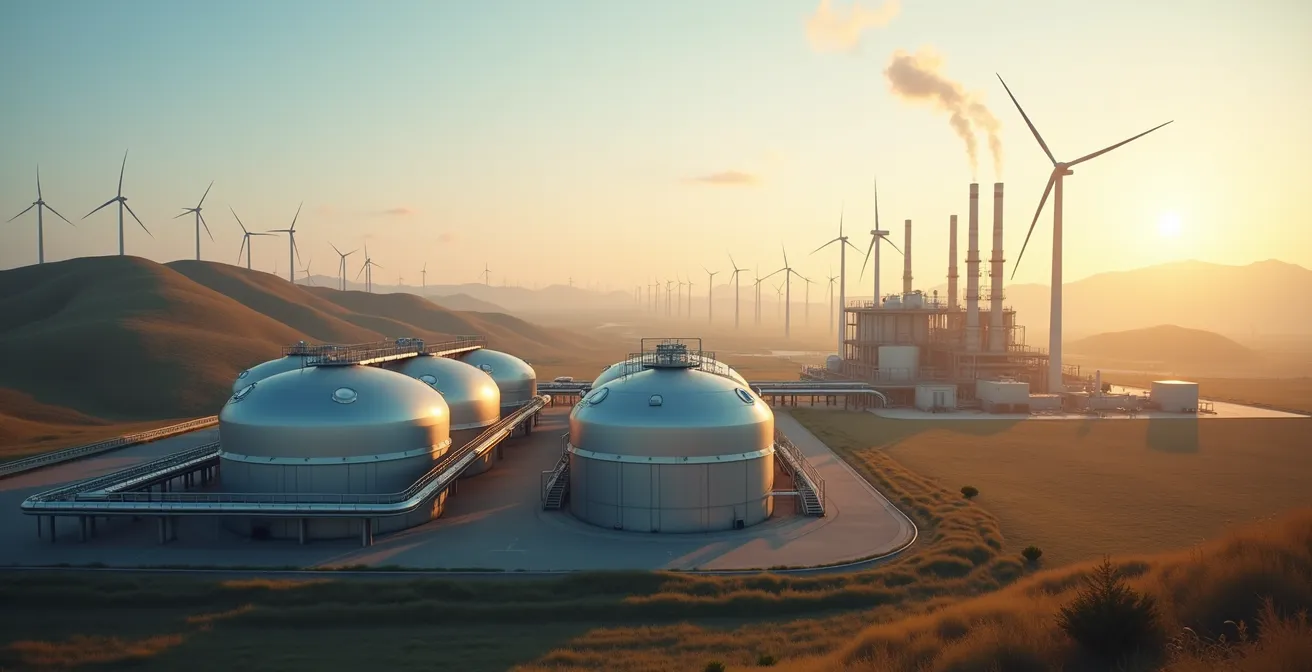
The successful decarbonization of steel manufacturing hinges not on simply swapping coal for hydrogen, but on mastering the systemic integration of variable power, continuous chemical processes, and large-scale industrial hardware.
- Green hydrogen production creates a fundamental conflict between the 24/7 operational demands of a steel mill and the intermittent nature of renewable energy.
- Technology choices, from electrolyzer type (PEM vs. Alkaline) to water sourcing, are critical engineering decisions that determine operational viability and cost.
Recommendation: Shift focus from a singular hydrogen price target to a holistic “Grid-to-Stack” optimization strategy that values process stability, asset utilization, and lifecycle emissions.
The imperative to decarbonize heavy industry places the steel sector under immense scrutiny. As a cornerstone of the global economy, its reliance on coking coal in blast furnaces makes it a primary source of industrial CO2 emissions. The consensus solution is green hydrogen, produced via electrolysis powered by renewable energy. Many discussions frame this as a straightforward fuel substitution, focusing almost exclusively on the target price per kilogram of hydrogen needed for economic viability. This perspective, however, dangerously oversimplifies a profound engineering and systems integration challenge.
The reality is that integrating green hydrogen is not a simple plug-and-play solution. It forces a collision between two fundamentally different operating logics: the variable, unpredictable output of wind and solar power, and the rigid, 24/7 “process inertia” of a multi-billion dollar steel mill. Shutting down a blast furnace or a Direct Reduced Iron (DRI) plant is a complex, costly, and often damaging procedure. Therefore, the core problem is not just producing cheap hydrogen, but producing it reliably and continuously at an industrial scale. This requires a shift in thinking from pure chemistry to systemic engineering.
This article moves beyond the surface-level discussion of hydrogen costs. We will dissect the critical, second-order engineering problems that industrial decision-makers and policymakers must solve. We will analyze the hardware choices, the operational constraints, the grid-level dependencies, and the economic realities of transforming one of the world’s oldest industries. The goal is to provide a clear-eyed, technical roadmap for navigating the true complexities of steel decarbonization.
To fully grasp the scale of this industrial transformation, it is essential to explore the specific engineering and economic hurdles that must be overcome. The following sections break down these core challenges, from the fundamental chemistry of the blast furnace to the systemic requirements of a hydrogen-powered industrial ecosystem.
Summary: How Can Green Hydrogen Decarbonize Steel Manufacturing?
- Why Do Blast Furnaces Need Molecules, Not Just Electrons?
- How to Run Continuous Electrolyzers With Variable Wind Power?
- PEM or Alkaline: Which Electrolyzer Handles Power Spikes Better?
- The Water Mistake: Can We Make Hydrogen in arid regions?
- When to Retrofit: Waiting for the $3/kg Hydrogen Price Point?
- Blue or Green Hydrogen: Which Is Truly Zero Emission?
- How to Pay Power Plants Just to Stand By for Backup?
- Why Will Hydrogen Beat Batteries for Long-Haul Trucking?
Why Do Blast Furnaces Need Molecules, Not Just Electrons?
To understand hydrogen’s role, we must first address a fundamental principle of steelmaking: it is a chemical process, not just a thermal one. The primary goal in a blast furnace is not merely to melt iron ore, but to chemically reduce it by removing oxygen from iron oxide (Fe₂O₃). For centuries, this has been achieved using carbon monoxide (CO), a molecule derived from burning coking coal. The carbon atom in the CO effectively “steals” the oxygen atom from the iron oxide, leaving behind metallic iron and creating CO₂ as a byproduct. Electrifying this specific chemical step is impossible; you cannot simply run a current through iron ore to remove oxygen. You need a reducant molecule.
This is where hydrogen (H₂) enters the equation. Hydrogen is an excellent reducing agent. In a Direct Reduced Iron (DRI) process, hydrogen molecules react with iron oxide to produce pure iron and water (H₂O), completely eliminating CO₂ from the core chemical reaction. This molecular substitution is the foundation of green steel. The goal is to replace the blast furnace with a DRI shaft furnace fed with hydrogen, followed by an Electric Arc Furnace (EAF) to melt the resulting DRI into steel. The potential is immense; analysis shows that the green hydrogen-based DRI pathway can achieve over a 95% reduction in CO2 emissions compared to the traditional route. For instance, HBIS in China has already demonstrated this at scale, producing high-quality DRI and cutting CO₂ emissions by 800,000 tons annually in its pioneering project.
Therefore, the debate isn’t about electrons versus molecules. Steelmaking requires both: hydrogen molecules for the chemical reduction of ore and electrons (electricity) to power the EAF that melts the resulting pure iron. The challenge lies in producing the massive volume of molecules needed—approximately 55 kg of hydrogen per ton of steel—in a reliable and cost-effective manner.
How to Run Continuous Electrolyzers With Variable Wind Power?
The greatest operational challenge in green steel is reconciling the 24/7 nature of steel production with the intermittent supply of renewable energy. A DRI plant, like a blast furnace, has immense process inertia; it is designed for continuous, steady-state operation and cannot be easily ramped up or down to match the fluctuating output of a wind farm. This creates a problem of “systemic intermittency,” where power variability threatens the stability of the entire production chain. The electrolyzer, which produces the vital hydrogen feedstock, sits at the heart of this conflict.
To bridge this gap, three primary strategies are employed. The first is oversizing the renewable generation capacity and coupling it with battery storage to smooth out short-term fluctuations. The second involves large-scale geological hydrogen storage in salt caverns, allowing for the creation of a massive buffer that decouples hydrogen production from consumption. The third, and most dynamic, is the use of sophisticated control systems—often called a “Grid-to-Stack” approach—that manage power flow from the grid, local renewables, and storage systems to provide a stable input to the electrolyzer stacks.

These digital twin and control platforms are crucial for optimizing the entire system. They must balance the need for continuous hydrogen output against the variable cost of electricity from the grid and the state of charge of local storage. This is less about chemistry and more about complex, real-time economic and logistical optimization. The dominant technology in this space, alkaline water electrolysis, currently accounts for about 65% of the global installed capacity, largely due to its maturity and lower capital cost, making it a common baseline for these large-scale integration projects.
PEM or Alkaline: Which Electrolyzer Handles Power Spikes Better?
The choice of electrolyzer technology is a critical engineering decision that directly impacts how well a steel plant can manage the power variability discussed previously. The two leading technologies are Proton Exchange Membrane (PEM) and traditional alkaline electrolyzers. While both produce hydrogen, their operational characteristics are vastly different, particularly their ability to handle dynamic power loads. The key trade-off is between responsiveness and cost.
PEM electrolyzers are known for their exceptional responsiveness. They can ramp up from a cold start to full production in minutes and adjust their output in seconds to follow a fluctuating power supply. This is due to their compact design and solid polymer electrolyte. This agility makes them ideally suited for direct coupling with volatile renewables like wind and solar. However, they come with a higher capital cost (CapEx) due to their reliance on expensive platinum-group metals as catalysts.
Alkaline electrolyzers, on the other hand, are the more mature and lower-cost technology. They have a longer lifespan and avoid the need for precious metals. Their primary drawback is a slower response time, often taking many minutes to an hour to adjust to significant changes in power input. They prefer a more stable power supply, making them better suited for scenarios with dedicated grid connections, large-scale energy storage, or operation in a baseload capacity. The following table, based on industry-wide data, summarizes the key operational differences.
This data, drawn from a comprehensive comparative analysis of hydrogen technologies, highlights the central engineering trade-off.
| Feature | PEM Electrolyzers | Alkaline Electrolyzers |
|---|---|---|
| Response Time | Seconds | Minutes |
| Current Density | 1-2 A/cm² | 0.2-0.4 A/cm² |
| Efficiency | 60-80% | 65-73% |
| Capital Cost | Higher | Lower |
| Lifespan | 60,000-80,000 hours | 80,000-100,000 hours |
Ultimately, there is no single “best” technology. The optimal choice depends on the specific project’s configuration: a plant with vast hydrogen storage may favor the lower cost of alkaline systems, while one directly exposed to wind power fluctuations may require the dynamic response of PEM technology to maintain process stability.
The Water Mistake: Can We Make Hydrogen in arid regions?
A common critique of green hydrogen is its water consumption, leading to the assumption that its production is unviable in arid regions—often the very places with the best solar resources. While water is a critical input, framing it as an insurmountable barrier is an engineering fallacy. The key is to quantify the need and engineer a solution. The production of hydrogen through electrolysis requires about 9-10 kg of ultrapure water for every 1 kg of H₂. Including cooling systems, the total water footprint is significant, with analyses indicating that hydrogen production needs approximately 35 kg of water per kg of H2.
For a large-scale steel plant producing millions of tons of steel, this translates to a substantial water requirement. However, the solution is readily available and technologically mature: seawater desalination. Many of the world’s largest industrial complexes are located in coastal areas, providing access to an effectively unlimited water source. Modern reverse osmosis (RO) desalination is highly efficient. Research shows that RO only requires 3.5-5 kWh of energy per cubic meter of water produced. For a large-scale hydrogen plant, this adds a negligible 0.06-0.13% to the total energy requirement and a minimal cost of around $0.01 per kg of hydrogen produced.

Furthermore, advanced system design focuses on creating closed-loop water circuits. The “waste” product of using hydrogen in a DRI furnace is pure water vapor, which can be captured, condensed, and recycled back to the electrolyzer. This dramatically reduces the plant’s net water draw from external sources. Therefore, water is not a fatal flaw but an engineering parameter to be managed. The cost and energy penalty of desalination are marginal in the overall economics of a multi-billion dollar industrial project.
When to Retrofit: Waiting for the $3/kg Hydrogen Price Point?
The decision for a steelmaker to invest in hydrogen-based production is often boiled down to a single variable: the price of green hydrogen, with figures like $2/kg or $3/kg frequently cited as the magic tipping point. This simplistic view ignores the complex matrix of factors that drive a real-world investment decision. The choice to retrofit or build new is not based on one price point, but on a strategic calculation involving carbon pricing, market premiums, and the age of existing assets.
First, the rising cost of carbon emissions is a powerful driver. As carbon taxes or emissions trading scheme prices increase, the operational cost of a traditional blast furnace rises, making the high capital expenditure of a new DRI-EAF plant more justifiable. Second, the market for “green steel” is emerging. Customers in sectors like automotive and construction are showing a willingness to pay a premium for steel with a lower carbon footprint. This “green premium” can offset a higher hydrogen cost. For example, recent analysis shows that in China, the green steel premium stands at $225 per ton at $5/kg H2, demonstrating that market demand can support prices well above the theoretical “tipping point.”
A plant operator must weigh these financial pressures and opportunities against the physical reality of their existing infrastructure. A blast furnace nearing the end of its 20-30 year campaign life is a prime candidate for replacement with a DRI-EAF route. A newer furnace might instead be a candidate for a hybrid approach, such as partial hydrogen injection to lower emissions incrementally before a full conversion. Making this multi-billion dollar decision requires a rigorous evaluation of all parameters.
Action Plan: Key Decision Factors for Steel Plant Retrofitting
- Assess remaining technical lifespan: Quantify the remaining operational years of existing blast furnace and coke oven infrastructure to establish a baseline for investment timing.
- Calculate carbon cost trajectory: Model the expected financial impact of local carbon taxes and regulatory compliance costs over the next 10-20 years.
- Secure green power supply: Initiate negotiations and secure long-term, low-cost green Power Purchase Agreements (PPAs) to de-risk future electricity costs.
- Evaluate green premium potential: Conduct market analysis to determine the achievable price premium for green steel in target customer segments and geographies.
- Model a phased conversion: Analyze the technical and economic feasibility of a hybrid conversion approach, using natural gas with increasing hydrogen blends as a transitional step.
Blue or Green Hydrogen: Which Is Truly Zero Emission?
The term “zero emission” is often used loosely in the context of hydrogen, but a rigorous engineering perspective demands a look at the full lifecycle. The debate largely centers on two production pathways: green hydrogen and blue hydrogen. While both offer a substantial reduction in emissions at the point of use compared to coal, neither is truly zero-emission when the entire supply chain is considered.
Green hydrogen is produced via electrolysis using renewable electricity. At the steel plant, its use is free of carbon emissions. For every kilogram used, it is estimated that each kilogram of green hydrogen used in DRI saves approximately 25 kg CO2 compared to the blast furnace route. However, its lifecycle footprint includes the “embodied carbon” from manufacturing the wind turbines, solar panels, and electrolyzers themselves. While this footprint is significant, it is a one-time capital emission, and the operational life of the equipment is carbon-free.
Blue hydrogen is produced from natural gas (methane, CH₄) through a process called steam-methane reforming (SMR), with the resulting CO₂ captured and stored (CCS). This process is currently cheaper than green hydrogen. However, it faces two major emissions challenges. First, no carbon capture technology is 100% effective, so some CO₂ is always released. Second, and more critically, is the problem of “upstream methane leakage.” Methane is a potent greenhouse gas, and even small amounts leaking during natural gas extraction and transportation can significantly undermine the climate benefits of blue hydrogen. As a leading industry watchdog points out, a true accounting is complex.
Truly zero emission is a fallacy. For green H2, include the carbon footprint of manufacturing wind turbines and solar panels. For blue H2, quantify upstream methane leakage from natural gas supply chains.
– SteelWatch, SteelWatch Explainer on Hydrogen in Steel
For an industrial operator focused on long-term decarbonization and regulatory compliance, green hydrogen represents a path to near-zero operational emissions. Blue hydrogen, while a potential transitional tool, carries the inherent risks of fugitive methane emissions and long-term liability for stored CO₂, making its “zero emission” claim far more tenuous.
How to Pay Power Plants Just to Stand By for Backup?
The reliance on intermittent renewables for hydrogen production raises a critical question of grid stability and energy security. What happens when the wind doesn’t blow or the sun doesn’t shine for an extended period? A steel plant cannot simply shut down. This necessitates a firm, dispatchable backup power source, which introduces a complex economic problem: how do you compensate a power plant (e.g., a natural gas turbine) to exist purely as an insurance policy, running only a few hundred hours a year?
This is where market mechanisms like capacity markets come into play. In a capacity market, power generators are paid not just for the electricity they produce (the energy market), but for their availability to produce power when called upon. This provides a revenue stream for backup plants to remain economically viable even with low utilization rates. For a large-scale green steel project, this means contracting for firm capacity from the grid becomes a crucial part of the overall energy strategy, acting as the ultimate backstop against prolonged renewable droughts.
The most advanced projects are designing their own industrial microgrids that integrate multiple sources. The H2 Green Steel project in Boden, Sweden, is a prime example. It employs a holistic power infrastructure strategy, often referred to as a “Grid-to-Stack” system. This approach actively manages power from a portfolio of sources: long-term hydro and wind PPAs, short-term market purchases, and potential on-site storage. By optimizing these assets in real-time, it ensures a reliable 24/7 power supply to the electrolyzers and the rest of the plant, achieving the stability needed for its projected 95% CO₂ reduction. This systemic approach treats grid reliability not as an external problem, but as an integral part of the plant’s own operational design.
Key takeaways
- Decarbonizing steel is a systems integration challenge, not a simple fuel substitution, balancing process inertia with energy intermittency.
- Electrolyzer technology choice (PEM vs. Alkaline) is a critical engineering trade-off between responsiveness to power spikes and capital cost.
- The economics of green steel are driven by a complex matrix of carbon taxes, green premiums, and asset lifespan, not a single hydrogen price point.
Why Will Hydrogen Beat Batteries for Long-Haul Trucking?
While this analysis focuses on steel, the massive scale of hydrogen adoption required by the industry will have profound spillover effects, creating an “industrial hydrogen backbone” that enables decarbonization in other hard-to-abate sectors. A prime example is long-haul trucking. On the surface, both batteries and hydrogen fuel cells are viable zero-emission solutions, but for heavy-duty commercial applications, hydrogen holds a decisive advantage rooted in industrial logic: asset utilization.
A heavy-duty truck is an expensive capital asset, and its profitability depends on it being on the road, not sitting idle. Battery-electric trucks require long charging times—several hours to reach full charge—which can take a vehicle out of service for an entire shift. This downtime severely cripples the utilization rate and the economic model for logistics operators who run their fleets 24/7. Hydrogen fuel cell trucks, by contrast, can be refueled in 15-20 minutes, a duration comparable to diesel refueling. This allows for near-continuous operation, maximizing the return on a very expensive asset.
For expensive industrial assets like heavy-duty trucks that need to run two or three shifts per day, long charging times for batteries cripple utilization rates.
– Global Efficiency Intelligence, Green H2-DRI Steelmaking Analysis
The steel industry’s immense demand for hydrogen will drive the build-out of production and pipeline infrastructure needed to make it widely available. With the industrial sector serving as the anchor customer, the cost of hydrogen is expected to fall, and its availability along major transport corridors will increase. This synergy—where industrial demand underwrites the infrastructure that other sectors can then leverage—is why hydrogen is poised to become the dominant solution for applications where high utilization and rapid refueling are non-negotiable.
Ultimately, the transition to a hydrogen-based economy is a complex, interconnected challenge. By focusing on solving the core engineering and systemic problems in foundational sectors like steel, we create the technological and infrastructural momentum needed to decarbonize the entire industrial and transport landscape. The next logical step is to move from analysis to action, developing detailed engineering plans and securing the long-term energy partnerships required for these capital-intensive projects.