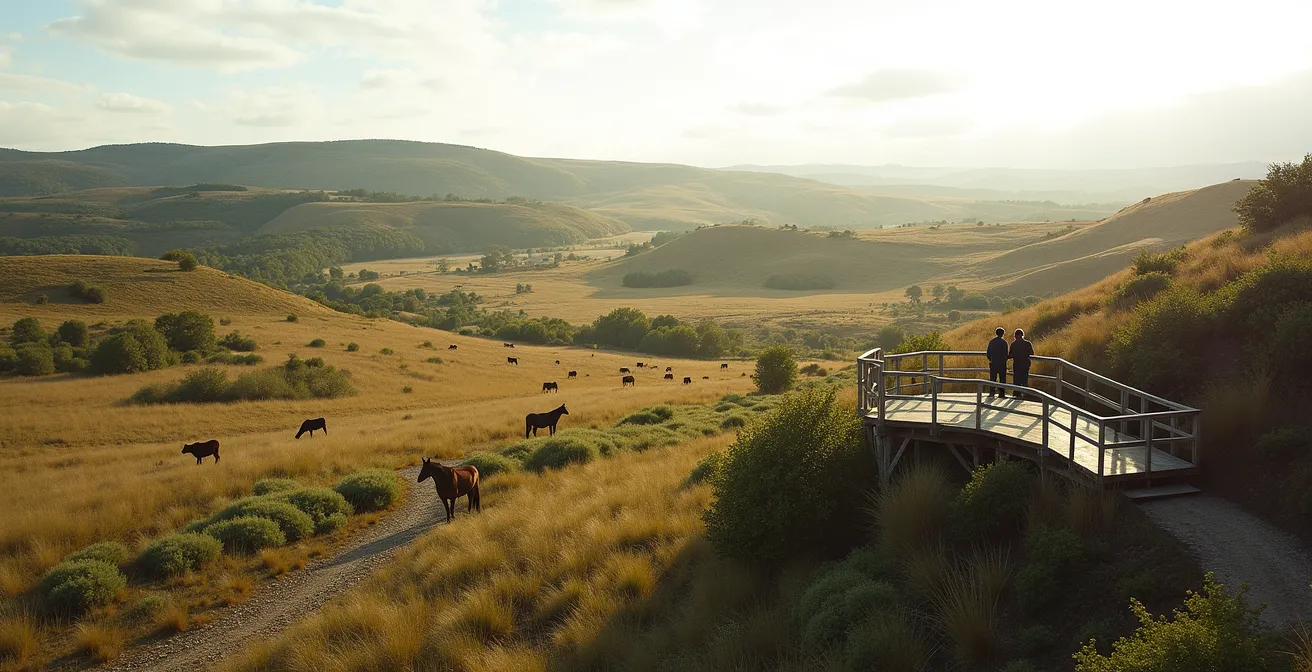
Rewilding creates more and better jobs than traditional farming not by replacing it, but by building a diversified ‘nature-based economy’ on marginal land.
- It pivots from low-yield agriculture to high-value roles in specialized eco-tourism, land management, and scientific monitoring.
- It creates entirely new markets by assigning economic value to ecosystem services like flood prevention and carbon storage, paid for by downstream beneficiaries.
Recommendation: Rural communities should focus on developing community-owned enterprises to capture the full economic value of their restored landscapes, ensuring long-term prosperity.
For generations, the economic pulse of many rural communities has been tied to the rhythm of farming. Yet, on marginal lands—the steep hills and poor soils—this pulse is weakening. Many farms survive not on profit, but on subsidies, locking communities into a cycle of economic stagnation. The conventional answer is often more of the same: more intensive farming or abandonment. But what if this binary choice is a false one? What if the path to revitalizing these areas lies not in fighting against nature, but in investing in it?
This isn’t an argument to end farming. It’s an economic proposition to look at land differently. The dominant conversation often pits rewilding against agriculture, a narrative of conflict. This article reframes the debate entirely. The key is not replacing one industry with another, but evolving a struggling, singular economy into a robust, diversified one. We will explore the shift from a subsidy-dependent model to a dynamic nature-based economy.
We’ll deconstruct the economic traps that keep unprofitable farms afloat and demonstrate, through real-world examples, how a transition to rewilding can generate a higher quantity and quality of jobs. We will address the practical challenges, from managing returning predators to designing new tourism models, and reveal the ultimate economic frontier: turning the services nature provides for free into new, monetizable revenue streams. This is the blueprint for a more prosperous, resilient, and wilder rural future.
This guide offers a clear economic analysis of how rewilding can be a powerful engine for rural development. It breaks down the components of this new economic model, from on-the-ground challenges to high-level financial strategies, providing a roadmap for communities considering a new way forward.
Summary: The Economic Case for Rewilding as a Job Creation Engine
- Why Do Subsidies Keep Unprofitable Farms on Bare Hills?
- How to Prepare a Community for the Return of Wolves or Lynx?
- Fencing or Free Roaming: Which Approach Restores Vegetation Faster?
- The “Disney Nature” Mistake: Why Rewilding Looks Messy at First
- How to Design Safari Experiences in Rewilding Zones?
- Why Do Monarch Butterflies Need Your City Balcony?
- How to Know if an Elephant Sanctuary Is Truly Ethical?
- How to Calculate the Dollar Value of a City Tree?
Why Do Subsidies Keep Unprofitable Farms on Bare Hills?
The persistent image of sheep grazing on windswept, marginal hills is often seen as an ancient tradition. In reality, it’s frequently a modern economic paradox sustained by subsidies. These payments, intended to support farmers, can unintentionally create a system where land is farmed beyond its natural carrying capacity, yielding minimal profit while preventing more innovative land uses. The core issue is that subsidies are often tied to agricultural activity itself, regardless of profitability, creating an incentive to maintain the status quo even when it’s economically failing.
This system creates a significant barrier to change. As Professor Alastair Driver, Director of Rewilding Britain, points out, “subsidies artificially inflate marginal land values, making it too expensive for new entrants like rewilding community trusts or enterprises to acquire land.” In effect, public money locks land into low-productivity use, preventing the emergence of a more diverse and resilient rural economy. The alternative, however, is not abandonment but transformation. Evidence from rewilding projects shows a dramatic economic uplift when this transition is made. For example, a study of rewilding sites in England showed a 47% increase in full-time equivalent jobs post-rewilding.
Case Study: Knepp Estate’s Economic Transformation
The Knepp Estate in West Sussex is the quintessential example of this economic pivot. Once a failing traditional farm burdened with £1.5 million in debt, it embraced a radical rewilding strategy. By shifting from intensive agriculture to a process-led conservation model, it has become a beacon of profitability. Today, its diverse nature-based enterprises, primarily focused on nature tourism and wild-range meat, generate an annual turnover of £800,000 with a 22% profit margin, consistently outperforming the average for English rural estates. Knepp demonstrates that moving beyond subsidy-dependent farming can create a thriving, multi-faceted business that is both ecologically and economically superior.
How to Prepare a Community for the Return of Wolves or Lynx?
The return of large predators is often the most contentious aspect of rewilding, sparking deep-seated fears of livestock loss and threats to human safety. A purely ecological argument for their return is doomed to fail. For community buy-in, the conversation must be reframed from one of conflict to one of economic opportunity. The key is not to dismiss concerns, but to design systems where the presence of predators generates more income than their absence, directly benefiting the people who live alongside them.
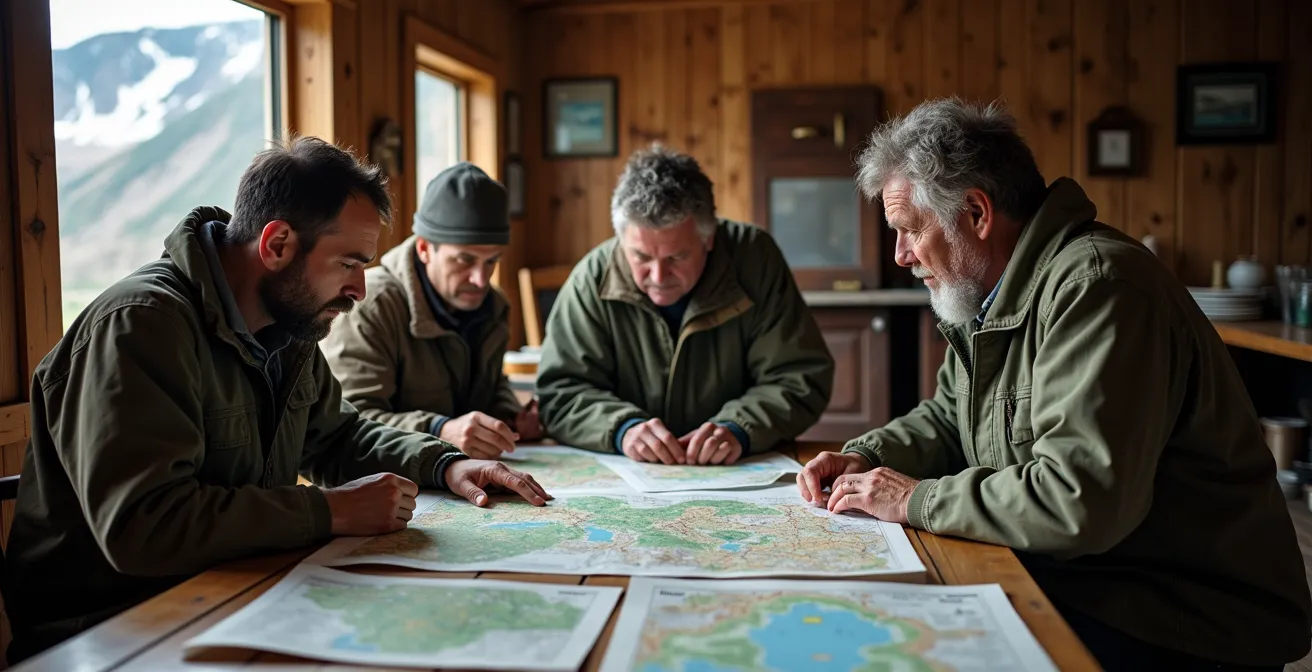
This involves creating community-owned enterprises where local people, including former shepherds, are the primary beneficiaries. By turning a perceived threat into a valuable asset, communities can develop new, high-skilled jobs in guiding, monitoring, and hospitality. It’s about empowering locals to become the stewards and storytellers of their wilder landscape. This approach transforms the narrative from “fear” to “fascination” and, crucially, to “financial benefit.”
Action Plan: Building Community Support for Predator Return
- Develop ‘Wolf-Country Certified’ premium branding for local products like cheese or honey to create direct economic benefits from the predator’s presence.
- Establish community-owned guiding cooperatives that employ and train former shepherds as expert wildlife trackers and guides, leveraging their invaluable local knowledge.
- Create community-managed Livestock Loss Funds, financed by a micro-levy on local tourism revenue, to ensure swift and fair compensation for any losses.
- Train local individuals as ‘Conflict Mitigation Technicians,’ specialists in deploying and maintaining non-lethal deterrents such as specialized guard dogs, acoustic devices, and smart fencing.
- Implement ‘Fear-to-Fascination’ training programs for hospitality and experience managers, equipping them with safety protocols and compelling storytelling skills.
Fencing or Free Roaming: Which Approach Restores Vegetation Faster?
While the ecological question of vegetation recovery is important, the choice between fencing a rewilding area or allowing animals to roam freely is fundamentally an economic one. Each approach represents a different business model with distinct investment profiles, operational costs, and job creation outcomes. There is no single “best” answer; the optimal choice depends on the project’s scale, social context, and market strategy. Fencing offers control and predictability, while free-roaming offers authenticity and scale.
The “fencing” model essentially creates a ‘safari-in-a-box.’ It requires high initial capital expenditure (CapEx) for infrastructure but can lead to a quicker return on investment as wildlife is contained, making sightings more predictable for tourists. The jobs created are initially in construction and later in fence maintenance. In contrast, the “free-roaming” model has low initial CapEx but demands higher operational expenditure (OpEx). It requires a team of highly-skilled rangers for monitoring, ‘virtual shepherding’ using GPS and drones, and community liaison. While this ‘premium-wild’ model may take longer to mature, it can create more diverse, higher-skilled, and better-paying long-term jobs. The economic impact can be profound, as rewilding projects in Scotland saw a 412% increase in jobs between 2008 and 2023, many in these skilled ranger and ecologist roles.
This decision is a strategic trade-off between two different tourism products and operational philosophies, as outlined in the economic comparison below.
| Aspect | Fencing Approach | Free-Roaming Approach |
|---|---|---|
| Initial Investment (CapEx) | High – Infrastructure construction | Low – Minimal infrastructure |
| Operational Costs (OpEx) | Low – Basic maintenance | High – Skilled rangers, GPS/drone monitoring |
| Job Types Created | Construction, fence maintenance | High-skilled rangers, virtual shepherding |
| Tourism Model | ‘Safari-in-a-box’ – predictable, quick-to-market | ‘Premium-wild’ – authentic but requires maturity |
| Social Acceptance | Higher – visible control for neighbors | Lower initially – requires trust building |
The “Disney Nature” Mistake: Why Rewilding Looks Messy at First
One of the biggest public relations challenges for rewilding is aesthetic. We are culturally conditioned to prefer tidy, park-like landscapes—manicured lawns, evenly spaced trees, and clear sightlines. A newly rewilding landscape, by contrast, can look “messy.” Patches of scrub, thorny bushes, fallen trees, and uneven vegetation can be perceived as neglect. This is the “Disney Nature” mistake: judging a wild ecosystem by the standards of a landscaped garden.

From an economic and ecological perspective, this “mess” is actually a vital asset. It is what ecologists call structural complexity. Every fallen log, thorny thicket, and patch of weeds creates a new micro-habitat, a niche for a different species of insect, bird, fungus, or mammal. This complexity is the very engine of biodiversity. A tidy landscape is a simple landscape, supporting little life. A complex, “messy” landscape is a rich one, teeming with life at every level.
The ‘mess’ – scrub, deadwood, uneven vegetation – creates structural complexity that supports more biodiversity and therefore creates a more interesting and resilient ‘product’ for eco-tourism.
– Charlie Burrell, Chair of Rewilding Britain, Knepp Estate
This biodiversity is the foundation of the nature-based economy. More species mean a more interesting experience for visitors, more subjects for photographers, more data for scientists, and a more resilient ecosystem that can better withstand shocks like drought or disease. The “mess” is the factory floor where the economic product of rewilding is built. Educating stakeholders about this is crucial for managing expectations and demonstrating the long-term value being created.
How to Design Safari Experiences in Rewilding Zones?
Once a landscape begins to restore, the most direct way to create jobs is through nature-based tourism. However, designing a “safari” experience in a European or North American context requires a different mindset than a traditional African safari. The goal is not just to “see” animals, but to immerse visitors in the process of ecological restoration. This is a shift from a product-based model (guaranteed sightings of a “big five”) to a process-based model (witnessing a landscape in transformation).
Successful experiences are built on authenticity and education. Instead of promising a visitor they will see a wolf, the promise is that they will learn how to track a wolf with an expert guide—a far more engaging and memorable experience. This creates demand for high-skilled jobs: not just drivers, but naturalist guides, wildlife trackers, ecologists who can interpret data for visitors, and hospitality professionals trained in storytelling. The experience becomes a masterclass in ecology, not just a sightseeing tour.
The design should focus on a variety of scales. This could include:
- Macro-level Safaris: All-day or multi-day guided trips focusing on tracking large herbivores like bison or wild horses.
- Micro-level Safaris: Guided walks focusing on insect life, wildflower meadows, or the role of fungi and deadwood in the ecosystem.
- Self-guided Experiences: Well-designed trails with interpretive apps that explain the ecological processes visitors are seeing.
- Specialized Workshops: Offering courses in wildlife photography, bird language, or regenerative land management, led by resident experts.
This diversified offering creates multiple revenue streams and caters to a wider range of visitors, from casual tourists to dedicated naturalists, maximizing job creation and economic resilience.
Why Do Monarch Butterflies Need Your City Balcony?
The title is a metaphor for a fundamental economic driver of rewilding: the growing urban demand for authentic nature experiences. A butterfly on a city balcony is a small, personal connection to the wild. Multiplied by millions of city dwellers, this desire for connection creates a vast and powerful market. Rural areas undertaking rewilding are perfectly positioned to supply what this market demands: space, authenticity, and a sense of wonder. The economic success of rural rewilding is therefore inextricably linked to the aspirations of urban populations.
This connection creates a virtuous cycle. The demand from cities for getaways in nature directly fuels job creation in the countryside. The overall market is substantial; in the UK alone, it is estimated that nature-based tourism generates £1.4 billion annually. These are not just low-wage, seasonal hospitality jobs. This demand supports a whole ecosystem of ecological entrepreneurs: guides, local food producers, wellness retreat operators, and digital marketers who sell these experiences online to an urban clientele.
The Network Effect of Small-Scale Rewilding
The economic impact is greatest not from isolated “islands” of nature, but from a connected network of rewilding projects. As one study highlights, connected rewilding at farm-scale and along river corridors creates a resilient ‘tourism circuit.’ This network generates far greater economic value than a single, isolated park. Visitors can travel from one project to another, staying longer and spending more in the region. This network effect demonstrates how urban demand for varied nature experiences can drive job creation across an entire rural landscape, not just in one location. The city balcony and the wild rural valley are two ends of the same economic engine.
How to Know if an Elephant Sanctuary Is Truly Ethical?
While a rewilding project in a temperate zone won’t feature elephants, the principles of ethical wildlife tourism are universal and absolutely critical for the long-term success of a nature-based economy. Modern, high-value tourists are increasingly sophisticated and skeptical. They will actively avoid operations that feel exploitative of either wildlife or local people. Building a sustainable business means building an ethical one. An “ethical scorecard” is therefore an essential tool for designing and marketing any rewilding tourism venture.
The core principle of ethical tourism is a shift away from entertainment and towards authentic conservation. This means no forced interactions, no guaranteed sightings that rely on baiting, and complete transparency about where the money goes. The local community should not be a passive backdrop for a tourist’s experience; they must be active partners and primary beneficiaries. This builds trust with both visitors and the community, creating a brand that can command a premium price and attract a more conscientious clientele.
Key criteria for an ethical rewilding enterprise include:
- No Guaranteed Sightings: The focus is on the thrill of the search and the wildness of the process, not on a zoo-like guarantee.
- Genuine Conservation: A clear and transparent portion of profits is reinvested into tangible conservation work, like habitat restoration or scientific monitoring.
- Community Partnership: Local communities are co-owners or receive a direct share of profits, not just low-wage jobs. All positions, including management, should prioritize local hiring and training.
- Respect for Wildlife: Strict protocols are in place to minimize disturbance to animals, ensuring the tourism model is truly sustainable.
- Educational Focus: The primary goal is to educate visitors about the ecosystem, fostering a deeper appreciation rather than a superficial thrill.
Adhering to these principles is not just a moral choice; it is a strategic business decision that secures the venture’s social license to operate and its long-term market viability.
Key Takeaways
- Economic viability on marginal land requires shifting from subsidy-dependent farming to a diversified nature-based economy.
- Successful rewilding creates higher-skilled, more resilient jobs in eco-tourism, land management, and scientific monitoring.
- The ultimate economic frontier is monetizing ecosystem services, where downstream beneficiaries pay for upstream benefits like clean water and flood control.
How to Calculate the Dollar Value of a City Tree?
This question opens the door to the most visionary and potentially lucrative aspect of the nature-based economy: Ecosystem Services Valuation. A city tree has a calculable value in the cooling it provides, the pollution it absorbs, and the stormwater it manages. In the same way, a rewilded landscape upstream has a massive, calculable economic value to the cities and industries downstream. This value lies in services it provides for free: clean water filtered by wetlands, flood mitigation from healthy soils that act like a sponge, and carbon sequestration in growing woodlands and recovering peatlands.
The creation of jobs no longer stops at tourism. By calculating the dollar value of these services, rewilding projects can create entirely new markets. This is where the nature-based economy moves beyond tourism and becomes a sophisticated utility. A water company might pay an upstream rewilding project to restore wetlands because it’s cheaper than building a new water treatment plant. A consortium of insurance companies might invest in floodplain restoration because it reduces their flood-damage payouts. The potential is enormous; it’s estimated that rewilding just 5% of England could create over 20,000 rural jobs, many in this emerging sector.
New Markets from Ecosystem Services
This is not a theoretical future; these markets are emerging now. The practice of Natural Capital Accounting allows organizations to quantify these services, creating the basis for financial transactions. This has led to the creation of entirely new, high-skilled rural job categories that didn’t exist a decade ago. As one report notes, this includes roles like ‘Ecosystem Service Broker,’ who negotiates these deals, and ‘Watershed Services Manager,’ who oversees the land management that generates the desired outcome. In this model, downstream cities effectively pay upstream rewilding projects for critical services, creating a self-sustaining financial model for conservation that is independent of both subsidies and tourism.
By embracing this comprehensive vision, rural communities can move from being recipients of subsidies to becoming producers of valuable, marketable ecosystem services, fueling a genuine and lasting economic revival.