In summary:
- Shift from a tourist’s mindset to a conservator’s, viewing your visit as an act of preservation.
- Support the local economy by visiting during the shoulder or winter seasons and staying for several nights.
- Choose authentic, locally made crafts over imported trinkets to keep the city’s heritage alive.
- Explore beyond the main hotspots by visiting lagoon islands and residential neighborhoods.
- Practice “urban safari” principles: observe respectfully, choose low-impact transport, and value details over icons.
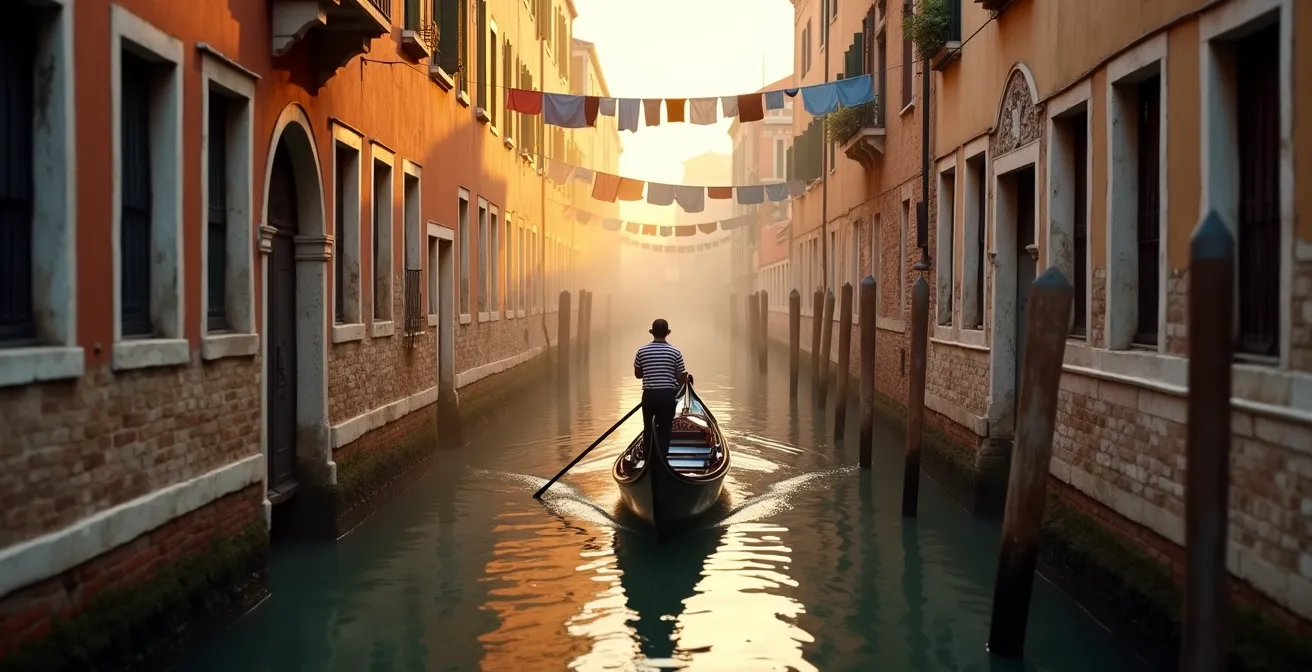
Venice is not a theme park; it is a fragile, living city, a treasure of world heritage wrestling with its own beauty. The question for any conscientious traveler is no longer *if* you should go, but *how* you can go without becoming part of the problem. Many guides offer simple advice: visit in the off-season, get off the beaten path. While well-intentioned, this advice barely scratches the surface. It treats the symptoms of overtourism without addressing the core disease: a relationship with the city based on consumption, not conservation.
The true challenge is to transform our role from a transient visitor to that of a temporary resident, a guardian of the heritage we’ve come to admire. This requires a fundamental shift in perspective. It’s about understanding that every choice—from the season of your visit to the souvenir you buy and the photo you take—creates a ripple effect in Venice’s delicate ecosystem. Your presence can either be a strain on its ancient stones and dwindling population or a vital contribution to its resilience and authentic future.
This guide is built on that principle. We will move beyond the platitudes to explore the “why” behind sustainable choices. We’ll delve into how your travel patterns directly impact the local economy, how to become a respectful observer in a city that is also a home, and how to invest your tourist euros in a way that nourishes Venetian culture rather than eroding it. The goal is to equip you with the knowledge to make your visit a positive force, ensuring this miraculous city can be cherished by generations to come.
To help you navigate this new approach, this article is structured around eight key principles for a more mindful and impactful visit. Each section will provide concrete strategies to transform your trip from a simple vacation into a meaningful act of cultural stewardship.
Summary: A Conservator’s Guide to Mindful Travel in Venice
- Why Are Millions of Steps Eroding Ancient Stones?
- How to Find “The Next Machu Picchu” Before the Crowds Do?
- Summer or Winter: When Does Your Visit Support the Local Economy Best?
- The Souvenir Mistake: Why Buying Imported Trinkets Hurts Heritage
- When to Visit Popular Sites: The Early Morning Strategy?
- How to Design Safari Experiences in Rewilding Zones?
- The Flower Field Mistake: Crushing Blooms for a Selfie
- How to Spot “Greenwashing” in Hotel Marketing?
Why Are Millions of Steps Eroding Ancient Stones?
The beauty of Venice lies in its physicality: the worn marble steps of a bridge, the polished flagstones of a quiet campo, the ancient foundations that have held firm for centuries. Yet, this very tangibility is its vulnerability. The concept of a “cultural footprint” goes far beyond carbon emissions; it encompasses the literal, physical pressure exerted on irreplaceable heritage. When we consider that Venice receives around 30 million tourists annually, while its resident population has dwindled to under 50,000, the scale of this physical burden becomes starkly clear. This isn’t just about crowded squares; it’s about the cumulative weight of millions of feet.
Each footstep contributes to the slow, relentless erosion of stone staircases, church floors, and cobblestone pathways. The vibrations from shuffling crowds and rolling suitcases transmit through the delicate structures of buildings that were never designed for such intense, constant traffic. The humidity and salt brought in on clothing and shoes accelerate the decay of priceless frescoes and intricate stonework inside historic sites. The phenomenon of “moto ondoso,” the wave action from countless motorboats, eats away at the foundations of palaces lining the canals, a problem exacerbated by the demand for water taxis and delivery services catering to a massive transient population.
Understanding this direct, physical impact is the first step toward a conservator’s mindset. It transforms the act of walking through the city from a simple transit into a conscious interaction with a fragile artifact. It forces us to ask critical questions: How can we move through the city more lightly? How can our presence avoid adding to the strain? This awareness is not meant to induce guilt, but to foster a profound sense of responsibility. We are not just visitors in a museum; we are temporary custodians of its very fabric.
How to Find “The Next Machu Picchu” Before the Crowds Do?
The phrase “the next Machu Picchu” often suggests a quest for an undiscovered global wonder. In the context of Venice, however, the real treasure is not finding a new city, but rediscovering the one that lies hidden in plain sight, away from the choked arteries between the Rialto Bridge and St. Mark’s Square. The most sustainable act of exploration is to intentionally diffuse your presence, seeking out the authentic, living heart of Venice that thrives beyond the tourist hotspots. This is where the concept of “temporary residency” truly comes to life.
Instead of following the dense crowds, you can follow the lead of initiatives like the DETOURISM campaign, which encourages visitors to experience the city through the eyes of its residents. This means venturing into the quieter sestieri (districts) like Castello or Cannaregio, where you can witness daily life unfold: children playing soccer in a campo, neighbors chatting from their windows, and the authentic sounds of a community. It means looking at a map and intentionally choosing to explore the terminal stops of a vaporetto line, where the city’s pulse is calmer and more genuine.
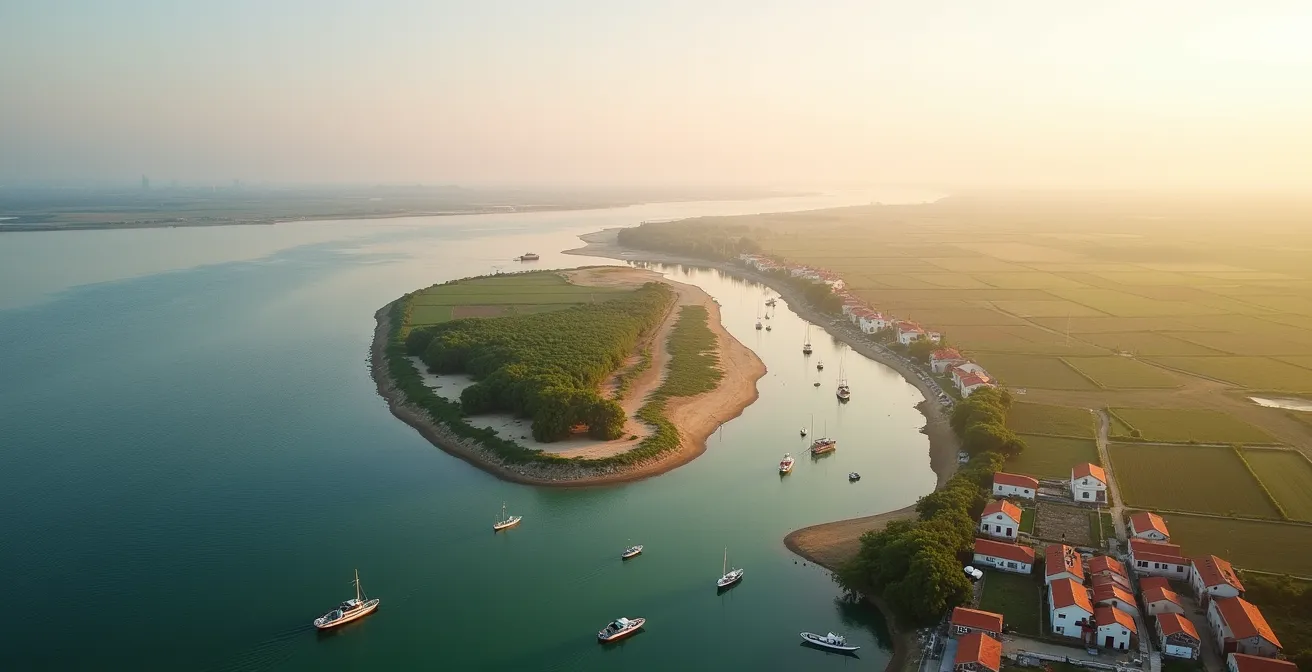
This approach also extends to the Venetian Lagoon itself. As the aerial view above reveals, the lagoon is a vibrant ecosystem of islands, each with its own unique character. You can escape the crowds by visiting:
- Sant’Erasmo, known as the “vegetable garden of Venice,” where you can see the agricultural roots that feed the city.
- Pellestrina, a rustic fishing island with colorful houses and a serene atmosphere, perfect for a bicycle ride.
- Mazzorbo, connected to the more famous Burano by a footbridge, home to the Venissa vineyard which cultivates the native Dorona grape.
By exploring these areas, you not only find tranquility but also distribute your economic impact to smaller, family-run businesses that are the lifeblood of the Venetian community.
Summer or Winter: When Does Your Visit Support the Local Economy Best?
The common advice to “visit in the off-season” is often presented as a simple way to avoid crowds. However, its most profound impact is economic. The timing of your visit can determine whether your money props up a seasonal, extractive tourist machine or sustains the year-round, local community. During peak summer, the city’s infrastructure is pushed to its breaking point. On some days, Venice experiences an influx of 110,000 tourists, more than double its resident population. This massive volume primarily benefits large hotel chains, international restaurant franchises, and businesses geared towards high-turnover crowds, with profits often “leaking” out of the local economy.
In contrast, a visit during the shoulder seasons (April-May, October) or the winter (November-March) provides a crucial lifeline to local artisans, family-run trattorias, and independent hoteliers. These are the businesses that employ Venetians year-round and form the bedrock of the community. Your spending during these quieter months is not just a transaction; it’s an investment in the city’s social fabric. It ensures that the master craftsman can keep his workshop open in February and the corner café doesn’t have to lay off staff come November.
This idea is further reinforced by the principle of staying longer. As the travel experts at Curiosity Saves Travel point out, a longer, more immersive stay is inherently more sustainable. As they note in their guide, “If your itinerary in Venice is less than two full days, your visit will unlikely be sustainable. I recommend staying at least three to four nights.” A short visit encourages a frantic, box-ticking approach that concentrates spending in the most crowded areas. A longer stay allows for a slower pace, deeper exploration of quieter neighborhoods, and a more distributed economic footprint.
The following table, based on tourism data analysis, clearly illustrates how the nature of your support changes with the seasons.
| Season | Economic Impact | Local Business Support | Sustainability Score |
|---|---|---|---|
| Summer (June-August) | High revenue but concentrated in large chains | Limited – mostly international businesses | Low |
| Shoulder (April-May, October) | Balanced revenue distribution | Strong – local shops remain open | High |
| Winter (November-March) | Lower total revenue but vital for locals | Critical – sustains year-round businesses | Highest |
The Souvenir Mistake: Why Buying Imported Trinkets Hurts Heritage
The desire to bring home a piece of Venice is natural, but the modern souvenir market has created a system that actively harms the city’s heritage. The vast majority of trinkets sold in stalls near tourist landmarks—plastic gondolas, cheaply made masks, and “Murano-style” glass—are mass-produced abroad. Buying them contributes to a phenomenon known as economic leakage, where tourist money flows directly out of Venice to foreign manufacturers, bypassing the local community entirely. More insidiously, this trade suffocates the very artisanal traditions that make Venice unique.
For every euro spent on an imported knock-off, a euro is diverted from a true Venetian artisan. These are the masters who have passed down skills for generations, from the glassblowers of Murano to the mask-makers (mascherari) and paper marblers. Their survival depends on a circulatory economy, where your purchase directly funds their workshop, supports their family, and allows them to train the next generation. When these artisans can no longer make a living, a piece of Venice’s soul is lost forever. Choosing an authentic souvenir is an act of cultural preservation.

The difference between a mass-produced object and a handcrafted piece is palpable. It’s the difference between a sterile commodity and an object with a story. So, how can you ensure your money supports true Venetian heritage?
- Look for Trademarks: Genuine Murano glass often bears the “Vetro Artistico Murano” trademark, a guarantee of origin and quality.
- Embrace Imperfection: Real handcrafted glass will have slight imperfections and a “pontil mark” on the base where it was detached from the blower’s rod. A flawless, uniform piece is likely machine-made.
- Understand the Materials: Authentic Venetian masks are traditionally made from lightweight papier-mâché, designed to be worn for hours. Heavy ceramic or plastic masks are tourist-grade products.
- Seek Experiences: The most sustainable souvenir is often a skill. Consider booking a workshop to learn paper marbling, mask making, or even traditional Venetian rowing (Voga alla Veneta).
Supporting these traditions means investing directly in the city’s living culture.
When to Visit Popular Sites: The Early Morning Strategy?
The “early morning strategy” is a classic tactic for avoiding crowds at iconic landmarks like St. Mark’s Basilica or the Doge’s Palace. Arriving before the tour groups descend is indeed effective for a more peaceful experience and better photographs. More importantly, it is a form of respectful crowd management. By visiting during off-peak hours, you help reduce the intense congestion that puts physical strain on the sites and overwhelms the staff during the midday rush. It’s a simple act of diffusing your impact throughout the day rather than concentrating it at the busiest times.
However, a truly strategic approach to visiting popular sites goes beyond just waking up early. Consider the “Closing Bell” strategy: visiting major attractions in the last 45-60 minutes before they close. By this time, most large tour groups have departed, the atmosphere is more contemplative, and the late afternoon light can be magnificent for photography. This allows you to experience the grandeur of a place with a fraction of the crowd.
Another powerful principle is the “See One, Fund Many” approach. After visiting one major, must-see attraction (like the Doge’s Palace), make a conscious effort to visit and pay the entrance fee for two or three lesser-known but equally fascinating museums or “Scuole Grandi” (Great Schools). Sites like the Scuola di San Giorgio degli Schiavoni, with its stunning Carpaccio paintings, or the Museo Querini Stampalia, a beautifully preserved noble residence, are cultural jewels that are often overlooked. Your entrance fee provides them with vital funding for maintenance and preservation, helping to sustain the city’s diverse cultural landscape.
Ultimately, the goal is to weave the iconic sites into a broader, more balanced itinerary. The magic of early morning in Venice isn’t just about empty squares; it’s about witnessing the city awaken. It’s the quiet splash of delivery boats, the scent of fresh pastries from a local pasticceria, and the sight of Venetians walking their dogs. It’s an experience of cultural immersion, not just crowd avoidance.
How to Design Safari Experiences in Rewilding Zones?
The term “safari” conjures images of wildlife observation in vast natural parks. In Venice, we can adapt this concept into an “Urban Safari,” applying the same principles of respectful, quiet observation to the city’s unique cultural and social ecosystem. This re-framing shifts the goal from “seeing the sights” to “observing a life,” transforming you from a passive consumer of scenery into an active, respectful witness of Venetian culture. This is the essence of a conservator’s mindset in practice.
An Urban Safari in Venice is built on a few key principles. First, practice the quiet observation of a wildlife photographer. Instead of crowding around a monument or a craftsman’s window, stand back and use a zoom lens. This respects the personal space of residents and the integrity of the scene. Second, learn the local “wildlife patterns.” Understand the rhythms of Venetian daily life: the morning commute via vaporetto, the midday pause, the evening passeggiata. Plan your movements to flow with these rhythms, not against them, avoiding blocking narrow calle (streets) or bridges during peak local transit times.
Case Study: The Venice Lagoon Eco-Safari Initiative
A perfect example of this principle in action is the work of organizations like Classic Boats Venice. They restore beautiful, traditional Venetian boats and fit them with silent, non-polluting electric engines. By renting one of these boats, visitors can embark on a low-impact “safari” through the quieter canals and the delicate ecosystem of the lagoon. This approach directly minimizes “moto ondoso” (wave damage) to building foundations and reduces noise pollution, allowing for a more intimate observation of both the city’s architecture and the lagoon’s birdlife without causing harm.
The focus of an Urban Safari is on the details that mass tourism overlooks. Instead of just ticking off the main landmarks, your “checklist” becomes about spotting the variety of historic wellheads (vere da pozzo) in different campi, the unique ornate door knockers, or the textures of fading frescoes on a forgotten wall. Hiring a certified sustainable tourism guide can elevate this experience, providing deep cultural insights that go far beyond basic historical facts. They can teach you to “read” the city’s architecture and understand the stories hidden in its stones.
The Flower Field Mistake: Crushing Blooms for a Selfie
The “flower field mistake”—trampling a delicate landscape for the perfect social media photo—has a powerful urban equivalent in Venice. While there are no flower fields, the city itself is the fragile ecosystem being damaged. The relentless pursuit of the “perfect shot” without regard for the surroundings is a significant source of friction and harm. When a bridge is blocked by a photo shoot, it’s not an inconvenience; it’s a disruption of the city’s circulatory system for residents who need to get to work, school, or the market. As travel experts note, with more than 80,000 tourists arriving on some summer days, the collective impact of such behavior becomes overwhelming, making residents feel like extras in someone else’s movie.
Responsible photography in Venice is not about giving up on capturing memories; it’s about shifting the mindset from “proof I was here” to “this is what I observed.” It requires applying the same ethics of respect you would in a private home or a nature reserve. This means never crossing a private threshold with your lens, resisting the urge to zoom into someone’s window, and always being aware of your physical footprint. Are you blocking a narrow thoroughfare? Are you leaning against a fragile, centuries-old wall?
A more creative and respectful approach involves seeking out an “Anti-Instagram Shot List.” Instead of replicating the same tired photos of St. Mark’s Square, challenge yourself to capture the city’s unique soul through its details. Focus on:
- The abstract reflections of palace facades in a puddle after a rain shower.
- The rich, layered textures of a 500-year-old brick wall.
- The surprising variety of Venice’s iconic chimneys (comignoli).
- The play of light and shadow in a narrow, deserted alleyway.
This approach not only leads to more original and personal photographs but also fosters a deeper appreciation for the city’s subtle beauty.
Action Plan for Mindful Photography
- Points of Contact: List all the places you plan to photograph. Are they busy thoroughfares, private-looking courtyards, or open squares?
- Collect Existing Shots: Before you go, look at your saved “inspiration” photos. Are they all iconic, crowded shots, or do they show unique details?
- Check for Coherence: Does your desire for a photo align with the principle of respecting residents and heritage? Is blocking a bridge for 5 minutes for your shot a respectful act?
- Assess Memorability: Will your photo be a generic copy or a unique observation? Challenge yourself to find a perspective no one else has captured.
- Plan Your Integration: Prioritize your shots. Decide which iconic photos are essential and plan to take them at off-peak times (early morning/late evening). For the rest of your time, focus on observing and capturing unique details.
Key takeaways
- True sustainable tourism in Venice is an active mindset of conservation, not a passive checklist of actions.
- Timing your visit for the shoulder or winter season and staying longer provides critical support to the year-round local economy.
- Your spending is a powerful tool: choose authentic, local crafts and businesses to ensure money circulates within Venice.
How to Spot “Greenwashing” in Hotel Marketing?
As sustainability becomes a major concern for travelers, more hotels are using “eco-friendly” language in their marketing. However, many of these claims are a form of “greenwashing”—vague or misleading statements designed to attract conscientious guests without implementing meaningful practices. In a city as fragile as Venice, choosing a genuinely sustainable accommodation is one of the most impactful decisions you can make. Learning to distinguish true commitment from empty marketing is a crucial skill for the responsible traveler.
Greenwashing often relies on generic claims and token gestures. A hotel that proudly advertises its towel reuse program but says nothing else about water conservation is a classic red flag. In a city with water scarcity and complex infrastructure, true sustainability involves comprehensive measures. Similarly, a hotel boasting of being “eco-friendly” while operating a large, heated swimming pool is sending a contradictory message. You must look for specificity and evidence.
Here are some signals to help you decode a hotel’s true commitment:
- Genuine Green Practices: Look for hotels that go beyond the basics. Do they mention harvesting rainwater, using greywater recycling systems, or installing high-efficiency fixtures? Do they have specific certifications or list partnerships with respected conservation bodies like the Venice in Peril Fund? Do they source their breakfast ingredients from the lagoon’s islands like Sant’Erasmo?
- Greenwashing Red Flags: Be wary of hotels that rely solely on claims like “green” or “eco-friendly” without providing details. The presence of single-use plastic amenities (tiny shampoo bottles), a breakfast buffet filled with imported goods, or a lack of information on waste management are all warning signs.
The most reliable way to assess a hotel’s practices is to ask direct questions. A genuinely sustainable establishment will be proud to share details about its operations. Inquire about how they manage waste in a city with boat-based collection, whether they use certified biodegradable cleaning products to protect the lagoon’s water, and, crucially, if they employ local staff year-round, which is a key indicator of commitment to the local community versus reliance on seasonal, external labor.
Your journey as a conservator begins with the first choice you make. By applying these principles, you are not just planning a trip; you are investing in the future of one of the world’s most treasured places. Start today by researching accommodations and artisans that are truly committed to a sustainable Venice.
Frequently Asked Questions About Responsible Tourism in Venice
What’s the ‘Closing Bell’ strategy for visiting Venice sites?
Visit major attractions 45 minutes before closing when tour groups have left, light is beautiful for photos, and the experience is more contemplative.
How can I support lesser-known Venice museums?
Apply the ‘See One, Fund Many’ principle – after visiting one major site, pay entrance fees to 2-3 lesser-known venues like Scuola di San Giorgio degli Schiavoni or Museo Querini Stampalia.
What makes early morning special beyond avoiding crowds?
Experience Venice waking up before 8 AM: quiet splash of delivery boats, smell of fresh pastries, locals walking dogs – it’s cultural immersion, not just crowd avoidance.
How do you manage waste given Venice’s unique logistics?
Look for specific answers from hotels about separation, recycling partnerships, and composting programs adapted to Venice’s boat-based collection system.
Are your cleaning products certified eco-friendly to protect the lagoon?
Hotels should name specific biodegradable product lines or certifications that ensure no harmful chemicals enter the water system.
Do you employ local staff year-round?
Genuine sustainable hotels maintain permanent local employment rather than seasonal hiring from outside Venice.