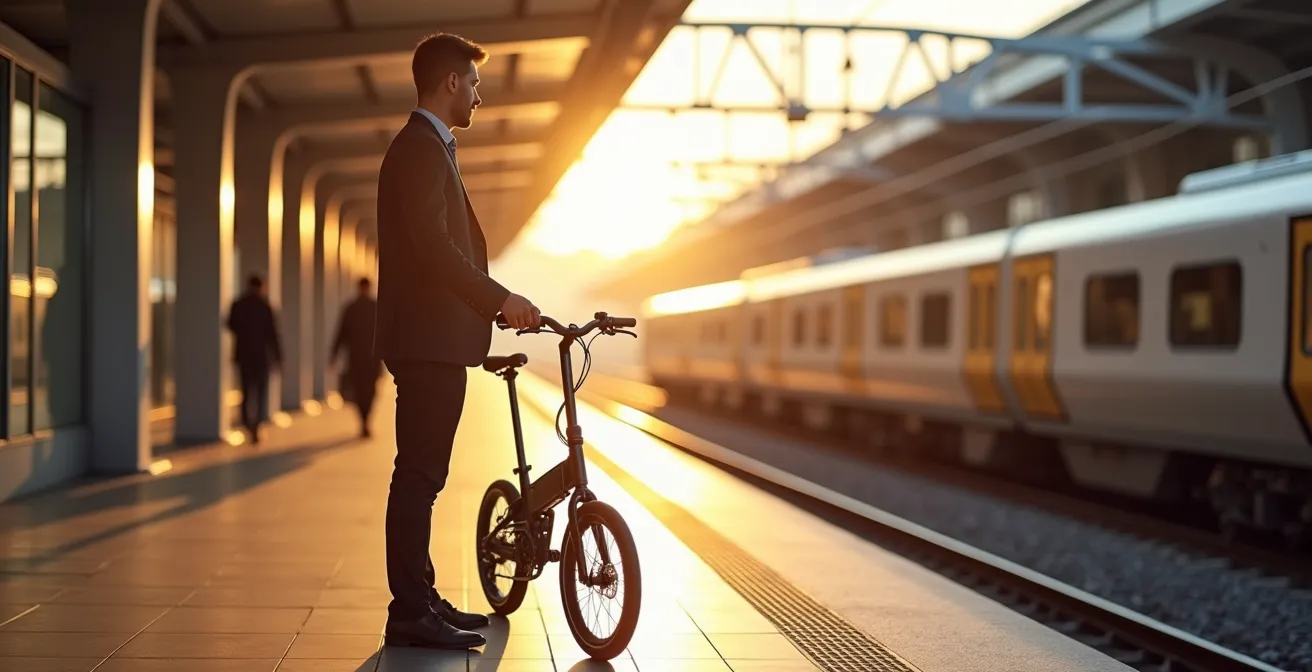
The fastest way across a city isn’t a faster vehicle; it’s a smarter logistics system you control.
- Treat your commute as a “mobility stack” by layering public transit with a personal last-mile vehicle like a folding bike or scooter.
- Focus on minimizing “intermodal friction”—the time lost during transfers—through optimized gear and scheduling buffers.
Recommendation: Stop thinking about your A-to-B trip as a single journey. Instead, break it down into strategic links you can optimize individually to build a faster, more resilient commute.
The 8 AM crawl is a universal urban experience. You’re in your car, staring at the taillights ahead, realizing that your powerful engine is being defeated by simple geometry: too many vehicles, not enough space. Many commuters try basic solutions—leaving earlier, trying different routes, or switching to public transport—only to trade one frustration for another, like long waits at a bus stop or a crowded train. This approach treats the symptoms, not the underlying disease of urban inefficiency.
The conventional wisdom about multimodal commuting often stops at “buy a folding bike” or “use a transit app.” While correct, this advice misses the core principle. The true hack to slashing your commute time isn’t just about mixing transport modes; it’s about treating your daily journey as a professional logistics chain. It’s about understanding and minimizing the friction at every transfer point, from the seconds it takes to fold your bike to the minutes you save by strategically crossing a fare zone on foot.
But what if the key wasn’t finding a single perfect route, but building a flexible, personal mobility system? This guide re-frames the challenge. We won’t just tell you to mix train and bike. We’ll show you how to think like an urban logistics planner, optimizing each link in your commute. You’ll learn how to synchronize schedules without the wait, choose the right last-mile vehicle for a crowded train, master your gear for any weather, and even hack transit fares to make your commute cheaper as well as faster.
This article provides a complete framework for building that system. By the end, you will have the tools not just to survive your commute, but to master it. Forget the traffic jams; your new commute is a series of optimized decisions that get you where you’re going with time to spare.
To help you navigate these strategies, this guide is broken down into a series of logistical deep dives. The following summary outlines the key systems and hacks we will cover to help you reclaim your time.
Summary: Your Guide to Building a Faster, Smarter Commute
- Why Is Your Car the Slowest Way to Cross the City at 8 AM?
- How to Synchronize Bus and Train Schedules Without Waiting?
- Folding Bike or E-Scooter: Which Fits Better on a Crowded Train?
- The Rain Gear Mistake That Ruins Intermodal Commuting
- How to Hack Transit Fares by Combining Regional Passes?
- Company Car or Mobility Budget: Which Saves the Firm More Money?
- How to Combine Scooters and Subways for Fastest Commutes?
- How to Navigate a City Without Owning a Car in 2024?
Why Is Your Car the Slowest Way to Cross the City at 8 AM?
The perception of a car as the fastest mode of transport is a persistent illusion, shattered daily by the reality of rush hour. The core issue is not speed potential, but average speed achieved. In dense urban environments, your car spends more time stationary than in motion, a victim of traffic signals, congestion, and the sheer volume of other single-occupancy vehicles. This transforms your commute into a series of frustrating stops and starts, where the final average speed is often comparable to that of a jogging pace.
This isn’t just a feeling; it’s a measurable phenomenon. The problem with car commuting is its lack of resilience. A single accident, construction zone, or even a minor weather event can cause a cascading failure across the road network, adding unpredictable delays. In contrast, transport systems operating on dedicated pathways—like trains and, to a lesser extent, bicycles in dedicated lanes—are insulated from this kind of widespread disruption. They offer a level of predictability that cars simply cannot match during peak hours.
Case Study: The Bristol to Bath Commuting Race
To put this to the test, real-world races have been conducted pitting cars against bikes and trains. In one such test covering the congested corridor between Bristol and Bath, the results were definitive. During morning rush hour, cyclists consistently outpaced cars through the city center. While the car was stuck in traffic, the bike maintained a higher average speed. Data confirms this is no anomaly; in congested cities like Bristol, you can expect to average 21km/h in a car if you’re lucky, a speed easily surpassed by a moderately fit cyclist who can bypass the gridlock.
Ultimately, the car fails at 8 AM because it is part of the problem it’s trying to solve. Every additional car on the road degrades the efficiency of the entire system for everyone. A multimodal approach, leveraging the strengths of different transport types, bypasses this fundamental flaw. The train provides the high-speed, long-distance artery, while the bike offers the agile, congestion-proof solution for the first and last miles. It’s not about abandoning cars entirely, but deploying them strategically outside of the hours and locations where they are mathematically guaranteed to be the slowest option.
How to Synchronize Bus and Train Schedules Without Waiting?
The biggest point of failure in any multimodal commute is the transfer. Waiting 15 minutes for a connecting bus after your train arrives completely negates the time saved by avoiding traffic. The amateur commuter hopes for the best; the logistics pro engineers a solution. The secret isn’t just about using a planning app, but about actively managing the inherent uncertainty of public transit through a system of intentional buffers and real-time data cross-referencing.
This is where the concept of “Buffer Management” becomes your most powerful tool. Instead of aiming for a perfectly tight connection that will inevitably fail, you build a small, 5-to-10-minute buffer into your schedule at each transfer point. This buffer isn’t wasted time; it’s your system’s shock absorber. It accounts for a train running two minutes late or a bus that’s slightly ahead of schedule. Crucially, you should fill this buffer with productive micro-tasks: triaging your inbox, listening to a short podcast segment, or simply taking a moment for a few deep breaths. This transforms “wasted” waiting time into a planned, useful part of your day.
The next layer of this system is your technology stack. Don’t rely on a single app. Use a primary app like Citymapper for its powerful multimodal routing capabilities to create your initial plan. Then, use a secondary, real-time-focused app like Transit for its superior live tracking and crowdsourced data as you are actively making the journey. This gives you both a strategic overview and tactical, up-to-the-second information to make adjustments on the fly, such as walking to a different bus stop if you see your intended bus is delayed.

As you can see, the modern commute is a hands-on, data-driven process. The goal is to work backward from your desired arrival time, layering in your travel segments and buffer zones. For the core of your journey, a heavy rail train often offers the best speed with fewer stops, while a light rail or tram system can provide more flexibility with higher frequencies, sometimes as often as every 8 minutes. By understanding the specific characteristics of each mode and managing the transitions between them, you remove the element of chance and replace it with engineered predictability.
Folding Bike or E-Scooter: Which Fits Better on a Crowded Train?
Choosing your “last-mile” vehicle is a critical decision that directly impacts the efficiency of your entire commute. It’s not about which is “better” overall, but which is better for the specific, high-pressure environment of a packed train car at 8:05 AM. The two leading contenders, the folding bike and the e-scooter, present a fascinating trade-off between deployment speed, folded footprint, and maneuverability. Your choice will define the level of intermodal friction you experience daily.
An e-scooter’s primary advantage is its near-instantaneous deployment speed. You can go from walking to riding in under 10 seconds, a massive advantage when rushing to catch a connection. Once on the train, its long, narrow profile can often be tucked into vertical spaces more easily than a folded bike. However, scooters are typically heavier and their electronics are more vulnerable to rain. Furthermore, an increasing number of transit systems are placing restrictions on or banning e-devices due to fire concerns, making them a potentially risky long-term investment.
The folding bike, on the other hand, is a masterpiece of mechanical engineering. While high-end models offer incredible speed, a key metric for commuters is that quality folding bikes can be deployed in under 30 seconds. What it loses in deployment speed, it gains in ride quality, stability over varied terrain, and near-universal acceptance on public transit when fully folded. Its folded footprint is often more compact and cuboid, making it easier to slide under a seat or into a luggage rack. Maneuvering a folded bike with one hand while navigating a crowded platform takes practice but is a key skill to master.
To make the right choice, you need to analyze your specific journey’s pain points. A direct comparison of their characteristics in a peak-hour context is the most logical approach.
| Factor | Folding Bike | E-Scooter |
|---|---|---|
| Deployment Speed | 15-30 seconds | 5-10 seconds |
| Weight Range | 20-30 lbs (9-14 kg) | 26-40 lbs (12-18 kg) |
| Folded Footprint | Smaller when fully folded | Longer but narrower profile |
| One-Hand Maneuverability | Possible with practice | Generally easier |
| Storage at Destination | Fits under desk easily | May need wall/corner space |
| Weather Resilience | Mechanical, all-weather | Electronics vulnerable to rain |
| Transit Restrictions | Generally allowed when folded | Some systems ban e-devices |
The final decision rests on your priorities. If your commute involves smooth surfaces and your primary concern is the speed of transition, the e-scooter is a strong contender. However, for all-weather reliability, ride comfort over longer distances, and guaranteed access to transit, the folding bike remains the more resilient and versatile choice for the serious urban logistician.
The Rain Gear Mistake That Ruins Intermodal Commuting
There’s nothing that unravels a perfectly planned multimodal commute faster than a sudden downpour. The common mistake isn’t forgetting rain gear; it’s choosing the wrong kind. Commuter rain gear is a specialized system, and applying logic from hiking or casual cycling leads to failure. The key metrics aren’t just waterproofness, but deployment speed and packability. If it takes you five minutes to put on your waterproofs, you’ve already missed your train connection. Your gear must be as optimized as the rest of your mobility stack.
The core principle is a 3-layer system adapted for speed. The base layer should be a moisture-wicking fabric to manage sweat. The mid-layer provides insulation. But the crucial element is the outer shell. You need a packable rain jacket with a full-zip front that can be deployed in 15 seconds, and waterproof overpants with side zips that allow you to put them on without taking off your shoes. This is a non-negotiable feature for minimizing friction at transfer points.

Beyond the clothes themselves, the system extends to managing the aftermath. Arriving at the office or on the train dripping wet is unprofessional and uncomfortable. The solution is to include two small items in your dry bag: a compact, highly absorbent microfiber towel and a set of packable gear hangers. Once you board the train, your wet gear should immediately go into a dedicated waterproof stuff sack. This contains the moisture, prevents puddles, and shows consideration for fellow passengers. This small act of organization is a hallmark of a logistics-minded commuter.
Mastering your rain gear is about building a repeatable, rapid-deployment process. It ensures that weather is not a variable that can derail your schedule, but simply another known condition for which your system is prepared.
Your Action Plan: The Quick-Deploy Rain Gear System
- Gear Selection: Prioritize a packable rain jacket with a full-length front zipper and waterproof overpants with ankle-to-hip side zips for quick on/off over shoes.
- Layering Strategy: Adopt a 3-layer system: a moisture-wicking base layer (merino/synthetic), an optional insulating mid-layer, and a breathable, waterproof outer shell.
- Dry Kit: Pack a dedicated dry bag containing a compact microfiber towel for a quick dry-off and portable hangers to air out gear at your destination.
- On-Transit Protocol: Immediately upon boarding the train or bus, remove wet outer layers and store them in a waterproof stuff sack to contain moisture.
- Practice Deployment: Time yourself putting on and taking off your full rain kit. Aim to get the entire process under 90 seconds to minimize downtime during transfers.
By treating your rain protection as a pre-planned system rather than an afterthought, you build resilience into your commute, making it virtually weatherproof and maintaining your schedule’s integrity no matter the forecast.
How to Hack Transit Fares by Combining Regional Passes?
Once you’ve optimized the physical logistics of your commute, the next frontier is financial optimization. A faster commute that costs a fortune isn’t a true win. The goal is to achieve what urban planners call “Fare Arbitrage”—the art of strategically combining passes, tickets, and travel modes to pay the lowest possible price for your journey. This requires a level of analysis that goes beyond simply buying a monthly pass. For many, the financial benefits are substantial; by intelligently mixing modes, commuters can save approximately $1,300 annually.
The first step is to map your transit system’s zone boundaries. Often, the most expensive part of a train journey is crossing from one zone to the next. Identify stations located just inside a cheaper zone that are a short, bikeable distance from your home or office. By using your folding bike to cross the “seam” between zones, you can often buy a pass for a cheaper zone and save a significant amount each month. This “zone-bleeding” tactic is a cornerstone of fare hacking.
Next, you must calculate your break-even point. Don’t automatically assume a monthly pass is the best value. Track your trips for one month. Compare the total cost of pay-per-ride fares against the price of a monthly pass. If you plan to work from home several days a week, a pass may not be cost-effective. Also, investigate off-peak discounts. If your work offers flexible hours, shifting your commute by just 30 minutes can sometimes result in a dramatically lower fare. The most sophisticated systems often offer multi-operator passes that combine regional rail with local bus and tram services for a bundled discount.
Finally, the most overlooked resource is your employer. Many companies offer transit benefits, including pre-tax commuter accounts that allow you to pay for your passes with untaxed dollars, effectively giving you an immediate discount of 20-30% depending on your tax bracket. A savvy commuter leverages all of these strategies in concert:
- Mapping zone boundaries to identify walkable or bikeable crossing points.
- Calculating the break-even point between monthly passes and pay-per-ride.
- Utilizing employer-sponsored pre-tax commuter benefits.
- Using a folding bike to access cheaper park-and-ride stations outside expensive central zones.
By applying these financial hacks, you transform your commute from a simple expense into a managed cost, optimizing your budget with the same precision you apply to your schedule.
Company Car or Mobility Budget: Which Saves the Firm More Money?
The conversation around commuting is shifting from a purely personal calculation to a strategic corporate decision. For decades, the company car was the default executive perk, a symbol of status and a tool for business travel. However, in the context of congested modern cities, it is increasingly becoming a financial and logistical liability. The alternative, a mobility budget, offers a more flexible, efficient, and often cheaper solution for both the employee and the firm.
A company car represents a bundle of fixed and hidden costs: the lease or purchase price, insurance, maintenance, fuel, and parking. In an urban setting, that car likely spends 95% of its time parked, depreciating in value. When used for a daily commute into a city center, it becomes a source of stress and lost productivity for the employee stuck in traffic. This has a real, tangible cost to the business; research demonstrates that commutes over 30+ minutes in a car significantly increase stress levels, which is directly linked to higher rates of absenteeism and lower employee engagement.
A mobility budget, by contrast, unbundles this transportation cost. Instead of a physical car, the employee is given a monthly allowance that can be used across a wide range of transport options: public transit passes, bike-share memberships, ride-sharing apps, and even car-sharing services for the rare occasions a car is truly needed. This approach is fundamentally more efficient. The company is no longer paying to maintain an underutilized asset. The employee is empowered to build their own optimal “mobility stack,” choosing the fastest and most convenient mode for each specific journey.
From a purely financial perspective, the savings for the firm can be significant. It eliminates insurance and maintenance overheads and often reduces the need for expensive corporate parking spaces. More importantly, it promotes a healthier, more active, and less-stressed workforce. An employee who arrives at the office after a brisk bike ride and a calm train journey is demonstrably more productive than one who arrives frustrated after an hour of gridlock. The mobility budget isn’t just a cost-saving measure; it’s an investment in employee well-being and a modern solution to a dated problem.
How to Combine Scooters and Subways for Fastest Commutes?
The synergy between a subway system and an e-scooter is a masterclass in urban micro-logistics. The subway provides the high-speed, traffic-proof backbone for the main leg of your journey, while the scooter offers unparalleled agility and speed for the “first and last mile”—the critical distances between the station and your start or end point. Mastering this combination requires a focus on seamless integration and minimizing the friction of each transfer.
The first rule of scooter-subway integration is defining the scooter’s role. Its ideal use case is for trips under 1.5 km (approximately one mile) from the station. For these short distances, its rapid deployment time and minimal storage footprint make it far more efficient than a folding bike or walking. Before you even enter the subway, your planning should be complete. Use your mapping app to pre-load offline maps of your destination area, as you will likely lose signal underground. This ensures you can navigate instantly upon exiting the station without fumbling with your phone.
Ergonomics and gear are also key components of the system. A lightweight scooter is easier to carry up and down stairs. When riding, a quality backpack with both chest and waist straps is essential for distributing the weight of your belongings, improving your balance and comfort. Similarly, wearing lightweight gloves provides better grip and control, while shoes with good grip and some vibration dampening will make the ride much more pleasant. Finally, practice your scooter’s folding and unfolding mechanism until it becomes muscle memory. Your goal should be a sub-30 second deployment, turning the transition from pedestrian to rider into a single, fluid motion.
The choice between a scooter and a bike isn’t always obvious and depends heavily on the specifics of your first and last mile. The following matrix provides a clear decision-making framework.
| Distance | Best Option | Key Advantage |
|---|---|---|
| <1.5 km | E-Scooter | Quick deployment, minimal storage |
| 1.5-3 km | Folding Bike | Better stability, exercise benefit |
| 3-5 km | E-Bike | Speed without sweat |
| Multiple stairs | Lightweight scooter | Easier to carry |
| Smooth paths only | Scooter | Maximum portability |
| Mixed terrain | Folding bike | Handles rough surfaces |
By thoughtfully integrating the scooter as a specialized tool for short-distance, rapid-transit links, you can significantly reduce your total door-to-door time. It’s the perfect complement to the subway’s long-distance efficiency.
Key Takeaways
- Stop seeing your commute as a single trip; view it as a logistics chain with distinct links you can optimize.
- The fastest commute is built on a “mobility stack” that layers public transit with agile last-mile vehicles like folding bikes or e-scooters.
- True mastery involves minimizing friction at every transfer point, from gear deployment speed to pre-planned weather resilience and fare arbitrage.
How to Navigate a City Without Owning a Car in 2024?
Living car-free in a major city is no longer a niche lifestyle; it’s a strategic choice for efficiency, cost-savings, and well-being. The key to success is not about replacing the car with a single alternative, but about building a robust, layered “Mobility Stack.” This is your personal, curated collection of transport services and vehicles that, when combined, offer more flexibility and resilience than car ownership ever could. This approach acknowledges that no single mode of transport is optimal for every type of journey.
The foundation of any mobility stack is the Core Layer: a public transit pass. This covers your most predictable, high-volume routes with unmatched cost-effectiveness. The next layer is for Flexibility: a bike-share or scooter-share membership. This provides on-demand options for short trips, one-way journeys, or beautiful days when you want to be outside. This layer is seeing steady growth; in some cities, bicycle commuting rates are on the rise as infrastructure improves, reflecting a wider shift in urban mobility.
Your stack must also include a Backup Layer, typically ride-sharing apps (like Uber or Lyft), for late nights, emergencies, or transporting bulky items. For many, an Ownership Layer is the key to daily efficiency; this is your personal folding bike or e-scooter, optimized for your specific last-mile needs. Finally, an Emergency Layer, like a car-share membership (e.g., Zipcar), gives you access to a car for the handful of times a year you might need one for a large shopping trip or a visit outside the city. Building this stack doesn’t have to happen overnight. Start by committing to a car-free commute two days a week to test and refine your system.
Case Study: The Seattle Tech Worker’s Hybrid Commute
A tech worker in Seattle successfully implemented a sophisticated multimodal strategy for a 25-mile commute from the suburbs to downtown. The system breaks the journey into three distinct legs. The first mile is covered by car, driving to a suburban train station with cheaper parking. The main journey is on the high-speed train, bypassing all traffic. The final mile, from the downtown station to the office, is completed on a folding bike stored at the office. This hybrid approach provides maximum flexibility, combining the car’s utility for the suburban leg with the train’s speed and the bike’s agility in the congested city core.
By deliberately constructing your mobility stack, you are no longer a passive user of transportation. You are an active manager of your own personal logistics network. This system is not only often faster and cheaper than owning a car, but it is also infinitely more adaptable to the dynamic needs of modern urban life.
To put these strategies into practice, the next logical step is to audit your current commute. Identify the biggest time sinks and friction points, and begin experimenting with one or two of the hacks outlined in this guide. Start small, refine your system, and reclaim your time.