
Maximizing your EV battery’s lifespan to 15 years isn’t about avoiding fast chargers; it’s about understanding the physics of when and how you charge to mitigate electrochemical stress.
- Consistent fast charging isn’t the enemy; charging at a high state-of-charge (above 80%) is what causes physical damage known as lithium plating on the anode.
- Battery health is best preserved in the 30-80% state-of-charge “sweet spot,” not by daily 100% top-ups (unless you have a specific LFP battery chemistry).
Recommendation: Adopt a charging strategy based on your daily needs, not your battery’s maximum capacity, to protect your vehicle’s long-term value as a critical asset.
For a first-time electric vehicle owner, two anxieties often loom larger than any other: the fear of running out of charge and the nagging worry about the battery’s long-term health and its impact on resale value. You’ve likely heard the common advice: avoid fast charging, don’t let the charge drop too low, and never charge to 100%. While well-intentioned, this advice often misses the fundamental “why,” leaving you with a set of rules but no real understanding.
The key to unlocking a 15-year lifespan for your EV battery isn’t about following a rigid, inconvenient dogma. It’s about shifting your perspective. You must stop thinking of your battery as a simple fuel tank and start treating it as a complex electrochemical asset. Its longevity is not determined by magic, but by managing the physical stresses placed upon it, primarily voltage and temperature. Understanding these core principles allows you to make intelligent decisions that preserve your vehicle’s most valuable component.
This guide moves beyond the platitudes. We will delve into the engineering principles behind battery degradation. We’ll explore why fast charging can be harmful under specific conditions, how to optimize your charging habits without sacrificing convenience, and what truly matters when assessing a battery’s health. By the end, you will be equipped not just with rules, but with the knowledge to actively manage and protect your investment for the long haul.
To navigate these critical concepts, this article is structured to build your expertise from the ground up, covering everything from daily charging habits to the battery’s end-of-life options. Explore the key topics below to become a master of your EV’s battery health.
Contents: How to Extend Your EV Battery Life to 15 Years?
- Why Does Fast Charging Every Day Kill Your Battery?
- How to Precondition Your Car to Gain 20% More Range in Winter?
- New or Used EV: How to Spot a Degraded Battery Before Buying?
- The 100% Mistake: Why You Should Stop Charging at 80%?
- When to Unplug: Optimizing Charging Stops for Speed?
- How to Connect Your EV to Power Your House During an Outage?
- How to Repurpose Old Car Batteries for Home Solar Storage?
- What Happens to Your EV Battery When It Dies?
Why Does Fast Charging Every Day Kill Your Battery?
The narrative that daily fast charging “kills” a battery is a simplification. The real culprit isn’t the speed itself but the physical phenomenon it can induce under the wrong conditions: lithium plating. Think of your battery’s graphite anode as a multi-story parking garage and lithium ions as cars. During slow (AC) charging, the “cars” have ample time to find an empty spot and park neatly. During DC fast charging, the cars are forced in at high speed. If the garage is already mostly full (a high state of charge) or the ramps are “icy” (a cold battery), the cars can’t park properly. They pile up at the entrance, forming a metallic layer of lithium plating.
This plating is problematic for two reasons. First, it permanently removes lithium from the cycle, reducing the battery’s total capacity. Second, over time, it can grow into sharp structures called dendrites, which can pierce the separator between the anode and cathode, leading to a short circuit and catastrophic failure. The conditions that most encourage this damaging process are a combination of high charging speed, a high state of charge, and low temperatures. This is why the last 20% of charging (from 80% to 100%) slows down so dramatically; the Battery Management System (BMS) is actively preventing this electrochemical stress.
Recent research has focused on understanding these limits. Advanced computer modeling allows engineers to visualize and quantify this damage, with studies confirming how plating changes with electrode thickness and charging rates. The goal is to develop smarter charging algorithms that push speeds to the limit without crossing the physical threshold into damage. For an owner, the takeaway is clear: fast charging is a tool for long journeys, not for daily top-ups to 100% in your garage.
How to Precondition Your Car to Gain 20% More Range in Winter?
Cold weather is the arch-nemesis of a lithium-ion battery. The electrochemical reactions that generate power slow down significantly as temperatures drop, leading to reduced power output and a noticeable decrease in range. Furthermore, charging a frozen battery—especially fast charging—is one of the most effective ways to cause permanent damage via lithium plating. To combat this, EVs are equipped with a thermal management system, and your most powerful tool to leverage it is preconditioning.
Preconditioning is the process of using grid power (while plugged in) to bring the battery pack to its optimal operating temperature—typically around room temperature—before you start driving. When you activate preconditioning via your car’s app or infotainment screen, heaters within the battery pack warm it up. This has two immediate benefits. First, a warm battery operates more efficiently, instantly restoring a significant portion of the range you would have otherwise lost to the cold. Second, it prepares the battery for regenerative braking, which is often limited when the pack is cold.
The process also warms the cabin, a significant advantage. Heating the cabin with grid power means you don’t have to use precious battery energy for that task once you’re on the road. The energy required to maintain a warm cabin is far less than the energy required to heat it from freezing. For first-time owners, the rule is simple: if the temperature is below 10°C (50°F), and your car is plugged in, always precondition before you leave. It not only provides a more comfortable and longer-range drive but also acts as a critical protective measure for your battery’s long-term health.
New or Used EV: How to Spot a Degraded Battery Before Buying?
When evaluating a used EV, the battery’s State of Health (SoH) is a more critical metric than the odometer reading. SoH represents the battery’s current maximum capacity as a percentage of its original capacity. A vehicle with high mileage but gentle charging habits can have a healthier battery than a low-mileage car that was frequently fast-charged to 100% and left in a hot climate. The good news is that modern EV batteries are remarkably resilient. Early research from 2019 showed batteries losing 2.3% capacity per year, but more recent analysis shows this has improved to just 1.8% annually under moderate conditions.
However, you still need to verify the health of the specific vehicle you’re considering. While a simple range test (charging to 100% and seeing the estimated mileage) can give a rough idea, it’s easily influenced by recent driving style and temperature. More reliable methods are needed for an accurate assessment. A professional pre-purchase inspection is always recommended, but you can perform several effective checks yourself.
The most accurate DIY method is using an OBD2 scanner dongle paired with a specialized app (like A Better Routeplanner or Car Scanner). This combination can directly query the BMS and provide the SoH percentage and individual cell voltage data, revealing any imbalances. A simpler, free method is the “Charging kWh Test”: run the battery down to a low state of charge (e.g., 10%), charge it to a high state (e.g., 90%) at a Level 2 charger that displays energy delivered, and compare the kWh added to the usable capacity of the battery when it was new.
This table summarizes the most common methods for assessing the battery’s condition before you commit to a purchase.
| Assessment Method | Accuracy | Cost | What It Reveals |
|---|---|---|---|
| OBD2 Scanner Apps | High | $20-100 | State of Health %, cell voltages |
| Charging kWh Test | Medium | Free | Actual vs original capacity |
| Range Test | Medium | Free | Real-world range degradation |
| Charging History Check | High | Free | Fast charging frequency impact |
The 100% Mistake: Why You Should Stop Charging at 80%?
The advice to limit daily charging to 80% is one of the most important principles for maximizing the life of most EV batteries. The reason is rooted in chemistry: a lithium-ion battery is under the most electrochemical stress at very high and very low states of charge (SoC). Think of voltage as a measure of pressure inside the battery. At 100% SoC, the “pressure” is at its peak, which accelerates chemical degradation processes like the breakdown of the electrolyte and cathode materials. Leaving a battery at this high-pressure state for extended periods is like constantly stretching a rubber band to its limit; it will lose its elasticity much faster.
The sweet spot for a lithium-ion battery’s longevity is between 30% and 80% SoC. Research consistently shows that minimizing the time spent at the extremes has a profound impact. According to data from Battery University, a battery using 40% depth of discharge lasts 2.5 times longer than one regularly using an 80% depth of discharge. This doesn’t mean you can never use the full capacity. Charging to 100% right before a long road trip is perfectly fine; the damage comes from letting the battery sit at that high state of stress for hours or days on end.
As one expert in the EV community noted, this principle is widely acknowledged by manufacturers:
Li-ion batteries are least stressed when at 50% SOC, which is why most products are shipped at 50% SOC. If you only use 10% of battery capacity daily, no need to top to 90% each night – the battery will stand fully charged for up to 12 hours.
– Battery Research Community, Taycan Forum Discussion on Best Practices
It is crucial to note that this advice primarily applies to Nickel Manganese Cobalt (NMC) batteries, which are the most common type. Lithium Iron Phosphate (LFP) batteries, increasingly used by manufacturers like Tesla and Ford, have a different chemistry that is far less stressed at high SoC. In fact, for LFP packs, manufacturers recommend charging to 100% at least weekly to help the BMS accurately calibrate its range estimates.
When to Unplug: Optimizing Charging Stops for Speed?
For long-distance travel, minimizing time spent at charging stations is paramount. The secret to efficient road trips is not to charge to 100% at every stop. Instead, you should leverage your vehicle’s charging curve. An EV’s charging curve is a graph of the charging speed (in kW) versus the battery’s state of charge (in %). Every EV has a unique curve, but they all share a common characteristic: the fastest charging speeds occur at a low state of charge, typically between 10% and 50%. As the battery fills, the speed tapers off significantly to prevent damage.
This means charging from 10% to 60% might take 20 minutes, while charging from 60% to 80% could take another 20 minutes. That final 20%, from 80% to 100%, could take an additional 30-40 minutes. The most time-efficient strategy is to “graze,” not “gorge.” Arrive at the next charger with a low SoC (10-20%), charge just enough to comfortably reach the next planned stop (typically to 60-70%), and get back on the road. This keeps you in the fastest part of the charging curve, dramatically reducing your total time spent waiting.
Route planning apps like A Better Routeplanner (ABRP) are indispensable tools for this strategy, as they know your specific vehicle’s charging curve and can plan optimal stops automatically. While there’s a persistent fear that frequent fast charging degrades the battery, large-scale analysis has shown that the impact is less significant than once thought, provided the other rules (avoiding high SoC and cold temperatures) are followed. A Recurrent Auto study of over 160,000 data points found no statistically significant difference in degradation between cars that fast-charged frequently and those that did so rarely.
Action Plan: The Road Trip Charging Strategy
- Arrive with a low battery (10-30%) to access the fastest charging speeds available.
- Charge only what you need to reach the next charger plus a small buffer (e.g., 20%), aiming to unplug around 60-70%.
- Use a route planning app like ABRP that understands your EV’s specific charging curve to plan stops.
- If your car supports it, use the built-in navigation to a DC fast charger to trigger automatic battery preconditioning for maximum speed on arrival.
- For the last few percent on an overnight stop, switch to a Level 2 charger, as fast charging speeds are heavily curtailed above 80% anyway.
How to Connect Your EV to Power Your House During an Outage?
One of the most compelling, yet underutilized, capabilities of an EV is its potential to serve as a massive mobile battery for your home. This technology, known as Vehicle-to-Home (V2H), allows the bidirectional flow of energy, enabling your car to power your essential circuits during a power outage. For a homeowner, this transforms an EV from just a mode of transport into a key component of their energy resilience strategy. The sheer scale of an EV’s battery dwarfs that of typical home battery storage solutions.
Consider the numbers: according to analysis from GM Energy, the average American home uses 30 kWh per day. A typical home battery like a Tesla Powerwall holds about 13.5 kWh. In contrast, an EV like the Silverado EV can have a battery pack of over 170 kWh, enough to power that average home for nearly six days. Even using just half the battery to preserve range, you’d still have three days of backup power—far more than most outages last.
To enable V2H, you need three key components: an EV that supports bidirectional charging, a compatible bidirectional charger, and a home integration unit or “smart transfer switch.” This switch safely disconnects your home from the grid during an outage and allows the EV to power a dedicated sub-panel of essential circuits, such as your refrigerator, lights, internet router, and medical equipment. While the initial hardware investment is not trivial, it provides a level of energy security and peace of mind that a portable generator cannot match, offering silent, emission-free power at the flick of a switch.
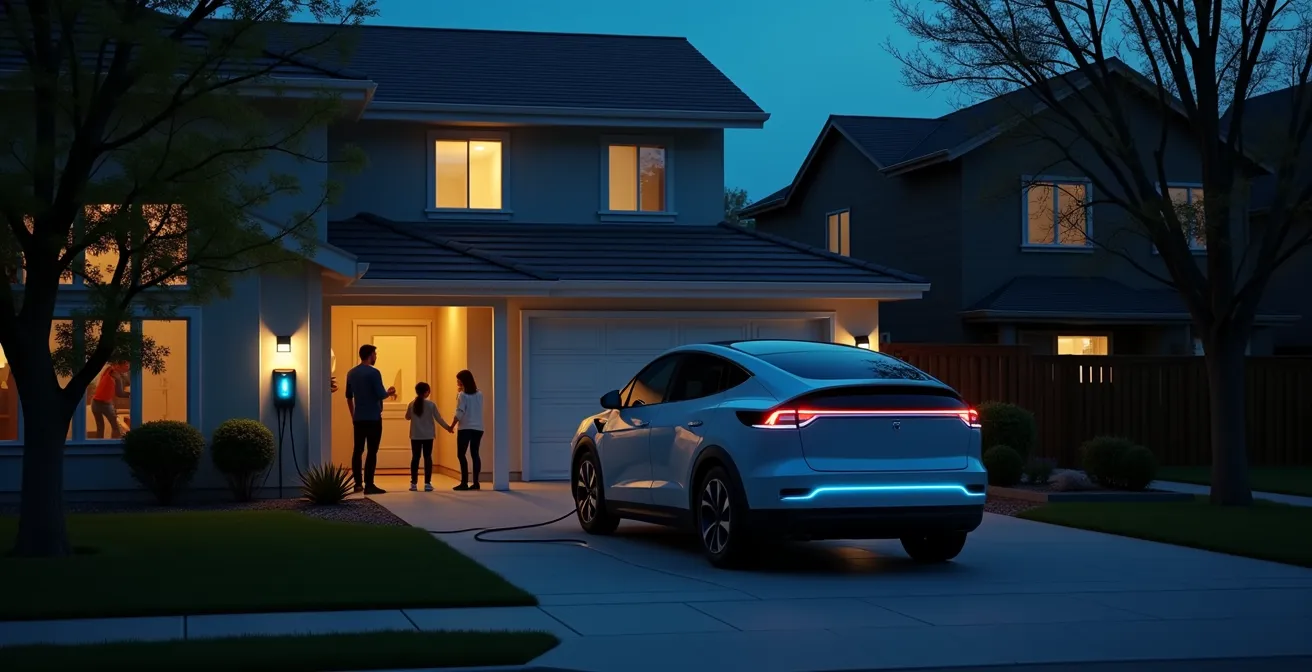
As this technology becomes more mainstream, the EV will increasingly be seen as an integral part of a modern, resilient smart home, providing stability when the grid fails. It’s a powerful demonstration of the battery as a multi-purpose asset.
How to Repurpose Old Car Batteries for Home Solar Storage?
An EV battery is typically considered at the end of its automotive life when its capacity degrades to 70-80% of its original state. At this point, the reduced range may become inconvenient for driving, but the battery is far from useless. It still holds a vast amount of energy and is perfectly suited for a “second life” as a stationary energy storage system, most commonly paired with a home solar installation. This process of repurposing is a cornerstone of a circular economy for batteries.
The value proposition is compelling. An average new home battery system offers 10-15 kWh of storage. A degraded 65 kWh EV battery, even at 70% SoH, still provides over 45 kWh of usable capacity—equivalent to three or four brand-new home batteries, often at a fraction of the cost. This allows a homeowner with solar panels to store a massive surplus of energy generated during the day to power their home through the night and during overcast periods, dramatically increasing their energy independence.
There are two main paths to repurposing. The DIY approach involves sourcing a used battery pack, breaking it down into modules, and integrating it with a dedicated Battery Management System (BMS), inverter, and safety enclosures. This requires significant electrical expertise and a deep respect for safety protocols. A more accessible route is to work with specialized companies that professionally refurbish and package second-life EV batteries into turnkey home storage solutions. These systems are designed to be plug-and-play with standard solar inverters, providing a safe and reliable way to give an old battery a new purpose.
Key Takeaways
- The primary goal of battery care is managing electrochemical stress, primarily from high voltage (SoC > 80%) and extreme temperatures.
- For most (NMC) EVs, the 30-80% state-of-charge window is the “sweet spot” for maximizing long-term battery health and preserving asset value.
- Preconditioning your battery in cold weather is a non-negotiable action that both improves immediate range and prevents long-term physical damage.
What Happens to Your EV Battery When It Dies?
The fear of a massive, expensive battery replacement is a common concern for prospective EV owners, but the reality is that a battery “dying” is an exceedingly rare event. The vast majority of EV batteries will outlast the vehicle they are in. Thanks to robust thermal management and sophisticated BMS software, battery degradation has slowed significantly. Based on analysis of thousands of vehicles, EV batteries could last 20 years or more if current degradation rates continue. A battery isn’t a single entity; it’s a collection of hundreds or thousands of individual cells, and the failure of one or two cells does not render the entire pack useless.
A battery reaches its end-of-life for automotive use not when it “dies,” but when its capacity has degraded to a point that it no longer meets the owner’s range requirements. Even at this stage, it’s not waste. As we’ve seen, it becomes a prime candidate for second-life applications in stationary storage, where its remaining capacity is still incredibly valuable. This repurposing phase can extend the battery’s useful life by another 10 to 15 years.
Only after a battery is no longer viable for a second life does it enter the final stage: recycling. The recycling industry is rapidly evolving to handle the coming wave of EV batteries. Advanced hydrometallurgical and pyrometallurgical processes can now recover over 95% of critical minerals like lithium, cobalt, nickel, and manganese from a spent battery. These recovered materials can then be used to produce new batteries, closing the loop and reducing the need for new mining. So, when an EV battery “dies,” it doesn’t go to a landfill; it begins the next phase of its journey in a circular economy, either as a power source for a building or as raw material for the next generation of batteries.
By applying these engineering-based principles to your daily use, you can move from being a passive user to an active manager of your EV’s most critical asset, ensuring its performance and value for many years to come.
Frequently Asked Questions about How to Extend Your EV Battery Life to 15 Years?
Does the 80% rule apply to all battery types?
No, it primarily applies to NMC (Nickel Manganese Cobalt) batteries. LFP (Lithium Iron Phosphate) batteries, which are used by manufacturers like Tesla in standard range models and by Ford, have a different chemistry that is more tolerant of a high state of charge. For these batteries, manufacturers generally recommend charging to 100% on a regular basis (e.g., weekly) to allow the Battery Management System (BMS) to properly calibrate and provide accurate range estimates.
What about calendar aging?
Calendar aging is the slow, unavoidable degradation of a battery that occurs over time, regardless of whether the vehicle is being driven or not. It’s a natural chemical process. However, the rate of calendar aging is heavily influenced by temperature and state of charge. A battery stored at 100% charge in a hot climate will degrade much faster than one stored at 50% charge in a temperate climate. This is why it’s recommended to leave your EV at around 50-60% charge if you plan to park it for an extended period (more than a week).
Is charging to 100% before a trip harmful?
No, charging to 100% immediately before embarking on a long trip is perfectly acceptable and is what the capacity is there for. The potential harm doesn’t come from the act of reaching 100%, but from letting the battery sit at that high state of charge for extended periods. The best practice is to time your charging so that it finishes close to your departure time.