
Effective dam modernization requires treating the river as a connected system, not just installing isolated fixes.
- Many conventional fish ladders show extremely low success rates for certain species, failing to restore ecological connectivity.
- Dams fundamentally disrupt sediment flow, starving downstream ecosystems of essential materials for habitat maintenance.
- Under specific conditions, particularly in the tropics, reservoirs can become significant sources of methane, a potent greenhouse gas.
Recommendation: Adopt a systems-thinking approach that weighs the trade-offs between sediment transport, flow regimes, and species-specific passage solutions for any retrofitting project.
For decades, the challenge of making hydropower dams compatible with river ecosystems has been distilled into a single, iconic image: the fish ladder. This solution, while well-intentioned, represents a narrow view of a much larger problem. The reality for environmental engineers and ecologists is that a dam’s impact is not a single blockage but a radical transformation of an entire river system. Modernizing these structures is not about finding a silver bullet, but about managing a complex web of interconnected systems.
True modernization moves beyond the dam wall itself to consider the flow of sediment, the thermal profile of the water, and even the gases released from the reservoir’s floor. It acknowledges that what works for a powerful salmon might be an insurmountable barrier for an American shad. The conventional approach often fails because it treats the symptom—blocked fish—without addressing the systemic disruption to the river’s ecological connectivity. The key to successful retrofitting lies not in a single piece of concrete or steel, but in a holistic, evidence-based strategy.
This article will deconstruct the challenge of dam modernization by exploring these systemic trade-offs. We will examine why downstream beaches vanish, why many fish ladders fail, and how some dams contribute unexpectedly to climate change. By moving from isolated problems to integrated solutions, we can build a more realistic and effective framework for balancing clean energy production with the restoration of our vital riverine habitats.
Contents: How to Modernize Old Dams to Allow Fish Migration?
- Why Are Beaches Disappearing Downstream of Hydro Dams?
- How to Build a Salmon Ladder That Fish Actually Use?
- Reservoir or Run-of-River: Which Destroys Less Habitat?
- The Flooding Mistake That Makes Some Dams Worse Than Coal
- When to Remove Obsolete Dams: The Safety vs Ecology Debate?
- When to Block the Drains: Timing Restoration to Avoid Downstream Flooding?
- What Are the Alternatives to Structural Fish Ladders?
- Why Are Nature-Based Bypasses Better Than Concrete Fishways?
Why Are Beaches Disappearing Downstream of Hydro Dams?
One of the most profound, yet often overlooked, impacts of a hydroelectric dam is its effect on sediment. A river is not just a conduit for water; it is a conveyor belt for silt, sand, gravel, and cobble. This material is the lifeblood of downstream ecosystems, building riverbanks, sandbars, and coastal beaches. When a dam is built, the reservoir acts as a giant sediment trap. The slow-moving water allows suspended particles to settle, effectively starving the downstream river.
This phenomenon, known as sediment starvation, has dramatic consequences. Without a continuous supply of new material, the river’s flow begins to erode its own bed and banks, a process called “channel incision.” This can lower the water table, disconnect the river from its floodplain, and destroy riparian habitat. The effect extends far beyond the river itself. Coastal areas that once relied on river-transported sediment for replenishment begin to erode. For instance, research on the Yangtze River shows the devastating scale of this issue, where dams have contributed to an 80% decrease in sediment discharge over the past 50 years, accelerating delta erosion.
The reversal of this process has been powerfully demonstrated by dam removal projects. The Elwha River in Washington saw a dramatic recovery following dam decommissioning. Before removal, the downstream shoreline was eroding at an average of 0.6 meters per year. After, the release of 30 million tonnes of trapped sediment not only halted but reversed this trend, rebuilding beaches and estuarine habitats. This illustrates a core principle of modernization: managing a dam is also about managing sediment, whether through engineered bypasses, flushing operations, or ultimately, removal.
How to Build a Salmon Ladder That Fish Actually Use?
The traditional fish ladder, or fishway, is the most common mitigation measure for fish passage, but its real-world effectiveness is highly questionable. The core assumption is that if you provide a staircase, fish will climb it. However, this simplistic view ignores the complex behaviors and physical limitations of different species. The result is a landscape of expensive infrastructure that often fails to restore ecological connectivity. In a stark example, some studies have found that only 3% of American Shad successfully pass through all the fish ladders on their migratory route along a single river.
The failure often lies in the design’s inability to account for two critical factors: attraction flow and species-specific behavior. As the FAO points out, the entrance to the fishway must be located where fish naturally congregate, and the flow of water out of the entrance must be strong enough to attract them away from the powerful main turbines.
The critical point in upstream fish passage design is the location of the fish pass entrance and the attraction flow, which must take into account river discharge during the migration period and the behaviour of the target species.
– FAO Technical Paper, FAO Fish Pass Design Guidelines
This is where modern engineering and ecology must collaborate. Designing a successful fishway is not a civil engineering problem alone; it’s an exercise in applied biology. It requires understanding the swimming speed, migratory triggers, and even the light sensitivity of the target species. Modern, adaptive fishways are now incorporating adjustable flows, multiple entrance points, and monitoring systems with PIT tag antennas to gather data and optimize performance over time.
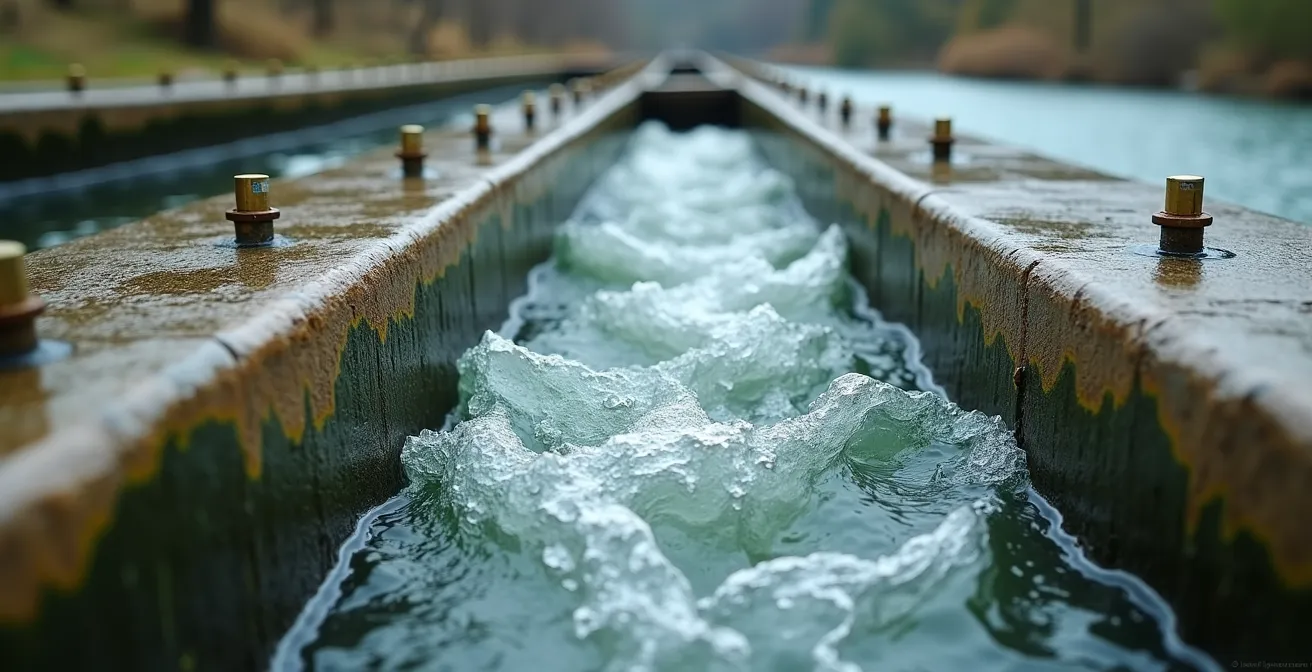
As the image shows, these advanced systems integrate technology directly into the structure to create a passage that is less of a static staircase and more of a responsive, managed system. Success isn’t measured by the completion of construction, but by the quantifiable number of fish that successfully navigate the passage and reach their spawning grounds.
Reservoir or Run-of-River: Which Destroys Less Habitat?
When assessing a dam’s impact, a fundamental distinction must be made between two primary designs: large reservoir dams and run-of-river projects. Neither is inherently “better”; they simply present different and significant systemic trade-offs for river ecosystems. Understanding these differences is critical for both retrofitting existing dams and planning new projects.
Reservoir dams, the classic image of hydropower, create massive artificial lakes by inundating vast areas of terrestrial and riverine habitat. This fundamentally transforms the ecosystem from a flowing (lotic) to a still (lacustrine) environment. These dams offer high levels of flow regulation and power generation on demand, but at a severe ecological cost, including thermal stratification of the water column and trapping nearly all incoming sediment.
Run-of-river dams, in contrast, create a much smaller reservoir (or “headpond”) and divert a portion of the river through turbines before returning it downstream. They maintain more natural flow and temperature patterns but are far from benign. They still fragment habitat and trap a significant amount of sediment. Furthermore, many are operated to meet peak electricity demand, leading to a phenomenon called hydropeaking—large, unnatural daily fluctuations in downstream water levels that scour riverbanks and strand aquatic organisms.
This table, based on a comprehensive analysis, breaks down the key differences in their impacts.
| Impact Type | Reservoir Dams | Run-of-River Dams |
|---|---|---|
| Habitat Transformation | Converts riverine to lacustrine ecosystem | Maintains river flow but fragments habitat |
| Sediment Management | Traps 90-95% of sediment | Traps 30-60% of sediment |
| Thermal Effects | Severe thermal stratification | Minimal temperature changes |
| Flow Alteration | Complete flow regulation | Daily hydropeaking effects |
As a comparative analysis from the journal *Earth’s Future* highlights, the choice is not between a damaging option and a safe one, but between different types of ecological disruption. Modernizing a reservoir dam might focus on managing thermal pollution and sediment, while retrofitting a run-of-river project might prioritize mitigating hydropeaking through modified turbine operations.
The Flooding Mistake That Makes Some Dams Worse Than Coal
While hydropower is often lauded as a clean energy source, this reputation overlooks a significant and inconvenient truth: under certain conditions, reservoirs are potent sources of methane, a greenhouse gas over 80 times more powerful than carbon dioxide over a 20-year period. This phenomenon is particularly acute in tropical regions, where the climate creates a perfect storm for methane production.
When a large area is flooded to create a reservoir, vast amounts of organic matter—trees, soil, and vegetation—are submerged. In the warm, oxygen-deprived (anoxic) bottom layers of a deep tropical reservoir, this material doesn’t fully decompose. Instead, microbes break it down through anaerobic digestion, producing large quantities of methane. This gas can be released in several ways, but a major pathway is ebullition, where bubbles rise directly from the sediment to the surface and into the atmosphere.

The scale of this issue is staggering. Research from the American Geophysical Union (AGU) reveals that while reservoirs exist globally, an estimated 83% of reservoir methane emissions occur in tropical zones. This means that a dam built in the Amazon or the Congo basin can have a much higher lifecycle greenhouse gas footprint than previously thought, in some cases rivaling that of fossil fuel power plants. This “flooding mistake”—creating large, deep, warm reservoirs without accounting for organic matter decay—turns a supposed climate solution into a significant climate problem.
This complicates the “clean energy” narrative and presents a new challenge for dam operators. Mitigation strategies are now being explored, including selectively clearing biomass before flooding and, more critically for existing dams, modifying turbine intakes to draw water from depths that avoid the most methane-rich layers. The focus has shifted from simply generating power to managing the reservoir’s biogeochemical footprint.
When to Remove Obsolete Dams: The Safety vs Ecology Debate?
In many developed nations, thousands of smaller dams built decades ago for milling, irrigation, or early power generation have outlived their usefulness. They are often structurally deficient, costly to maintain, and pose a significant safety risk, all while continuing to block fish passage and disrupt river ecosystems. In these cases, dam removal is increasingly seen as the most effective and often most economical path to restoration.
The decision to remove a dam, however, is a complex process that balances public safety, ecological restoration, and stakeholder interests. It is not simply a matter of demolition. One of the primary concerns is the massive volume of sediment that has accumulated behind the dam over decades. A sudden, uncontrolled release could be catastrophic for downstream habitats and infrastructure. Therefore, the decision to remove a dam must be guided by a careful, phased approach based on scientific modeling and risk assessment.
A key factor in this decision is understanding the nature of the trapped sediment. Is it clean sand and gravel that will replenish downstream habitats, or is it contaminated with industrial pollutants from a century of upstream activity? Answering this question is a prerequisite for any removal project. The process requires a methodical framework to ensure the benefits outweigh the risks.
Action Plan: Dam Removal Decision Framework
- Liability vs. Asset Analysis: Calculate the ongoing costs of maintenance, repairs, and insurance for the dam and compare them to the economic value it provides, if any.
- Sediment Assessment: Conduct core sampling of the impounded sediment to test for contaminants (heavy metals, PCBs, etc.) that could be released downstream.
- Transport Modeling: Develop a hydraulic model to predict how the released sediment will move, where it will be deposited, and what its impact will be on downstream flooding and habitats.
- Alternatives Evaluation: Assess less drastic options, such as partial removal (dam notching) to allow passage, or stabilization if the sediment is too contaminated to move.
- Phased Removal Plan: Design a removal schedule that is aligned with low-flow seasons to manage the rate of sediment erosion and minimize downstream impact.
This structured process transforms a potentially volatile event into a controlled restoration project. It allows engineers and ecologists to work together to maximize the ecological uplift while ensuring public safety and managing the expectations of local communities.
When to Block the Drains: Timing Restoration to Avoid Downstream Flooding?
Once the decision to remove a dam is made, the single most important factor for success is timing. A dam removal is essentially a controlled erosion event. The goal is to release the trapped sediment at a rate the river can handle, allowing it to be transported and redeposited to form new, functional habitats without causing destructive flooding or smothering existing ecosystems.
Research and experience from numerous removals have shown a predictable pattern of erosion. As USGS studies demonstrate, a large pulse of sediment is typically released in the initial phase. This is often followed by a period of stabilization as the river begins to form a new, natural channel through the former reservoir bed. As one U.S. Geological Survey report notes:
A similar two-phase erosion response has been reported for sediment releases at other dam removals in the United States, France and Japan across a range of dam and watershed scales.
– U.S. Geological Survey, Impounded Sediment and Dam Removal Study
This predictable response allows engineers to schedule the removal to coincide with the river’s natural flow patterns. The most common strategy is to perform the demolition during the low-flow season (typically late summer or early fall). This minimizes the initial erosive power of the river, allowing for a more gradual release of sediment. The subsequent winter and spring high flows then have the energy to transport and rework this material throughout the downstream system, rebuilding sandbars and deltas.
The successful restoration of the Klamath River provides a powerful case study. The removal of four hydroelectric dams was meticulously timed. The result was transformative: in the year following the removal, more than 500 adult Chinook salmon were confirmed to have spawned in habitats that had been inaccessible for over a century. This success was not an accident; it was the product of a scientifically-informed restoration plan where timing was everything.
What Are the Alternatives to Structural Fish Ladders?
For large dams where removal is not feasible and conventional fish ladders are ineffective, a new generation of innovative solutions is emerging. These technologies move away from the “one-size-fits-all” ladder approach and instead focus on site-specific, flexible systems that work with, rather than against, fish behavior. Two of the most promising strategies are “trap and haul” operations and operational mitigation.
Trap and haul systems are essentially a “fish elevator” service. Instead of expecting fish to navigate a complex ladder, these systems use attraction flows to guide migrating fish into a collection facility. From there, they are sorted, sometimes monitored, and then transported upstream via truck or barge and released above the dam. An exemplary case is the Baker River system in Washington, where an innovative floating fish collector safely transports hundreds of thousands of juvenile sockeye around the dams, leading to a dramatic increase in downstream migration success and a resurgent fishery.
A second, and perhaps more elegant, alternative is operational mitigation. This involves changing *how* the dam is operated to make it more fish-friendly, without major structural additions. One powerful example relates back to the issue of methane. The same anoxic bottom layers that produce methane are also lethal to fish due to the lack of oxygen. By changing the depth from which turbines draw water, operators can avoid pulling this dead water into the downstream river. Furthermore, research from Washington State University indicates that drawing water from a specific, middle depth can also lead to a potential 90% reduction in methane emissions being sent downstream. This single operational change can thus improve water quality, support fish survival, and reduce the dam’s climate impact.
Key Takeaways
- Dam modernization is a systemic challenge, requiring management of sediment, flow, and water chemistry, not just fish passage.
- Traditional fish ladders have a high rate of failure; success depends on species-specific design and proper attraction flows.
- Nature-based solutions, like bypass channels, often provide superior ecological benefits and are more resilient than hard-engineered structures.
Why Are Nature-Based Bypasses Better Than Concrete Fishways?
The final evolution in fish passage design is a move away from highly engineered, “hard” structures towards nature-based solutions (NBS) that mimic natural river processes. The limitations of concrete fish ladders are clear: they are expensive, high-maintenance, and often only work for a narrow range of strong-swimming species. As The Nature Conservancy reports, river systems altered by such barriers have left a huge percentage of America’s fish species imperiled. A more holistic and effective approach is the construction of a nature-like bypass channel.
A bypass channel is essentially a new, smaller river built around the dam. It is designed with a gentle slope, natural substrates (like rocks and gravel), and resting pools that replicate the features of a free-flowing stream. Unlike a concrete ladder, which is a sterile conduit, a bypass channel is a living ecosystem in itself. It provides passage for all aquatic species, regardless of size or swimming ability, from adult salmon to juvenile eels and invertebrates.
The co-benefits of this approach are immense. Beyond fish passage, these channels create valuable new habitat, help filter and clean water, and can even offer recreational opportunities like kayaking or bird watching. While the initial construction cost can be higher than a concrete ladder, the long-term maintenance is significantly lower as the channel is largely self-sustaining. This comparison table highlights the stark differences in value proposition:
| Feature | Concrete Fish Ladder | Nature-Like Bypass Channel |
|---|---|---|
| Construction Cost | $1-5 million | $2-8 million |
| Maintenance | High (annual cleaning) | Low (self-maintaining) |
| Species Compatibility | Limited (strong swimmers) | Broad (all species/life stages) |
| Co-benefits | None | Habitat creation, water filtration, recreation |
| Public Support | Low | High |
This shift from isolated, single-purpose structures to integrated, multi-benefit systems represents the future of dam modernization. It embodies the core principle of working *with* nature, not against it, to restore ecological connectivity. It is the ultimate expression of a systems-thinking approach, where the solution is not an appendage to the problem, but a restoration of the process itself.
The next logical step for any modernization project is to incorporate these ecological performance metrics and systemic trade-offs directly into the initial design and feasibility studies. By moving beyond a simple “pass/fail” on fish passage and embracing a holistic view of river health, engineers and policymakers can deliver projects that are not only powerful but also truly sustainable.