
Many photographers believe ethical nature photography is a restrictive list of “don’ts.” The truth is the opposite. True ethical practice is a creative framework that transforms technical decisions—like lens choice, timing, and composition—into powerful statements of respect. This guide moves beyond the obvious rules to reveal how seeing the world through an ethical lens unlocks more profound, artistic, and meaningful images of the wild.
As an amateur landscape photographer, you’ve likely felt the frustration. You see a majestic mountain range, but your photos come out flat. You spot a deer, but by the time you’re in position, it has fled, leaving you with a sense of missed opportunity and slight guilt. You want to capture the profound beauty of nature, but the act of photographing it often feels like an intrusion, a disturbance that diminishes the very wildness you seek to celebrate.
The common advice is well-intentioned but often superficial: “use a long lens,” “stay on the trails,” “be quiet.” While correct, these rules are the “what,” not the “why.” They don’t equip you with the deeper understanding needed to make creative choices that are also profoundly ethical. They don’t teach you how to see the landscape not just as a subject, but as a living system that your presence impacts.
But what if the key to more powerful nature photography wasn’t just following rules, but adopting a new way of seeing? What if your choice of aperture, your timing for a hike, and even the way you share a photo online were all part of your artistic and ethical toolkit? This is the core of ethical composition: a mindset where every technical choice is an opportunity to honor your subject. It’s about understanding that the most beautiful images are often born from the deepest respect.
This guide will deconstruct that mindset. We will explore how to work with light, not against it; how to use your gear to create distance, not proximity; and how to find beauty in the authentic, “messy” processes of nature. You will learn to transform your photography from an act of taking to an act of witnessing, resulting in images that are not only visually stunning but also rich with integrity.
This article provides a comprehensive framework for transforming your approach to nature photography. Below is a summary of the key areas we will explore, designed to guide you from technical settings to ethical considerations in the field and beyond.
Summary: A Guide to Responsible Nature Photography
- Why Do Your Midday Photos Look Flat and Boring?
- How to Share Photos Without Exposing Fragile Spots to Crowds?
- Telephoto or Wide Angle: Which Captures the Scale of Mountains?
- The Flower Field Mistake: Crushing Blooms for a Selfie
- When to Start Hiking to Catch the Summit Sunrise?
- The “Disney Nature” Mistake: Why Rewilding Looks Messy at First
- When to Visit Popular Sites: The Early Morning Strategy?
- How to Spot “Greenwashing” in Hotel Marketing?
Why Do Your Midday Photos Look Flat and Boring?
The most common complaint from landscape photographers is the “midday problem.” Between 10 a.m. and 4 p.m., the sun is high and harsh, creating strong, unflattering shadows and washing out colors. This isn’t just an aesthetic issue; it’s an ecological one. Forcing a great shot at this time often means fighting the natural rhythm of the landscape. Most wildlife is inactive, seeking shelter from the heat. This is why ethical photography is patient photography; it aligns itself with the patterns of nature rather than imposing its own schedule.
Instead of putting your camera away, see this harsh light as a creative challenge. It’s the perfect time to shift your focus from grand vistas to intimate details. The strong contrast is ideal for monochrome work, emphasizing textures in bark, rock, or sand. It’s also an opportunity to practice high-key photography, using the bright light to create ethereal, minimalist compositions. Look for subjects in open shade, where the light is naturally diffused and soft. Or, create dramatic silhouettes by placing a subject against a bright sky or a shimmering body of water.
This approach transforms a “bad” time of day into a productive, creative session. You’re not just waiting for the golden hour; you’re actively engaging with the environment on its own terms. You’re learning to find beauty not in the perfect, easy conditions, but in the challenging reality of the midday sun. This shift in perspective is the first step toward developing a more profound and respectful photographic eye.
By embracing these limitations, you develop a more versatile skill set and a deeper appreciation for the subtle beauty that is present at all hours of the day.
How to Share Photos Without Exposing Fragile Spots to Crowds?
In the digital age, the photographer’s responsibility doesn’t end when the shutter clicks. Every photo we share online carries a “digital scent”—a trail of information that can lead hundreds, or thousands, of people to a fragile location. The phenomenon of “geotag-fueled over-tourism” has caused irreversible damage to delicate ecosystems, from wildflower meadows to sensitive wildlife habitats. The ethical photographer’s role is to share the beauty of nature without betraying its secrets.
This requires a conscious strategy for online sharing. The first and most critical step is to strip all GPS data (EXIF metadata) from your images before uploading them. Numerous apps and software can do this easily. Secondly, be intentionally vague in your captions and hashtags. Instead of tagging “Hidden Falls, Whispering Pines Park,” use broader terms like “Mountain Waterfall” or “Forest Hike in the Pacific Northwest.” This shares the mood and the beauty without creating a treasure map for the masses.
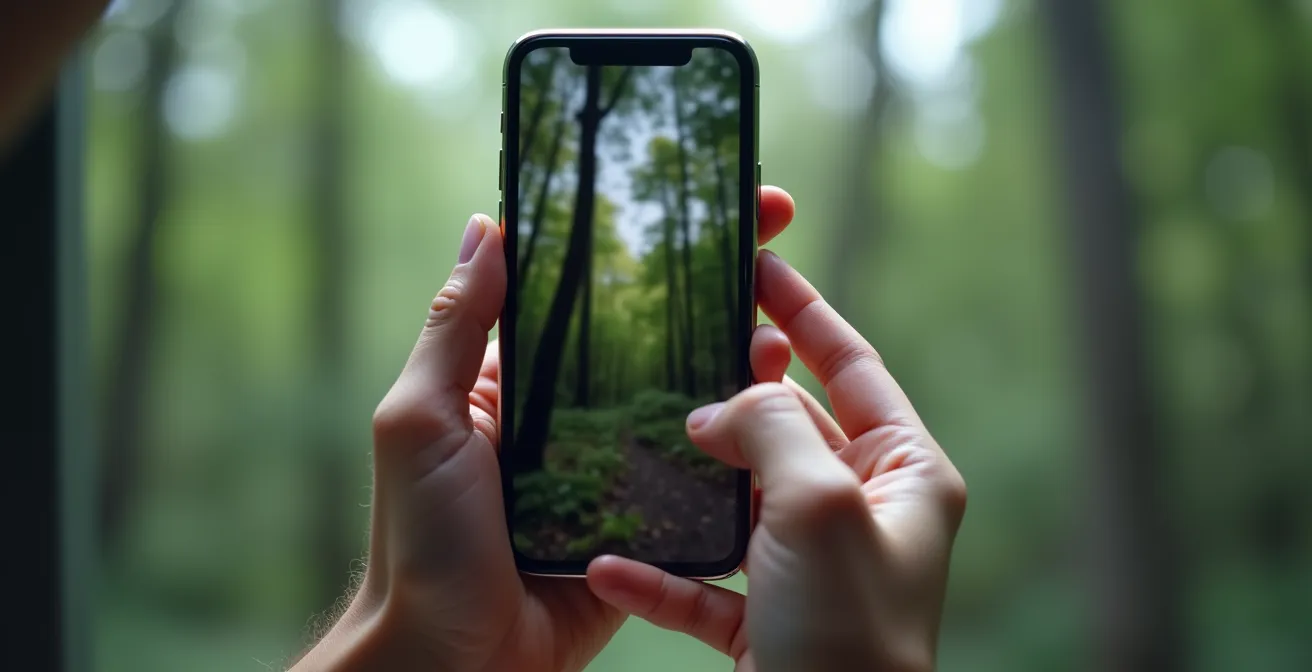
As the image above illustrates, this act of removing data is a protective one. The Audubon Society’s guide to ethical bird photography has become a gold standard, advocating for this exact approach to protect rare species. Their principles encourage photographers to become educators, explaining *why* they are not sharing specific locations. By doing so, you reframe the act from one of secrecy to one of conservation leadership, inspiring your audience to appreciate nature responsibly rather than just consume it as a checklist of photo-ops.
Your goal is to inspire a love for the wild, not to drive traffic to it. A beautiful photo should be an invitation to explore one’s own local nature, not a directive to trample a specific, fragile spot.
Telephoto or Wide Angle: Which Captures the Scale of Mountains?
The choice between a telephoto and a wide-angle lens is often seen as purely artistic, but in nature photography, it is a profoundly ethical decision. While a wide-angle lens (e.g., 16-35mm) is great for immersive, sweeping landscapes, it has a dangerous side effect: it makes distant objects appear smaller and farther away. To make a mountain look grand or to fill the frame with an animal, you are tempted to get closer, often leaving the trail and disturbing habitats.
The telephoto lens (e.g., 100-400mm or longer) is the cornerstone of ethical wildlife and landscape photography. Its power lies in compression: the ability to make the background appear closer and larger relative to the foreground. This allows you to stand on a designated trail, far from a delicate meadow or a sensitive animal, and still create a powerful, intimate composition. You can frame a distant mountain peak behind a field of flowers without ever stepping into it, or capture the subtle behavior of a deer from a hundred yards away, ensuring it remains undisturbed. As photographer Paolo Sartori notes in his “7 Rules for Ethical Wildlife Photography,” if you are using a standard zoom to photograph wildlife, you are likely too close. He states, “A 400mm or 600mm lens allows you to frame tight shots while maintaining a respectful distance.”
This table clearly shows how a technical choice directly translates to an ethical outcome. Using a long lens isn’t a limitation; it’s a tool that enables respect and unlocks creative possibilities that are impossible with a wide angle.
| Aspect | Telephoto (400-600mm) | Wide Angle (24-35mm) |
|---|---|---|
| Minimum Distance Required | 100+ yards maintained | Often requires <30 feet |
| Habitat Disturbance | Minimal – shoot from trails | High – may trample vegetation |
| Wildlife Stress Level | Low – animals unaware | High – visible presence |
| Compression Effect | Enhances scale relationships | May diminish mountain grandeur |
| Ethical Score | Highly recommended | Use with extreme caution |
By investing in and mastering a telephoto lens, you are investing in the well-being of the ecosystems you love to photograph. It is the single most important piece of gear for the responsible nature photographer.
The Flower Field Mistake: Crushing Blooms for a Selfie
The allure of a vibrant field of wildflowers is undeniable. The desire to capture that perfect shot, placing a subject right in the middle of the colorful expanse, has led to one of the most visible forms of environmental damage: the creation of “social trails” and flattened patches in once-pristine meadows. What many don’t realize is that this damage is not temporary. The soil compaction from a single person’s footsteps can prevent future growth for years. The damage is severe, as research has shown a single footprint can affect soil structure for over a decade, destroying the delicate network of roots and microorganisms beneath the surface.
The ethical photographer’s challenge is to create the *illusion* of being in the field without ever setting foot in it. This is where technical skill and creative vision merge. The most powerful tool, once again, is your telephoto lens. By shooting from the very edge of the field, you can use lens compression to make the flowers in the foreground and background appear densely packed, effectively erasing the distance between you and the blooms. Combine this with a low shooting angle—getting your camera close to the ground—to make the nearest flowers tower in the frame, creating a sense of immersion.
Another approach is to shift your narrative focus. Instead of the grand, generic landscape, use a macro lens to focus on a single, perfect bloom. Or, even better, document the ecosystem at work by capturing pollinators like bees and butterflies interacting with the flowers. This tells a more interesting and specific story. Forced perspective is another excellent technique; by carefully aligning your subject on a designated path or viewing platform, you can make them appear to be right next to a distant patch of flowers. Ethical composition is about solving these visual puzzles creatively, not destructively.
The best photographers don’t need to be in the middle of everything; they know how to use their tools to bring the world to their lens, leaving the scene exactly as they found it.
When to Start Hiking to Catch the Summit Sunrise?
The pre-dawn hike to a summit for a sunrise shot is a rite of passage for many landscape photographers. But our romantic vision of a silent, solitary ascent often ignores a critical reality: our “acoustic footprint.” At night and in the early morning, sound travels much farther than during the day. As documented by the Washington Department of Fish and Wildlife, the combination of cooler, denser air and the lack of ambient daytime noise means that the crinkle of a snack wrapper, the rip of a velcro strap, or the scrape of a trekking pole on rock can be heard up to three times farther, alerting and stressing nocturnal and crepuscular wildlife.
Minimizing this impact requires a deliberate and thoughtful approach. First, audit your gear for noise. Replace velcro closures with magnetic or buckle systems. Pack your bag so that hard items don’t clang together. On the trail, practice slow, deliberate steps to avoid scuffing rocks or snapping twigs. A crucial piece of equipment is a headlamp with a red light mode. Red light preserves your night vision and is far less disruptive to most wildlife than a bright white beam. It allows you to navigate safely while minimizing your visual disturbance.
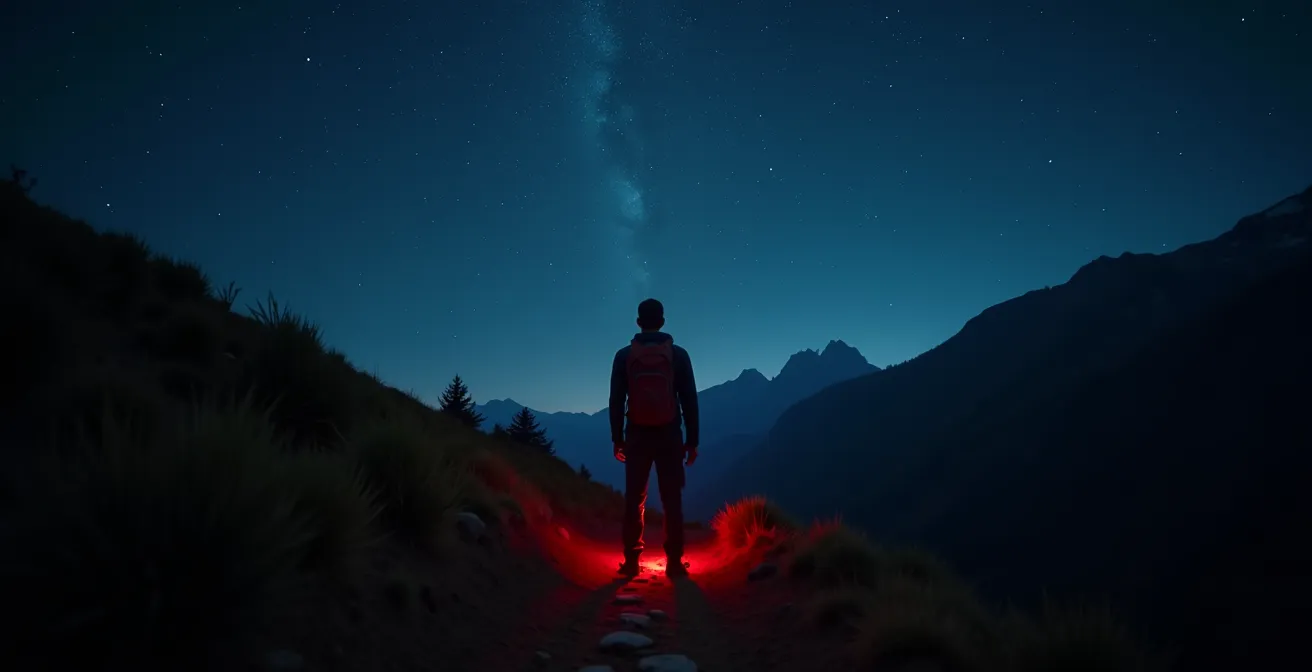
An even more ethical, albeit more advanced, strategy is to hike up the evening before and bivouac near the summit. This allows you to be in position for sunrise with minimal morning disruption. It requires more planning and skill but represents the highest level of commitment to minimizing your impact. The fundamental question to ask yourself is not just “What time do I need to leave?” but “How can I move through this awakening world with the greatest care and the least disturbance?”
Sometimes the most ethical choice might even be to forgo the summit sunrise and focus on the equally beautiful light of a forest floor or a quiet valley, where your presence is less intrusive.
The “Disney Nature” Mistake: Why Rewilding Looks Messy at First
Our culture has conditioned us to see nature through a manicured lens. We expect pristine, park-like forests and clear, open streams. This is the “Disney Nature” mistake: a preference for tidiness that is ecologically sterile. A truly wild, healthy ecosystem is often messy. It’s characterized by fallen logs, standing dead trees (snags), dense undergrowth, and the visible evidence of natural processes like fire, flood, and decay. The ethical photographer’s job is to learn to see the beauty in this “mess” and to educate their audience about its vital importance.
A standing dead tree, for example, is not an eyesore; it’s a wildlife apartment complex. It provides essential nesting cavities for birds, homes for mammals, and a food source for insects. In fact, ecological research demonstrates that snags and fallen logs are critical, supporting as much as 40% of all forest biodiversity. A log slowly decaying on the forest floor is not waste; it is a nutrient bank, a nursery for new saplings, and a habitat for countless fungi, insects, and amphibians. These are the engines of a healthy forest.
To capture this, you must adjust your compositional eye. Instead of framing out the fallen log, make it your subject. Use its leading lines to guide the viewer’s eye through the scene. Instead of avoiding the charred remains of a forest fire, document the vibrant green shoots of new life emerging from the ashes—a powerful story of resilience. Focus your lens on the intricate patterns of fungi on a decaying stump or the engineering marvel of a beaver dam that creates a thriving wetland. By photographing these processes, you celebrate the authentic, unedited beauty of rewilding. You are telling a more honest and ultimately more hopeful story about how nature heals itself.
Your role as a photographer is not to be a landscaper, cleaning up the scene for a tidy photo. It is to be a naturalist with a camera, revealing the profound beauty and complexity of nature as it truly is.
When to Visit Popular Sites: The Early Morning Strategy?
The standard advice for avoiding crowds at popular photography spots is simple: go early. The “dawn patrol” strategy works because it gets you there before the majority of tourists. This often yields better light and a more serene experience. However, from a purely ethical standpoint, the answer is more nuanced. As we’ve discussed, early morning activity can be highly disruptive to wildlife. So, is there a better way?
The most impactful strategy is to visit during the off-season or shoulder seasons. Visiting a national park in October instead of July not only guarantees fewer crowds at any time of day but also provides vital economic support to local communities and conservation efforts year-round. Wildlife behavior is often more natural due to reduced human pressure, offering more authentic photographic opportunities.
However, the most counter-intuitive and expert-level insight comes from questioning the “dawn patrol” itself. In some situations, visiting midday might be the most ethical choice. As the North American Nature Photography Association (NANPA) points out, your individual impact must be weighed against the cumulative effect. They wisely state:
Sometimes, the most ethical choice is to visit mid-day when wildlife is less active and crowds are present, as your individual impact is lower.
– Nature Photography Ethics Committee, North American Nature Photography Association Guidelines
This perspective is challenging but logical. Arriving at 1 p.m. along with 50 other people may create less overall disturbance to wildlife than being the single, solitary figure moving through their territory at 5 a.m. It forces us to move beyond a self-centered view (“I want the place to myself”) to an ecosystem-centered one (“What time of day is my presence least harmful?”).
There is no single right answer, but the responsible photographer is the one who consciously asks these questions and makes an informed choice, rather than just defaulting to the most convenient or popular option.
Key Takeaways
- Lens Choice is an Ethical Choice: A telephoto lens is a tool for respect, allowing you to capture intimate shots from a safe, non-intrusive distance.
- Your Digital Footprint is Real: Sharing photos without removing location data can cause physical damage to fragile ecosystems through over-tourism.
- Embrace the “Mess”: A truly wild and healthy ecosystem is characterized by decay, fallen trees, and natural chaos. Learn to see and photograph this authentic beauty.
How to Spot “Greenwashing” in Hotel Marketing?
As a nature photographer, where you choose to stay has an impact. The rise of “eco-tourism” has been met with a parallel rise in “greenwashing”—marketing that presents a hotel or lodge as environmentally friendly when its practices are anything but. Vague claims about “loving nature” or simple “towel reuse” programs are often red flags. A truly sustainable operation goes much deeper, and the ethical photographer has a responsibility to support genuine efforts, not just clever marketing.
To become a discerning eco-traveler, you need to think like an auditor. Look for concrete, verifiable evidence of sustainable practices. Does the lodge have its own wastewater treatment system to prevent pollution? Can they document that their food is sourced from local farms? Are they employing local guides at fair wages, ensuring the community benefits directly from tourism? Do you see physical infrastructure like solar panels or rainwater harvesting systems on-site? These are tangible signs of a real commitment.
The most reliable indicators are third-party certifications. Look for logos from respected international bodies like B Corp, the Global Sustainable Tourism Council (GSTC), or other regional certification programs. These organizations conduct rigorous audits that go far beyond a hotel’s self-proclaimed eco-friendliness. By choosing certified accommodations, you are using your travel budget to reward genuine conservation efforts and support a more sustainable model for tourism.
Your 5-Point Eco-Lodge Audit Checklist
- Verify Certifications: Before booking, search the property’s website for credible third-party certifications like B Corp or GSTC. No certification is a major red flag.
- Question Energy & Water: Email the lodge and ask specifically about their energy source (e.g., solar panels, grid) and their wastewater management. Vague answers suggest greenwashing.
- Analyze Local Employment: Look at their “About Us” page or reviews. Are the guides and staff local? True eco-lodges invest in the local community.
- Check for Specifics, Not Fluff: Ignore vague phrases like “eco-friendly.” Look for concrete details: “We source 80% of our produce from within 50 miles,” or “We funded the local school’s new roof.”
- Look Beyond the Towel Program: If the only environmental initiative a hotel promotes is asking you to reuse your towel, it’s almost certainly greenwashing. Look for systemic, operational commitments.
By becoming a more discerning traveler, you ensure your passion for nature photography actively supports its preservation, rather than inadvertently contributing to its decline. Your next step is to apply this critical mindset not just to your next trip, but to every photographic decision you make.