
Contrary to popular belief, small gestures like recycling won’t make a significant dent in your carbon budget; achieving a 2-ton reduction requires a surgical, data-driven audit of high-impact emission sources.
- Your true carbon cost is often hidden in unexpected places like digital storage and poorly insulated walls, not just your tailpipe.
- Quantifiable analysis shows that major lifestyle changes (diet, home energy) have an exponentially higher Emission ROI than minor tweaks.
Recommendation: Stop ‘trying to be green’ and start acting like a carbon auditor by measuring, analyzing, and targeting the largest items in your personal emissions ledger.
The goal of reducing your personal carbon footprint often feels like an exercise in abstract virtue. You’re told to turn off lights, recycle diligently, and carry a reusable water bottle. While well-intentioned, these actions are the equivalent of trying to balance a corporate budget by cutting spending on paper clips. They are low-impact activities that generate a feeling of progress without delivering meaningful results. The challenge, especially for a data-oriented individual, is the lack of a clear, quantifiable framework. How do you move from vague gestures to a precise, measurable reduction?
The common approach is to rely on generic online calculators and follow a checklist of “eco-friendly” tips. This strategy fails because it ignores the principle of leverage. Not all carbon-cutting actions are created equal. The difference in impact between forgoing meat for a year and meticulously recycling every piece of plastic is staggering. To truly make a dent—specifically, to hit a target like cutting 2 tons of CO₂ emissions annually—you need to stop thinking like a consumer and start thinking like a carbon auditor.
This guide provides that shift in perspective. We will treat your personal carbon footprint not as a nebulous cloud of guilt, but as a quantifiable ledger with debits and credits. The real key isn’t just ‘reducing’ everywhere, but identifying the 20% of your activities that cause 80% of your emissions and targeting them with surgical precision. This is about calculating your Emission Return on Investment (ROI) for every significant choice you make.
We will move beyond the myths and platitudes to build a robust, data-driven strategy. This framework will empower you to analyze your own consumption, identify the highest-impact levers for change, and build a systematic plan to verifiably remove 2 tons from your annual carbon ledger. It’s time to trade guesswork for mathematics.
For a different perspective on the impact of digital content, the following video offers a visual commentary. It serves as a stark, meta-reminder of the energy consumption we’re about to analyze.
This article provides a structured audit of your personal emissions. The following sections will guide you through identifying hidden costs, calculating your precise baseline, evaluating high-impact decisions, and creating a long-term reduction plan.
Table of Contents: A Quantitative Roadmap to Carbon Reduction
- Why Your Cloud Storage Has a Higher Carbon Cost Than Your Commute?
- How to Calculate Your True Carbon Footprint Without Generic Estimators?
- Vegan Diet or Electric Car: Which Cuts More Emissions?
- The Recycling Myth: Why It Won’t Save Your Carbon Budget
- Structuring a 5-Year Plan to Reach Net Zero at Home
- How to Perform a Blower Door Test Alternative With Incense?
- Why Does Driving to Work Lower Your Productivity by 15%?
- How to Identify Thermal Bridges Losing You $500 a Year?
Why Your Cloud Storage Has a Higher Carbon Cost Than Your Commute?
In the personal carbon ledger, some of the most significant debits are hidden in plain sight, disguised as immaterial digital convenience. While daily commutes are a visible and commonly cited source of emissions, the invisible infrastructure powering our digital lives often carries a comparable, if not greater, carbon weight. The energy required to power and cool massive data centers, which house everything from your family photos to your work emails, is immense. This “digital pollution” is a prime example of an unaccounted-for expenditure in a typical carbon budget.
The numbers are startling. While a short, fuel-efficient commute might generate a few kilograms of CO₂ per day, the persistent energy draw of data storage creates a constant, year-round emission stream. Research into carbon footprint analysis reveals that storing just 100GB of data in the cloud can generate 0.2 tons of CO₂ annually. For individuals with terabytes of archived files, high-resolution photos, and video backups, this digital footprint can easily surpass the emissions from their vehicle, especially if they have a short commute or use public transport.
This doesn’t mean a return to physical hard drives is the only answer. Instead, it calls for an auditor’s approach. Leading tech companies are beginning to offer transparency and choice. For example, Google has set a goal to run its data centers on carbon-free energy (CFE) 24/7. They provide a CFE% metric for each data center region, allowing users to consciously choose cleaner locations for their applications and storage. This empowers you to actively manage your digital emissions, shifting from a passive consumer to an active auditor of your cloud-based carbon expenditures.
How to Calculate Your True Carbon Footprint Without Generic Estimators?
You cannot manage what you do not measure. Generic online estimators provide a dangerously simplified view of your carbon footprint, often relying on national averages and broad assumptions that mask your most significant emission sources. A true carbon auditor discards these tools in favor of a granular, bottom-up calculation based on actual consumption data. This process transforms your footprint from a vague estimate into a precise, actionable ledger.
The methodology, as outlined by organizations like the EPA, is systematic. It involves creating a personal emissions inventory categorized into three main areas: home energy, transportation, and waste. This is not a one-time calculation but the establishment of a baseline against which all future reduction efforts will be measured. It requires gathering primary source documents—your utility bills, vehicle mileage logs, and fuel receipts—to replace assumptions with facts. This detailed approach is the only way to identify your unique, high-impact levers for change.
To begin constructing your personal carbon ledger, follow a structured process. The goal is to move from abstract awareness to concrete data points that will form the basis of your 12-month reduction plan.
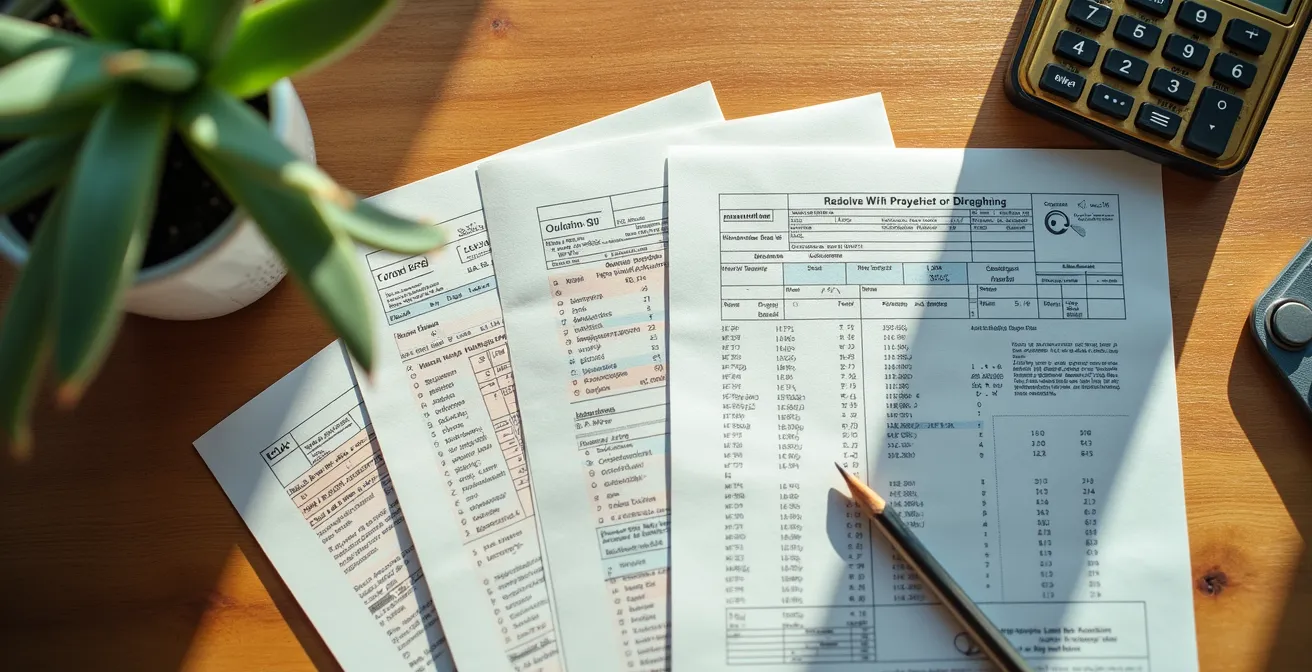
As the image suggests, this process is about organized analysis. The EPA provides a detailed framework that allows for this level of precision. By using their methodology for calculating personal emissions, you can benchmark your 18.3 tons of CO₂ per capita. The core of this method involves:
- Home Energy: Gather the last 12 months of utility bills (electricity, natural gas, fuel oil). Calculate your total annual consumption in kWh for electricity and in cubic feet or gallons for fuels. Use specific emission factors to convert this usage into tons of CO₂.
- Transportation: Determine your vehicle’s actual fuel efficiency (MPG) and your total annual mileage. Don’t use the manufacturer’s estimate; calculate it from your own fuel logs. This provides a precise measure of your transport emissions.
- Waste: This is often the hardest to track but involves estimating the weight of materials you send to landfill versus what you recycle. While less precise, it completes the picture of your consumption habits.
Vegan Diet or Electric Car: Which Cuts More Emissions?
Once your carbon ledger is established, the auditor’s next step is to analyze high-cost items and evaluate the ROI of potential changes. Two of the most discussed “high-impact levers” are switching to an electric vehicle (EV) and adopting a vegan diet. Both are significant commitments, but their quantitative impact on your carbon budget differs substantially. A common misconception is to view them as morally equivalent; a data-driven analysis reveals a clear hierarchy of effectiveness.
An EV directly addresses transportation emissions, which for the average American is a major slice of their personal footprint. The upfront cost is high, but the annual CO₂ reduction is significant. Conversely, changing your diet addresses emissions from agriculture, a complex and globally impactful system. A plant-based diet requires a high degree of lifestyle change but has a minimal financial cost and can even lead to savings. Comparing them requires looking at the absolute numbers.
A comparative analysis provides the clarity needed to make a strategic decision based on your personal circumstances and budget. Data from a Columbia University climate report quantifies this trade-off.
| Action | Annual CO2 Reduction | Implementation Cost | Lifestyle Change Level |
|---|---|---|---|
| Switch to Vegan Diet | 0.9 tons CO2e | $0 (potentially saves money) | High – Daily habit change |
| Vegetarian Diet | 0.5 tons CO2e | $0 (potentially saves money) | Medium – Partial diet change |
| Electric Vehicle (from gas car) | 2.0 tons CO2e | $15,000-30,000 premium | Low – Same driving habits |
| Forgoing Meat 1 Day/Week | 0.4 tons CO2e | $0 | Low – Weekly commitment |
The data is unequivocal: switching to an EV has more than double the carbon reduction impact of adopting a full vegan diet, immediately hitting the 2-ton annual goal. However, its Emission ROI is complicated by the high upfront cost. A vegan diet, while less impactful in absolute terms, offers an exceptional ROI, saving nearly a ton of CO₂ for zero financial outlay. For a carbon auditor, the strategic choice is clear: the EV is the power-play, while dietary changes offer the most efficient, cost-effective starting point. In fact, simply eliminating meat and dairy reduces emissions by about 8 pounds of CO₂ per day.
The Recycling Myth: Why It Won’t Save Your Carbon Budget
Recycling is the most visible “green” activity, a weekly ritual that provides tangible evidence of environmental effort. Unfortunately, its prominence in the public consciousness is vastly disproportionate to its actual impact on a personal carbon ledger. While it is unequivocally better than sending waste to a landfill, relying on recycling as a primary strategy for carbon reduction is a critical miscalculation. It is a low-ROI activity that can distract from the high-impact levers of consumption, energy, and transportation. The “Recycling Myth” is not that recycling is useless, but that it is a solution in itself.
The problem is twofold. First, the effectiveness of recycling varies dramatically by material. Second, the sheer volume of waste is a larger issue than its final destination. As an EPA analysis of material-specific recycling impact demonstrates, recycling aluminum is a huge win, saving over 90% of the energy needed for virgin production. However, the savings for most plastics are far lower, and the system is plagued by contamination and low processing rates. Even if you could perfectly recycle 100% of your household’s annual output of newspapers, glass, plastic, and metal, the total carbon saving, based on EPA data, is a fraction of a ton—a minor entry in your ledger compared to a single dietary or transport decision.
A carbon auditor, therefore, looks upstream. The focus shifts from “how to dispose” to “how not to acquire.” This is the principle of pre-cycling: designing waste out of your life at the point of purchase. It’s a proactive strategy that directly attacks the root of the problem, rather than managing the symptoms. Implementing a pre-cycling strategy involves a conscious shift in purchasing habits:
- Choose minimal packaging: Opt for products with no packaging, or packaging that is compostable or made from 100% recycled materials.
- Buy in bulk: Use reusable containers at zero-waste stores to eliminate single-use packaging entirely.
- Prioritize repairability: Select items designed for a long life and that can be repaired rather than replaced.
- Support take-back programs: Favor brands that take responsibility for their products at the end of their lifecycle.
Structuring a 5-Year Plan to Reach Net Zero at Home
Achieving a 2-ton reduction in 12 months is an aggressive short-term goal. The ultimate objective for a dedicated carbon auditor, however, is a long-term, systematic path to net-zero emissions at the household level. This requires a multi-year strategic plan that sequences investments and behavioral changes in a logical, financially manageable order. A 5-year roadmap transforms the overwhelming goal of “going green” into a series of concrete, achievable annual projects. This approach prioritizes the “low-hanging fruit” first while planning for larger capital expenditures in later years.
The structure of such a plan follows a clear progression from behavior to technology. Year one focuses on high-ROI, low-cost behavioral adjustments. Subsequent years are dedicated to systemic upgrades, tackling the building envelope, electrifying appliances, and finally, generating your own renewable energy. Each year builds upon the last, compounding carbon savings and moving the household systematically down the emissions ladder.
This phased approach allows for budgeting and planning, making the transition to a net-zero home a deliberate process rather than a sudden, costly overhaul. The transformation from a standard home to a decarbonized one is a powerful visual of this long-term commitment.
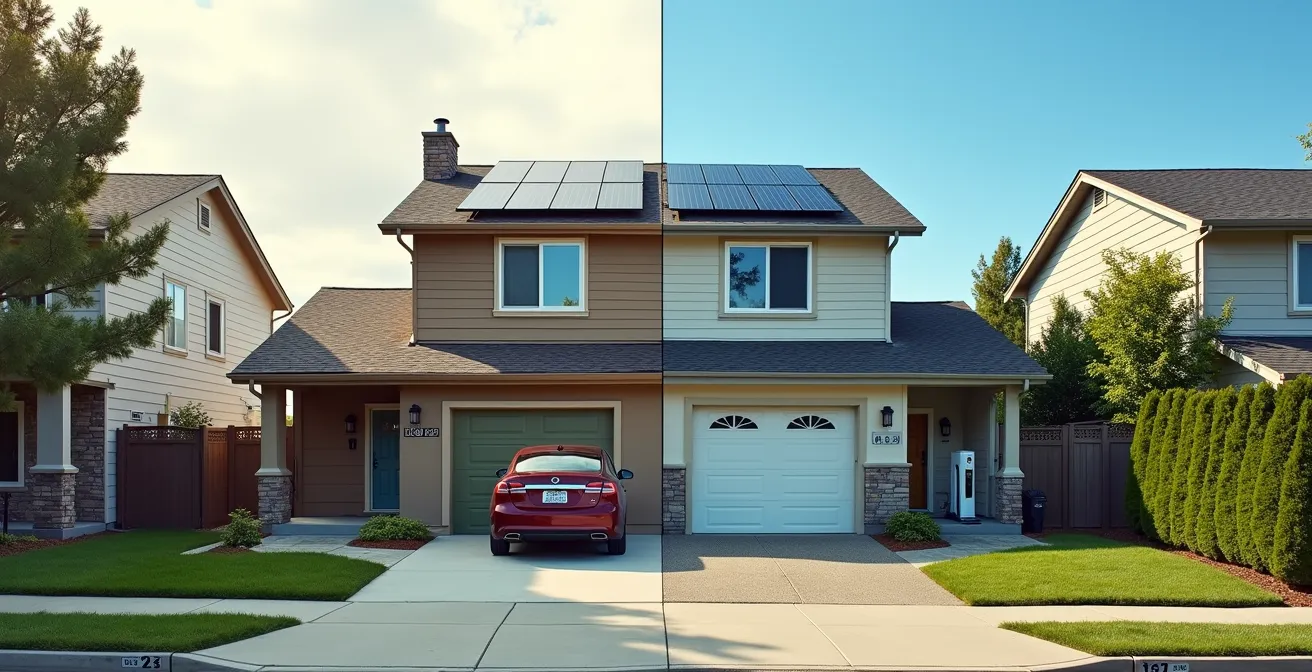
A typical 5-year home decarbonization roadmap might be structured as follows:
- Year 1: Behavioral Optimization. This is the year of no-cost changes. Lowering the thermostat by just 2°F, switching to all LED bulbs, and starting a composting system can collectively save nearly a ton of CO₂ (around 2,000 lbs) with zero capital investment.
- Year 2: Building Envelope Efficiency. Focus on sealing the leaks. This involves a home energy audit, adding insulation to attics and walls, and installing a programmable thermostat. These actions target heat loss, one of the biggest energy drains, saving up to 900 kg of CO₂ annually.
- Year 3: Strategic Electrification. Begin phasing out fossil fuels. When a major appliance reaches its end of life, replace it with a high-efficiency electric model, such as a heat pump for HVAC and an induction stove for cooking.
- Year 4: Renewable Energy Generation. With a newly efficient home, you can accurately size a solar panel system to match your reduced annual consumption. This is a major capital investment, but one that moves you from being an energy consumer to a producer.
- Year 5: Final Transition & Divestment. The final steps include adding battery storage to your solar array for true energy independence, transitioning to an electric vehicle, and aligning your investments away from fossil fuel-intensive funds.
How to Perform a Blower Door Test Alternative With Incense?
After tackling the major strategic decisions in your carbon ledger, the next phase of the audit is to hunt for “leakage”—small, persistent losses that add up over time. In a home, the most significant form of leakage is air infiltration. Unseen gaps and cracks in your home’s envelope can lead to massive heat loss in winter and heat gain in summer, forcing your HVAC system to work overtime. A professional blower door test is the gold standard for quantifying this leakage, but it’s expensive. A simple stick of incense, however, can serve as a surprisingly effective DIY alternative for identifying the exact location of these costly leaks.
The principle is simple: by creating a negative pressure environment inside your house, you force outside air to rush in through any available opening. The smoke from the incense stick will be visibly disturbed by these drafts, providing a clear map of where your home is losing energy. The impact of these small gaps is far greater than most people realize. According to EPA calculations, a tiny 1/8-inch gap under a standard 36-inch door is equivalent to having a 4.5-square-inch hole punched directly through your wall. Identifying and sealing these holes is a high-ROI activity that costs very little in materials but can save hundreds of dollars and a significant amount of CO₂ annually.
Performing this test requires a systematic approach. You are not just randomly waving a stick; you are conducting a methodical diagnostic of your building’s weak points. The goal is to create a detailed map of every leak to be sealed.
Action Plan: Your DIY Air Leakage Audit
- Create Negative Pressure: Close all windows and exterior doors. Turn on all exhaust fans in the house, including the kitchen range hood and bathroom fans, to pull air out of the building.
- Prepare Your Tool: Light a single stick of incense. You need a slow, steady stream of smoke that is easy to observe.
- Conduct the Scan: Slowly move the smoking incense stick 1-2 inches away from the edges of all potential leak points. Watch the smoke trail closely.
- Identify Leak Points: If the smoke wafts gently upwards, the area is sealed. If the smoke is pulled horizontally or visibly disturbed, you have found an air leak. Check around window frames, door frames, electrical outlets on exterior walls, attic hatches, and fireplace dampers.
- Map and Prioritize: Mark each identified leak on a simple diagram of your house. This map will serve as your checklist for sealing with caulk, weatherstripping, or foam.
Why Does Driving to Work Lower Your Productivity by 15%?
The carbon audit of a daily car commute typically stops at the tailpipe emissions. This is an incomplete accounting. A thorough auditor must also consider the secondary and tertiary costs of an activity, including its impact on human capital. The act of driving in traffic is not a neutral event; it is a cognitively draining activity that consumes mental energy, increases stress, and directly reduces your capacity for productive work. This “cognitive overhead” is a hidden cost of a car-centric commute, effectively lowering your professional output before the workday has even begun.
Research into commute alternatives highlights this stark contrast. Time spent driving is often “dead time,” where the brain is occupied with the low-level stress of navigation, traffic negotiation, and vigilance. This depletes the finite reservoir of executive function needed for deep work and complex problem-solving. A study on commute alternatives shows that switching this time to public transit or cycling transforms it. A 45-minute train ride can become a 45-minute deep work session, a period of reading, or a restorative meditation. This not only boosts productivity but also carries a substantial carbon benefit. A car-free lifestyle can reduce a personal carbon footprint by up to 2 tons of CO₂e annually—fully meeting the target of this guide through a single, albeit major, lifestyle change.
The productivity argument provides a powerful, self-interested incentive that complements the environmental one. You are not just saving the planet; you are reclaiming lost time and enhancing your professional effectiveness. This dual benefit makes re-evaluating your commute one of the highest-ROI decisions you can make. The goal is to reframe the commute from a necessary evil into a strategic part of your day. Even partial shifts, like carpooling, can have a significant impact, saving an estimated 2,000 pounds of CO₂e per person annually for a daily carpooler.
Key Takeaways
- Focus on High-Impact Levers: To achieve significant reductions, prioritize your efforts on the largest emission sources: home energy, transportation, and diet, rather than low-impact gestures.
- Measurement is Management: A precise carbon audit using your actual consumption data is the non-negotiable first step. You cannot effectively reduce what you do not accurately measure.
- Hunt for Hidden Emissions: Your most significant opportunities for reduction are often in areas you overlook, such as digital data storage and thermal leakage in your home’s structure.
How to Identify Thermal Bridges Losing You $500 a Year?
The final frontier of the home energy audit lies in identifying thermal bridges. These are pathways of high thermal conductivity within your home’s envelope that act like highways for heat to escape. They are structural flaws—such as uninsulated concrete porches, steel lintels over windows, or cantilevered floors—that bypass your insulation and bleed energy directly to the outside. This is a more advanced form of “leakage analysis” than simple air drafts. Thermal bridges can account for up to 30% of a home’s heat loss, representing a massive, invisible drain on both your energy bills and your carbon budget.
Identifying these weak points used to require expensive thermographic cameras. Today, an inexpensive handheld infrared (IR) thermometer, often costing under $30, can empower any homeowner to become a thermal bridge detective. The process involves systematically scanning your interior walls on a cold day. A thermal bridge will appear as a significantly colder spot compared to the surrounding, properly insulated surfaces. A temperature difference of even 5°F indicates a significant pathway for heat loss, which translates directly into wasted money and emissions.
Documenting these thermal anomalies is the first step toward correcting them. The potential savings are substantial, easily reaching hundreds of dollars per year. The following table breaks down common culprits and their typical financial impact.
| Thermal Bridge Location | Typical Heat Loss | Annual Cost Impact | Fix Complexity |
|---|---|---|---|
| Uninsulated Concrete Porch | 15-20% of wall heat loss | $150-200 | High – Requires professional |
| Steel Window Lintels | 5-10% increase locally | $50-75 | Medium – Insulation addition |
| Cantilevered Floors | 20-25% floor heat loss | $100-150 | Medium – Accessible from below |
| Wall-Foundation Junction | 10-15% of basement loss | $75-100 | Low – Sealant application |
This level of detailed diagnostics is the essence of the carbon auditor mindset. It moves beyond generic advice to a forensic examination of your home’s performance. By identifying and addressing these structural inefficiencies, you are making a permanent, one-time investment that will yield financial and carbon savings for years to come. It is the final piece of the puzzle in taking full control of your household carbon ledger.
You now possess the framework of a carbon auditor. The next step is to move from analysis to action. Begin your personal carbon audit today by applying these measurement and reduction frameworks to your own ledger.