
The secret to lifelong mobility isn’t isolating muscles on machines; it’s training the body as an integrated system for real-world resilience.
- Functional strength, like carrying heavy objects, is a better predictor of health than isolated leg power.
- True stability comes from mobility in adjacent joints (hips, upper back), not from a “stiff” and rigid core.
Recommendation: Prioritize compound, systemic movements like squats and farmer’s walks over machine-based exercises to build strength that translates directly to a long and independent life.
You follow the program. You hit the leg press, the leg extension machine, and the seated hamstring curl. You feel the burn, you see the progress in the weight you lift, and you believe you are building strong legs for the future. Then, you try to hoist a heavy suitcase into an overhead bin, and your body falters. Your back aches, your grip feels weak, and the strength you thought you built in the gym seems to have vanished. This frustrating disconnect is a common experience for many middle-aged adults trying to prepare their bodies for a long, active life.
The conventional wisdom tells us to build muscle and do cardio. We often translate this into a routine of isolated exercises that target one muscle group at a time. While this can increase the size and strength of a specific muscle, it fails to teach the body the most crucial skill for longevity: how to function as a cohesive, integrated unit. The strength to live independently at 80 isn’t about how much you can leg press; it’s about your ability to get up from the floor, carry your own groceries, and react to a sudden loss of balance without falling.
But what if the key wasn’t just building strength, but building the *right kind* of strength? This guide reframes the approach to longevity training. We will move beyond isolated movements to explore the principles of systemic training, functional stability, and metabolic health. It’s not about exercising more; it’s about exercising smarter to build a robust, anti-fragile body that serves you well for decades to come.
This article will guide you through the essential pillars of longevity training, from developing functional strength and fall-proofing your balance to understanding the critical roles of recovery and nutrition. Let’s build a body that’s not just strong in the gym, but capable in life.
Summary: A Blueprint for Lifelong Movement
- Why Can’t You Lift Your Suitcase Despite Using Leg Machines?
- How to Train Your Balance to Prevent Falls in Old Age?
- Squats or Leg Extensions: Which Burns More Calories in 10 Minutes?
- The Stiffness Mistake That Leads to Chronic Back Pain
- How to Recover From Heavy Lifting After 40?
- Talking or Moving: Which Releases Trauma Stored in the Body?
- How to Practice “Forest Bathing” for Stress Reduction?
- Why 2000 Calories of Processed Food Leaves You Starving?
Why Can’t You Lift Your Suitcase Despite Using Leg Machines?
The scenario is all too common: you can push hundreds of pounds on a leg press, but lifting a 50-pound suitcase feels awkward and dangerous. This is the classic disconnect between isolated strength and functional strength. Leg machines are excellent at strengthening the quadriceps in a fixed, stable pattern. However, lifting a suitcase is a chaotic, full-body event. It demands grip strength, a stable core to resist twisting, coordinated power from your glutes and hamstrings, and a strong back. These are elements that machine-based training simply ignores.
Your body is a linked system. The strength of your grip, for instance, is not just about your hands. It’s a powerful indicator of your overall systemic health. In fact, startling research published in The Lancet demonstrated that lower grip strength was a more accurate predictor of mortality than even blood pressure. This tells us that training for longevity must involve exercises that challenge the entire system, not just its individual parts.
The solution is to integrate “loaded carries,” such as the farmer’s walk or suitcase carry. Walking with a heavy weight in one or both hands forces your core to fire, challenges your grip, and teaches your body to maintain an upright posture under load. This is strength that has a direct functional transfer to real-life tasks. Start with a manageable weight, focusing on perfect posture: shoulders back, chest up, and a tight core. This is how you bridge the gap between gym strength and life strength.
How to Train Your Balance to Prevent Falls in Old Age?
As we age, a decline in balance can feel inevitable, with falls representing a major threat to independence. Traditional advice often involves static exercises like standing on one leg. While helpful, this overlooks a critical component: the brain. Exceptional balance is not just a physical skill; it’s a neurological one, rooted in your body’s ability to process information from your environment—a sense known as proprioception. To truly become “fall-proof,” you must train your body and your brain to work together, especially under distraction.
This concept is known as dual-task training. It involves performing a cognitive task while simultaneously challenging your balance. Think of walking a straight line while counting backward from 100 by sevens, or balancing on one leg while having a conversation. These activities mimic the complexities of real life, where you are rarely, if ever, focused solely on the act of balancing. You’re navigating a crowded sidewalk, carrying groceries, and talking on the phone all at once. Training for these scenarios is paramount.
The effectiveness of this method is not just theoretical. A comprehensive meta-analysis of 44 different studies involving over 2,700 older adults provided compelling evidence.
Case Study: The Power of Dual-Task Training
A meta-analysis of 44 studies with 2,782 older adults showed that combining cognitive and physical tasks (dual-task training) significantly improved dynamic balance scores and reduced the frequency of falls when compared to single-task physical training alone. This proves that engaging the brain during balance exercises provides a superior protective effect.
To put this into practice, start simply. While standing on one leg, try reciting the alphabet backward. As you improve, make the cognitive task more demanding or the physical environment more challenging, such as by standing on an unstable surface like a cushion or closing your eyes for brief periods.
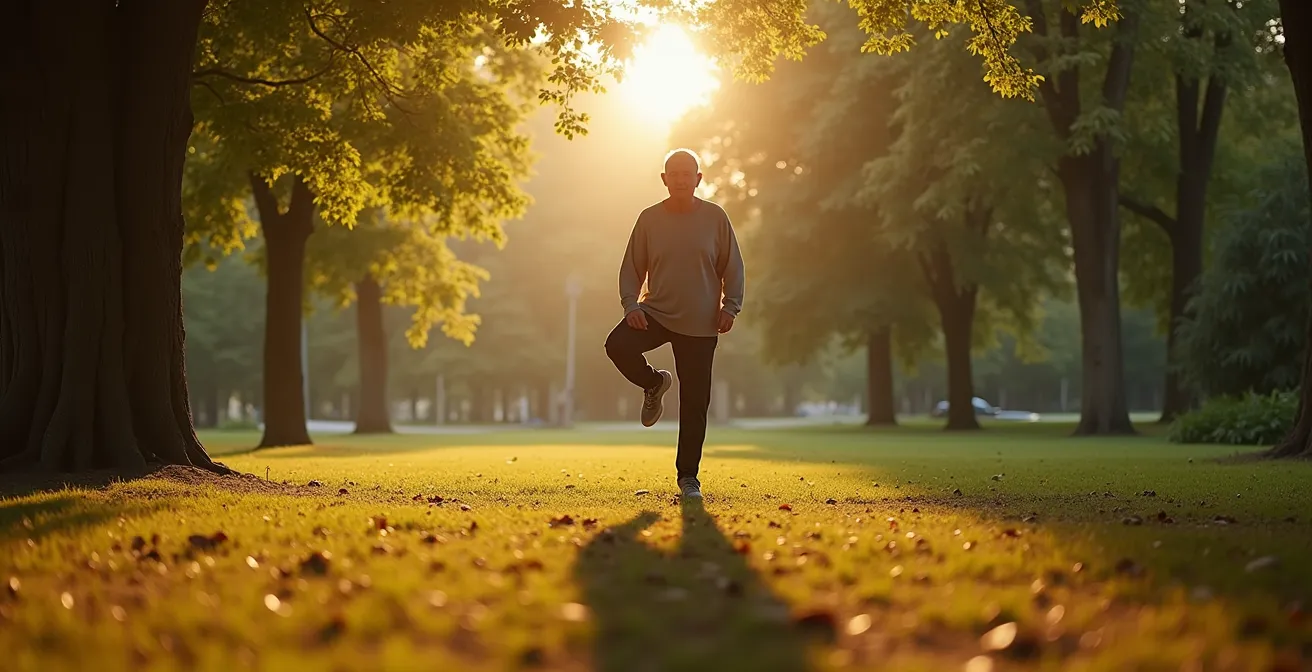
As shown in the image, practicing in a natural, slightly uneven environment can further enhance this training. The changing ground texture and sensory inputs from nature provide a rich source of proprioceptive input, teaching your feet, ankles, and core to make constant micro-adjustments. This is how you build a truly resilient and responsive sense of balance.
Squats or Leg Extensions: Which Burns More Calories in 10 Minutes?
On the surface, the question seems simple. The leg extension machine effectively isolates the quadriceps, creating a deep, targeted burn. The squat, on the other hand, is a complex, multi-joint movement. While both exercises build muscle, their impact on your body’s overall system is vastly different. The squat is a systemic exercise, triggering a cascade of metabolic and hormonal responses that an isolated movement like the leg extension cannot match. In 10 minutes, the squat will not only burn more calories during the activity but will also significantly elevate your metabolism for hours afterward.
This difference comes down to the number of muscles engaged and the resulting hormonal signal sent to your body. A leg extension primarily works one muscle group. A squat engages your quadriceps, hamstrings, glutes, calves, lower back, and core stabilizers all at once. This massive muscular recruitment demands more energy and triggers a potent release of beneficial hormones like growth hormone and testosterone, which are crucial for building and maintaining muscle mass, especially as we age.
The following table breaks down the profound systemic differences between these two common leg exercises.
| Aspect | Squats | Leg Extensions |
|---|---|---|
| Muscle Groups Engaged | Quadriceps, hamstrings, glutes, core, back | Primarily quadriceps |
| Metabolic Response | High EPOC effect lasting hours | Minimal post-exercise burn |
| Hormonal Response | Triggers growth hormone & testosterone | Limited hormonal cascade |
| Functional Transfer | Directly improves sit-to-stand, lifting | Isolated strength gain |
| Balance Challenge | Requires coordination & stability | Machine-stabilized movement |
The takeaway is clear: for longevity, prioritize movements that challenge the body as a whole. This principle extends beyond just lifting. As longevity expert Dr. Peter Attia notes regarding cardiovascular exercise, the goal should be to achieve a high level of fitness relative to your peers, which requires systemic effort. Choosing exercises like squats, deadlifts, and overhead presses ensures you are building not just muscle, but a more metabolically active and hormonally optimized body.
The Stiffness Mistake That Leads to Chronic Back Pain
Chronic low back pain is an epidemic, and it’s projected to get worse. With 619 million people affected in 2020 and a projection of over 800 million by 2050, the conventional approach is clearly failing. Many people who experience back pain instinctively try to “protect” their lower back by making it rigid and stiff. They brace, they avoid bending, and they perform endless crunches in an attempt to build a muscular “shield.” This is a fundamental mistake. The secret to a healthy, pain-free back is not stiffness; it’s creating stability through mobility in the joints above and below.
From an anatomical perspective, your lumbar spine (lower back) is designed for stability. It’s meant to be a strong, solid pillar. The joints directly above it (the thoracic spine, or mid-to-upper back) and below it (the hips) are designed for mobility. When your hips and thoracic spine become tight and immobile from years of sitting and poor posture, your lower back is forced to compensate. It starts moving and twisting in ways it was never designed to, leading to irritation, inflammation, and chronic pain.
The solution, therefore, is not to make your lower back even stiffer. It’s to restore mobility in your hips and thoracic spine. When these areas can move freely, your lumbar spine can finally do its job: to be stable. This allows your powerful glutes and core muscles, like the transverse abdominis, to properly engage and protect your spine during activities like lifting, twisting, and carrying. Restoring this natural order is the most effective way to build long-term resilience against back pain.
Your Action Plan: Audit for Core Stability
- Identify Contact Points: Lie on your back with knees bent. Where do you feel pressure? Is your lower back arched off the floor, or can you gently press it down? This reveals your baseline pelvic tilt and core engagement.
- Collect Mobility Data: Perform a 90/90 hip rotation on each side and a cat-cow stretch. Do you feel significant restriction, pinching, or asymmetry in your hips or upper back? Note these limitations.
- Assess for Coherence: Try a “dead bug” exercise. Can you keep your lower back stable on the floor while moving your opposite arm and leg? If your back arches, it shows a lack of core control and coherence between your limbs and trunk.
- Evaluate Stability vs. Stiffness: During a simple bodyweight squat, does your lower back round at the bottom (a “butt wink”)? This indicates that stiff hamstrings or immobile hips are forcing your stable lumbar spine to become mobile and vulnerable.
- Create an Integration Plan: Prioritize daily mobility work for your tightest areas (e.g., hip flexor stretches, thoracic rotations) and core stability exercises (planks, dead bugs) that focus on preventing movement in the lumbar spine.
How to Recover From Heavy Lifting After 40?
As we move past 40, a noticeable shift occurs in our training: recovery becomes the main limiting factor. You might feel just as strong during a workout, but the post-exercise soreness lasts longer, and bouncing back for the next session takes more time. This is a normal physiological process. One key metric, VO2 max—the maximum amount of oxygen your body can use during intense exercise—is a powerful indicator of this. After our 20s, studies on cardiorespiratory fitness indicate that VO2 max declines by about 10% per decade, and that rate can accelerate to 15% after age 50.
This reduced cardiovascular capacity directly impacts your ability to recover. Your circulatory system is less efficient at delivering oxygen and nutrients to damaged muscle tissue and clearing out metabolic byproducts. The consequence is that the same workout that took you two days to recover from at 30 might now take three or four. Ignoring this reality and pushing through with the same intensity and frequency is a recipe for overtraining, injury, and burnout. The mantra for training after 40 must shift from “more is better” to “smarter is better.”
Smarter recovery involves several key strategies. First, prioritize sleep. It is during deep sleep that your body releases growth hormone, which is essential for tissue repair. Aim for 7-9 hours of quality sleep per night. Second, focus on nutrition, particularly protein intake. Consuming adequate protein (around 1.6-2.2 grams per kilogram of body weight) provides the necessary building blocks for muscle repair and synthesis. Finally, incorporate active recovery. Light activities like walking, swimming, or stretching on your off days can increase blood flow and aid the recovery process without adding significant stress to your system. Training for longevity is a marathon, not a sprint; listening to your body’s need for recovery is how you stay in the race.
Talking or Moving: Which Releases Trauma Stored in the Body?
The idea that our bodies “store” trauma and stress is gaining wider acceptance. We’ve all experienced it: a tight jaw during a stressful week, a sore neck after a difficult conversation, or chronic tension in our shoulders. While talk therapy is an invaluable tool for processing the cognitive and emotional aspects of trauma, it doesn’t always address these deep-seated physical patterns. Movement, on the other hand, offers a direct pathway to communicate with the nervous system and release this stored tension.
From a physiological standpoint, stress and trauma can lock the nervous system into a state of high alert (the “fight or flight” response). This manifests as chronic muscle tension, shallow breathing, and a heightened startle response. Mindful, rhythmic movements can help shift the nervous system back toward a state of rest and safety (the “rest and digest” response). Practices that synchronize movement with breath are particularly powerful in this regard.
Tai Chi is a prime example of this. Its slow, deliberate, and flowing movements, combined with deep, controlled breathing, create a form of moving meditation. This practice not only challenges and improves physical balance but also helps to regulate the nervous system. According to research highlighted by experts at Alberta Health Services, Tai Chi’s unique combination of physical stability training and mental focus makes it an exceptional tool for processing both physical and emotional tension. It teaches the body that it is safe to relax and let go, helping to unwind patterns of tension that may have been held for years.
This principle extends to other forms of joyful movement, even social ones. As Dr. James O’Keefe notes, activities like pickleball combine physical activity with social connection and fun, which he calls “a potent recipe for a longer life.” Whether through the meditative flow of Tai Chi or the social joy of a sport, moving your body is a powerful way to process what words cannot always reach.
How to Practice “Forest Bathing” for Stress Reduction?
In our hyper-connected world, finding genuine recovery can be a challenge. “Forest bathing,” or *Shinrin-yoku*, is a practice that originated in Japan and offers a simple yet profound method for stress reduction and active recovery. It is more than just a walk in the woods; it is the conscious and contemplative practice of immersing yourself in the sights, sounds, and smells of nature. It’s about engaging all your senses to quiet the mind and calm the nervous system, making it an ideal complement to a rigorous training schedule.
The benefits are not merely psychological. Spending time in a natural environment has been shown to lower cortisol (the primary stress hormone), reduce blood pressure, and decrease heart rate. For the purposes of longevity training, it also serves as a form of low-intensity active recovery. A gentle walk on uneven, natural terrain provides a wealth of proprioceptive input, subtly challenging and refining your balance and joint stability without causing significant fatigue. It enhances blood flow to tired muscles, aiding in the removal of metabolic waste and promoting repair.
To practice forest bathing, leave your phone and headphones behind. Start by walking slowly, paying attention to your breath. Then, begin to engage your senses one by one. Notice the different shades of green in the leaves. Listen for the distinct songs of at least five different birds. Feel the texture of bark on a tree or the cool air on your skin. The goal is to shift your focus from internal rumination to external observation. This practice doesn’t require a huge time commitment to be effective. As research promoted by Dr. Peter Attia on longevity suggests, even small, consistent doses of exercise yield significant benefits. An analysis he highlights shows that as little as 90 minutes of weekly exercise reduces all-cause mortality risk by 14%. A 30-minute forest bathing session two to three times a week can easily contribute to this total while simultaneously supercharging your recovery.
Key Takeaways
- Longevity is built on functional, systemic strength, not isolated muscle work.
- A healthy spine requires mobility in the hips and upper back to allow the lower back to be stable.
- Balance is a neurological skill; train it by combining physical and cognitive challenges (dual-tasking).
Why 2000 Calories of Processed Food Leaves You Starving?
The old adage “a calorie is a calorie” is one of the most persistent and damaging myths in nutrition. Anyone who has tried to survive on 2000 calories of processed snacks versus 2000 calories of whole foods knows the profound difference. The former leaves you feeling hungry, tired, and craving more an hour later, while the latter provides sustained energy and satisfaction. This isn’t a matter of willpower; it’s a matter of biochemistry. The quality of your calories dictates the hormonal and inflammatory response in your body, which directly impacts everything from your hunger signals to your ability to recover from training.
Processed foods, which are typically high in refined sugars, unhealthy fats, and artificial ingredients, trigger a rapid spike in blood sugar and insulin. This is followed by an equally rapid crash, which sends a powerful signal to your brain that you are hungry again, creating a vicious cycle of overeating and energy swings. Furthermore, these foods promote systemic inflammation, a low-grade, chronic immune response that impairs muscle recovery, contributes to joint pain, and is a root cause of most chronic diseases.
Whole foods—like vegetables, fruits, lean proteins, and healthy fats—have the opposite effect. Their fiber and complex structure lead to a gradual release of energy, keeping blood sugar and insulin levels stable. They are also packed with micronutrients and anti-inflammatory compounds that actively support recovery and reduce cellular stress. This table illustrates the stark metabolic contrast.
| Factor | Whole Foods (2000 cal) | Processed Foods (2000 cal) |
|---|---|---|
| Insulin Response | Gradual rise, stable levels | Rapid spike and crash |
| Satiety Duration | 4-6 hours | 1-2 hours |
| Inflammatory Markers | Reduced CRP levels | Elevated systemic inflammation |
| Muscle Recovery | Enhanced protein synthesis | Impaired recovery |
| Micronutrient Density | High vitamins/minerals per calorie | Low nutrient density |
You cannot out-train a bad diet. The fuel you put into your body determines its ability to adapt, repair, and grow stronger from the stress of exercise. For longevity, nutrition and training are two sides of the same coin. As Dr. Peter Attia eloquently puts it:
Exercise might be the most potent ‘drug’ we have for extending the quality and perhaps quantity of our years of life.
– Dr. Peter Attia, Peter Attia MD
To get the full benefit of this “drug,” you must pair it with a high-quality, anti-inflammatory diet. This synergy is the foundation of a long and healthy life.
Now that you have the blueprint for training, the next step is to apply these principles consistently. Start by replacing one machine-based exercise with a functional, compound movement, and commit to five minutes of mobility work each day to build a foundation for a long, active, and independent life.