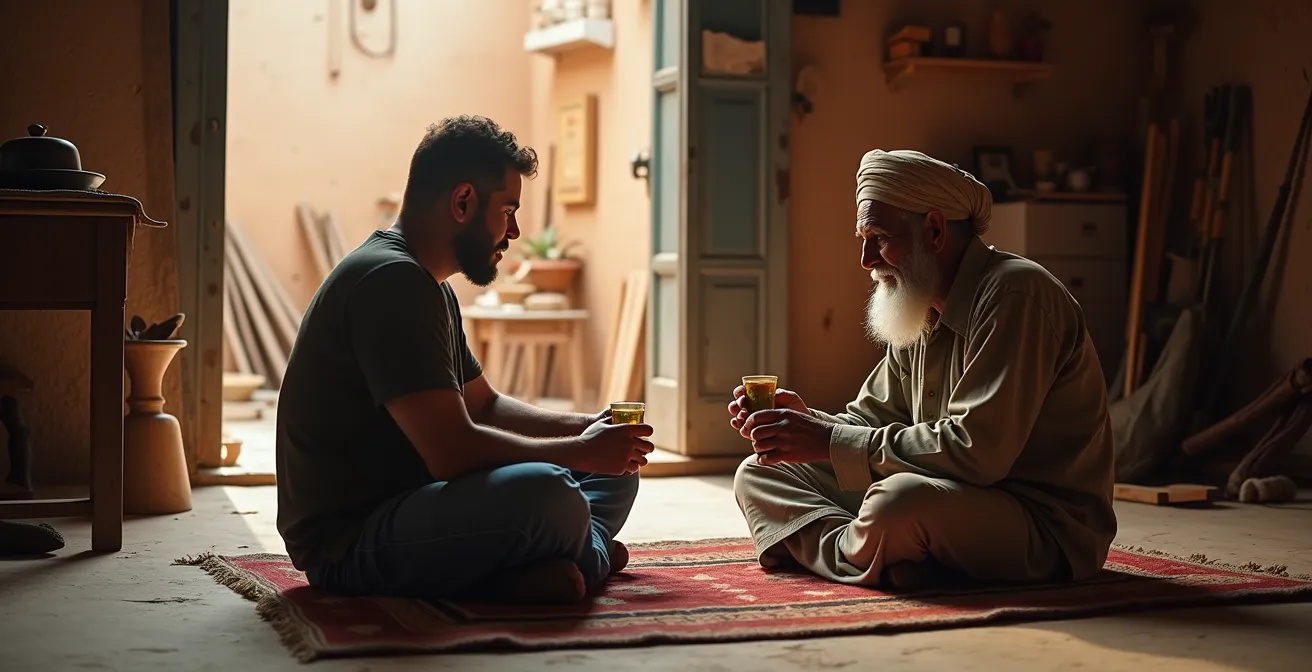
True travel is about reciprocity, not consumption; it’s an active exchange that values human connection over sightseeing checklists.
- Genuine interaction begins with learning the language of respect, which goes far beyond basic greetings.
- Authentic accommodation is found in exchanges of skill and time, not just monetary transactions.
- The true worth of a local craft is found in its story, skill, and cultural heritage, not just its price tag.
Recommendation: On your next journey, consciously shift your mindset from a ‘tourist’ who takes, to a ‘traveler’ who participates, observes, and respectfully exchanges.
You return from a trip with a camera roll full of landmarks and a faint sense of emptiness. You saw the sights, ate at the recommended restaurants, and bought the souvenirs, yet you feel like you merely skimmed the surface. This feeling is common among modern travelers, a quiet dissatisfaction with an experience that feels more like a theme park visit than a genuine connection with a new place and its people. The standard advice—”get off the beaten path,” “talk to locals”—is well-intentioned but often lacks a foundational framework for *how* to do so respectfully and effectively.
The problem isn’t the desire to connect, but the approach. We are often conditioned to be consumers, extracting value in the form of photos, stories, and experiences. But what if the key to a deeper, more meaningful journey wasn’t about what you can get, but what you can give? The true art of travel lies in a profound mental shift: from passive consumption to active, cultural reciprocity. It’s about understanding that every interaction is part of a delicate ecosystem, where your presence can either enrich or extract.
This guide moves beyond the platitudes to offer a practical and philosophical framework for this shift. We will explore how small efforts in language can transform relationships, how to find accommodation that fosters genuine connection, and why understanding the value of a handmade object is a window into the soul of a culture. This isn’t just about traveling differently; it’s about seeing the world, and your place in it, with new eyes.
Before we delve into the deep cultural connections, it’s worth remembering that travel also has its moments of unexpected joy and shared cultural references. The following video is a classic piece of internet culture that has brought smiles across the globe, a lighthearted reminder not to take every single moment too seriously.
To navigate this journey from tourist to traveler, it helps to have a map. The following sections break down the core principles of authentic travel, offering actionable strategies to transform your perspective and your experiences.
Summary: A Framework for Authentic Travel
- Why Learning 100 Words Changes How Locals Treat You?
- How to Find Host Families That Aren’t Just Hotels in Disguise?
- Planning or Wandering: Which Leads to Better Stories?
- The Photo Mistake: Why You Shouldn’t Photograph People Without Asking
- How to Get Invited to a Local Celebration Respectfully?
- How to Listen to Understand Instead of Listening to Reply?
- The Bargaining Mistake That Insults Master Craftsmen
- Why Is a Handmade Knife Worth 10x a Factory One?
Why Learning 100 Words Changes How Locals Treat You?
The common advice to learn “hello” and “thank you” is a starting point, but it barely scratches the surface of true connection. The real transformation occurs when you move beyond transactional phrases and into the language of emotion, respect, and appreciation. Learning just 100 words—carefully chosen—signals a profound shift in intent. It tells people you are not there to simply consume their culture, but to understand it. This effort is the first act of cultural reciprocity, and it fundamentally alters how you are perceived. Research shows that for nearly half of language learners, travel is the primary motivation, yet few harness its full potential to build bridges.
When you can describe a meal as ‘complex’ or ‘delicate’ instead of just ‘good’, or express gratitude for a craftsman’s work with words like ‘skillful’ or ‘masterful’, you are no longer a generic tourist. You become an individual who sees and values the nuance of their world. This small investment in language pays enormous dividends, opening doors to conversations, smiles, and a level of hospitality reserved for guests, not customers. It changes your status from an outsider looking in to a respectful visitor, invited to step a little closer.
The goal is not fluency, but connection. Focus on words that convey genuine feeling and observation. This demonstrates an intentional presence—a curiosity that goes beyond the surface. Prioritizing this small lexicon is one of the most powerful tools a traveler has:
- Learn words expressing gratitude for craftsmanship: ‘skillful’, ‘beautiful’, ‘masterful’, ‘impressive’
- Master taste descriptors beyond ‘good’: ‘complex’, ‘rich’, ‘delicate’, ‘balanced’
- Prioritize emotion words: ‘grateful’, ‘honored’, ‘curious’, ‘amazed’
- Study culturally unique concepts with no direct translation (like the Filipino *Gigil* or Portuguese *Saudade*)
- Practice pronunciation of respectful greetings and farewells specific to age and social status
How to Find Host Families That Aren’t Just Hotels in Disguise?
The promise of a homestay is authentic cultural immersion, yet many have become little more than informal bed and breakfasts, where the transaction remains purely financial. A true host family experience is not about a cheaper bed; it’s about a shared life. The key to finding these genuine connections is to look for platforms and opportunities based on exchange rather than payment. This is where you trade your skills, time, or curiosity for a place in a local home, shifting the dynamic from customer-to-provider to one of mutual interest and cultural reciprocity.
This approach requires you to think about what you can offer. Are you a photographer, a writer, a web developer, or fluent in a language the family wants to learn? By offering a skill, you create a relationship built on shared goals. The accommodation becomes a byproduct of the human connection, not the goal itself. This is the foundation of a memorable and transformative stay, where you are treated as a temporary member of the family, not a paying guest. The image below captures the essence of this connection—a shared meal that transcends tourism.
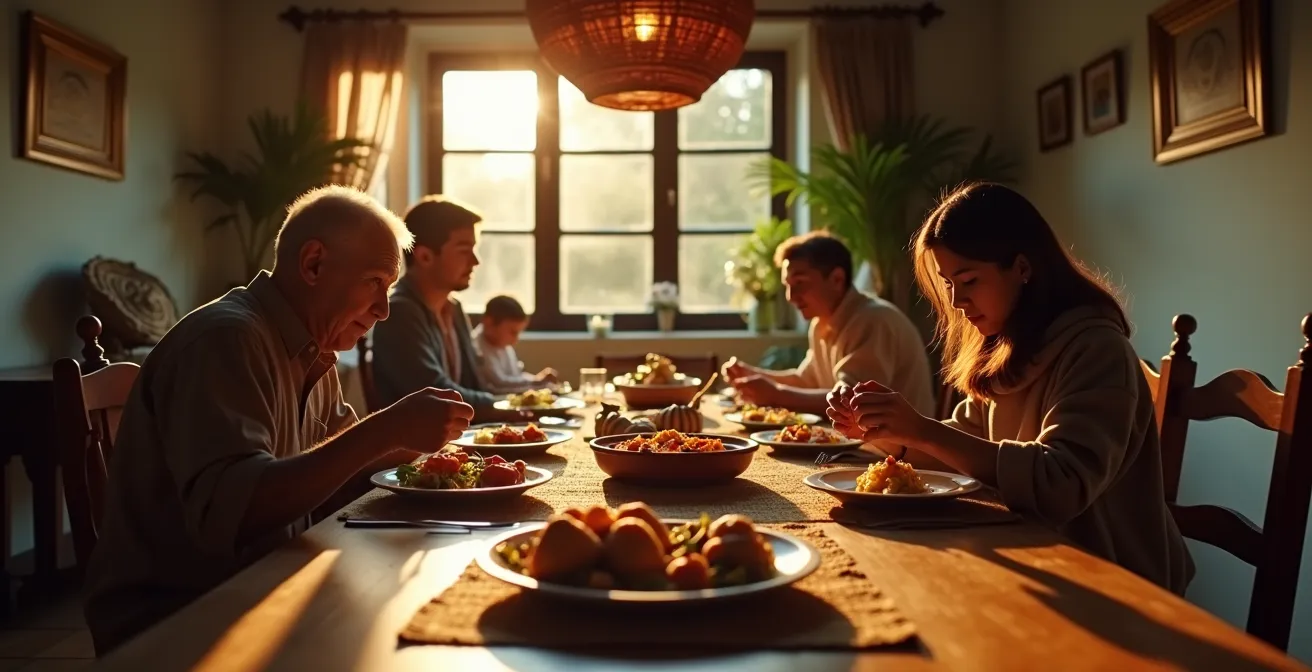
As you can see, the value here is not in the room, but in the relationships being built around the table. This is the goal. By participating in the daily rhythms of life—cooking, sharing stories, running errands—you gain an understanding of the culture that no museum or tour guide could ever provide.
Case Study: The Worldpackers Exchange Model
Platforms like Worldpackers connect travelers with hosts for skill exchanges rather than monetary transactions. Travelers might offer skills like photography, language teaching, or web development in exchange for accommodation. This model fosters genuine relationships and deep cultural immersion, with hosts in over 170 countries offering opportunities that range from helping in eco-villages to living with families, creating a system where value is exchanged through skills and shared time, not just money.
Planning or Wandering: Which Leads to Better Stories?
The modern traveler is often caught between two extremes: the hyper-scheduled itinerary that leaves no room for surprise, and the aimless wander that risks missing out on core experiences. From an anthropological perspective, neither approach is optimal. The best stories emerge from a hybrid model—a structure that provides anchors but leaves ample space for serendipity. Rigid planning turns a journey into a checklist, while pure wandering can be inefficient and unfulfilling. The solution is to create a loose framework that encourages, rather than prevents, spontaneous discovery.
This method involves identifying a few “anchor” experiences—a multi-day cooking class, a homestay, a guided trek—and leaving the days in between completely unstructured. These anchors provide depth and guarantee meaningful interaction, while the empty spaces become a canvas for the unexpected. You might use a simple daily theme to guide your wandering, such as ‘follow the music’ or ‘find the best coffee’. This blend of structure and freedom allows you to engage deeply while remaining open to the magic of the unknown—the hidden garden, the unexpected festival, the spontaneous conversation.
A traveler in Kuopio, Finland discovered that unplanned wanderings led to finding a hidden flower garden overlooking Lake Kallavesi. These spontaneous discoveries provided more authentic connection than racing through five European capitals in two weeks checking off tourist attractions.
This balance ensures you are not just a passive observer but an active participant in your own adventure, creating stories that are uniquely yours.
Your Action Plan: The Anchor & Radiate Method for Structured Spontaneity
- Book 2-3 ‘anchor’ experiences: a multi-day cooking class, a homestay, or a guided trek to ensure deep engagement.
- Leave the days between your anchors completely unstructured to allow for spontaneous wandering and discovery.
- Choose daily themes for your unstructured days, such as ‘follow the music’, ‘find the best local coffee’, or ‘photograph interesting doorways’.
- Stay a minimum of four nights in any single location to observe and adapt to the local rhythms and pace of life.
- Use public transportation without a specific destination in mind to discover neighborhoods organically.
The Photo Mistake: Why You Shouldn’t Photograph People Without Asking
In the age of the smartphone, it has become deceptively easy to capture a “candid” shot of a local person. From a traveler’s perspective, it’s a beautiful moment. From the subject’s perspective, it can be an act of theft—the taking of one’s image without consent. This single act can instantly shatter the fragile trust you are trying to build. A photograph is not a neutral object; it is a piece of a person’s story, and taking it without permission turns a human being into an element of scenery. It reinforces the power dynamic of the tourist who takes and the local who is taken from.
The alternative is not to stop taking photos, but to turn the act of photography into an interaction. It begins with a smile, eye contact, and a simple gesture towards your camera. This small moment of communication transforms the dynamic. A “no” must always be respected with a nod and a smile, without any hint of disappointment. A “yes” is an invitation to a shared moment. As the Roaming Sparrow Photography Ethics Guide notes, this is a fundamental principle of respectful travel.
Photographers should always seek consent before taking photos of people, especially in situations where people are vulnerable or in intimate settings.
– Roaming Sparrow Photography Ethics Guide, The Ethics of Travel Photography
This process of seeking consent is an act of cultural reciprocity in itself. When you show the person the photo you’ve taken, you complete the exchange. The moment is no longer something you’ve taken from them, but something you have created together. The image below illustrates this beautiful exchange, where technology becomes a bridge for connection, not a tool for extraction.

By following a simple protocol, you can ensure your photography is a tool for connection, not division. Always prioritize the human being over the photograph.
- Make eye contact and smile before raising your camera.
- Use gestures if language is a barrier—point to the camera, then to the person, with a questioning look.
- For children, always get explicit consent from a parent or guardian.
- If someone seems uncomfortable, declines, or turns away, respect their wishes immediately and without question.
- After taking the photo, offer to show it to them on your screen. This simple act of sharing closes the loop.
- Never photograph sacred ceremonies, private moments, or people in mourning without explicit permission.
How to Get Invited to a Local Celebration Respectfully?
Witnessing a local festival, a wedding, or a religious ceremony is one of the most profound travel experiences possible. However, these are not tourist attractions; they are intimate community events. An invitation to participate is not something you can demand or buy; it is something you must earn through relational currency. This currency is built over time through genuine interest, respect, and consistent, positive interaction within a community. You cannot arrive in a town and expect to be invited to a family event the next day.
The path to an invitation is indirect. It involves becoming a familiar, friendly face. This means patronizing the same local market, learning the names of vendors, asking thoughtful questions about their lives and traditions, and showing up with a posture of listening, not demanding. The invitation, when it comes, will feel natural—an extension of the relationships you have already built. It is a sign that you are no longer seen as a transient tourist, but as a temporary, welcome presence in the community’s life.
Case Study: Earning Trust for a Temple Ceremony
A traveler in Thailand earned an invitation to a local temple ceremony, an event rarely witnessed by outsiders. This didn’t happen by asking a tour guide, but by spending several weeks frequenting the same local market. The traveler made a point to learn the vendors’ names, ask about their families, and express a genuine, informed interest in Buddhist traditions. The invitation came organically from a vendor who had grown to see the traveler as a friend, not a customer. Trust was the key that unlocked the door.
Once invited, your role is to be a respectful observer first and a participant second. Your goal is to add to the atmosphere, not to become the center of it. By following a protocol of respect, you honor the trust that has been extended to you.
- Before the event, ask your local contact, “How can I help?” or “What would be an appropriate gift to bring?”
- Research the celebration’s meaning and show your informed interest through specific, respectful questions.
- Dress appropriately, following local customs for religious or cultural events. This may mean covering your head, shoulders, or legs.
- Contribute practically: help with setup or cleanup, or bring food to share if appropriate.
- Observe first, participate second. Watch social cues from locals to understand how to behave.
- Limit or avoid alcohol consumption and focus on listening and observing rather than talking.
How to Listen to Understand Instead of Listening to Reply?
In a cross-cultural conversation, the single greatest barrier to connection is the urge to reply. We are often so busy formulating our own response, searching for a similar story from our own life, that we fail to truly hear what the other person is saying. This is listening to reply. Listening to understand, by contrast, is a form of intentional presence. It is an active, empathetic process of absorbing not just the words, but the emotion, context, and unspoken meaning behind them. It requires you to silence your own ego and create space for the other person’s reality.
This is especially critical when a language barrier exists. Your body language, eye contact, and the sounds you make become even more important. A focused gaze, an open posture, and an empathetic nod can convey more understanding than a dozen poorly chosen words. The goal is not to prove you understand, but to make the other person *feel* understood. This is a profound gift you can offer anyone, and it is the foundation of any meaningful human connection, whether at home or abroad.
Instead of immediately relating their story back to yourself (“Oh, that’s like the time I…”), ask deepening questions that keep the focus on them (“What was that like for your family?”). This simple shift transforms the conversation from a competition of experiences into a shared exploration of one. It shows respect and genuine curiosity, the two most valuable currencies a traveler possesses.
Adopting an active listening toolkit can fundamentally change the quality of your interactions:
- Apply the Five-Second Rule: After someone finishes speaking, pause for a full five seconds before you respond. This prevents you from interrupting and gives you time to truly process what they said.
- Use Mirroring Questions: Gently rephrase what you think they said to confirm your understanding. “If I am hearing you correctly, you felt…” is a powerful way to show you are engaged.
- Ask Deepening Questions: Inquire further into their experience. “What was that like for you?” or “How did that change things?” keeps the focus on their story.
- Maintain Focused Presence: Keep open body language and maintain gentle eye contact, even if you don’t understand every word. Your focused attention speaks volumes.
- Use Empathetic Sounds: Simple, non-verbal cues like “mmm,” “ah,” and nodding show you are engaged without interrupting their flow.
- Resist the Urge to Relate: Make a conscious effort not to immediately share a similar personal experience. Let their story stand on its own.
The Bargaining Mistake That Insults Master Craftsmen
Haggling is often romanticized as an essential part of the travel experience, a fun game to be played in bustling markets. While this can be true in settings with mass-produced souvenirs, applying the same logic to an artisan’s workshop is a grave cultural mistake. For a master craftsman who has dedicated decades to honing their skill, aggressive bargaining is not a game; it is an insult. It devalues their time, their expertise, and the story embedded in their work. It reduces their art to a mere commodity.
The key is to understand the context. Is the seller a reseller in a tourist-heavy market, or are you standing in the studio of the artist who created the piece? The first scenario often has bargaining built into the pricing structure. The second does not. In an artist’s studio or a master craftsman’s workshop, the price is not an opening bid; it is a reflection of a lifetime of dedication. To question it is to question their worth as an artist. A far more respectful approach is to ask about the process, the materials, or the history of the technique. This shows you value the work, not just the price tag.
This distinction is crucial for any traveler wishing to support local economies respectfully. The following table, based on guidance for ethical travel, provides a clear framework for when and how to approach pricing discussions. As a responsible travel guide suggests, reframing the price is key.
| Setting | Bargaining Expected? | Appropriate Approach |
|---|---|---|
| Tourist Markets | Yes – Often Expected | Start at 50-60% of asking price |
| Reseller Stalls | Usually Yes | Friendly negotiation acceptable |
| Artisan’s Workshop | No – Often Insulting | Ask about the process, accept the stated price |
| Artist’s Studio | Never | Price reflects years of training |
| Street Food | Never | Fixed prices, often already low |
Reframe the price as the ‘Time, Skill, and Story Equation.’ Instead of seeing a price tag, see it as the sum of the artisan’s years of training, hours of labor, and cost of materials.
– Responsible Travel Guide, Ethics of Supporting Local Craftsmen
Key Takeaways
- Language is the first act of respect; learning words of emotion and appreciation opens doors that basic greetings cannot.
- Authentic experiences stem from reciprocal exchanges—of skill, time, or genuine interest—rather than purely monetary transactions.
- The true value of a handcrafted object lies in its “embodied story”: the time, skill, and cultural heritage it represents.
Why Is a Handmade Knife Worth 10x a Factory One?
In a world of mass production, it can be difficult to comprehend why a handmade object, like a kitchen knife, might cost ten times more than its factory-made equivalent. The answer lies in a concept that is central to authentic travel: the embodied story. A factory knife is an anonymous, disposable object. Its value is purely functional and temporary. A handmade knife from a third-generation blacksmith, however, is an artifact. It carries within its steel the story of a place, the history of a technique, and the soul of its maker.
When you hold such an object, you are not just holding a tool; you are holding the culmination of hundreds of hours of labor, generations of passed-down knowledge, and materials that are often locally and ethically sourced. The price reflects this entire ecosystem of value—what we can call the Value Equation of time, skill, and story. It is a direct investment in the preservation of a culture and the livelihood of a master artisan. This is a purchase that builds a connection, a story you will share every time you use the object for decades to come.
Case Study: The Embodied Story of a Sakai Knife
A handmade Japanese kitchen knife from a third-generation blacksmith in Sakai, Japan, carries the story of 600-year-old techniques, locally sourced steel, and 40 hours of individual crafting. Its value is not just in its superior cutting edge, but in this rich history. Buyers report using these knives daily for decades, creating a lasting, tangible connection to their travel experience, while factory-made knives are often replaced every few years. The purchase becomes part of the owner’s story, intertwined with the artisan’s.
To appreciate this deeper value, you must learn to ask the right questions. Instead of focusing on the price, focus on the story. This shifts the interaction from a transaction to a moment of learning and appreciation.
- Ask: “How long did this take to create?” to understand the investment of labor.
- Inquire: “Where do your materials come from?” to learn about local sourcing and connection to the land.
- Request: “Can you tell me about this technique?” to appreciate the level of skill involved.
- Consider the difference between ‘purchase price’ and ‘lifecycle value’—what is the cost over a lifetime of use?
- Think about the item as a future heirloom rather than a disposable product.
Start your next journey by shifting your focus from what you can get, to what you can respectfully exchange and understand. This change in perspective is the only passport you need to move beyond tourism and into the world of true, meaningful travel.