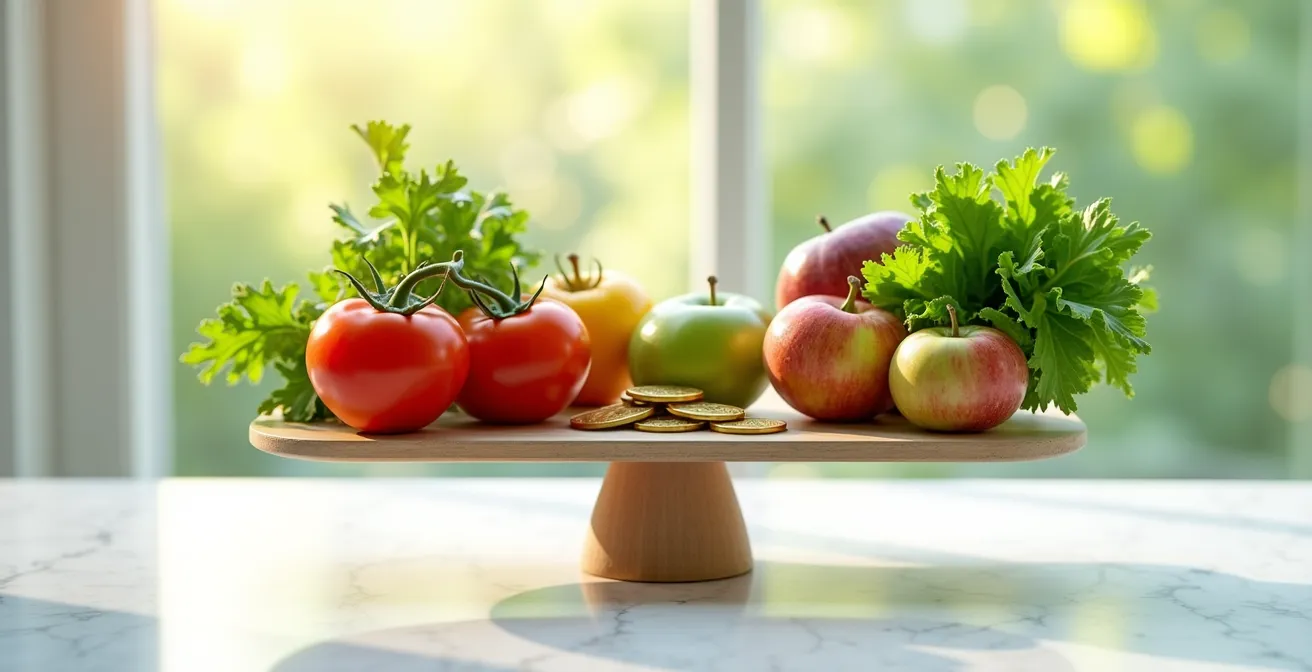
The “organic” label isn’t a simple health guarantee but a strategic risk-management tool for your grocery budget.
- Evidence shows organic produce has significantly lower pesticide loads and often higher concentrations of protective antioxidants.
- The true nutritional value is heavily influenced by seasonality and supply chain distance, sometimes making local conventional a better choice than long-distance organic.
Recommendation: Focus organic spending on the “Dirty Dozen” and foods you consume frequently. For everything else, prioritize local and seasonal produce to maximize nutrient density and support economic resilience.
The modern supermarket presents a constant economic and nutritional dilemma. In the produce aisle, it materializes as a choice: an organic apple for $3.99 per pound versus its conventional counterpart at $2.49. This 30% premium forces a question for any health-conscious consumer on a budget: is the added cost justified by a tangible health benefit? The public discourse is often polarized, with some heralding organic as the only path to health and others dismissing it as an expensive marketing ploy with no scientific backing.
Most advice defaults to simple heuristics, like avoiding the “Dirty Dozen” or simply “eating more vegetables” regardless of origin. While not incorrect, this guidance fails to address the underlying mechanisms. As a nutritional epidemiologist, my role is to look beyond the marketing and evaluate the evidence. The critical question isn’t whether organic is universally “better,” but rather how we can build a personal food strategy that intelligently manages risk within real-world financial constraints.
This article moves beyond the binary debate. We will adopt a risk-management framework to dissect the issue. The goal is to understand not just the presence of pesticides, but the concept of systemic stressors on both plants and our bodies. It’s about minimizing exposure to the “cocktail effect” of multiple chemicals and maximizing the nutrient density on your plate by understanding the realities of modern food supply chains. By analyzing the data, we can make informed, strategic decisions that benefit both our health and our local economies, without necessarily requiring a 100% organic shopping cart.
This evidence-based guide will break down the key factors to consider, providing a clear framework for navigating the grocery store. Follow along to learn how to allocate your food budget for the greatest impact.
Summary: An Epidemiologist’s Take on the Organic Food Debate
- Why Do Conventional Apples Have 20% Fewer Antioxidants?
- How to Prioritize the “Dirty Dozen” When You Can’t Afford 100% Organic?
- Seasonal Eating in Winter: How to Avoid Nutrient Deficiencies?
- The Cocktail Effect: What Happens When You Mix Low Doses of Pesticides?
- When to Buy What: A Monthly Calendar for Peak Nutrient Density
- Supermarket “Local” vs Farm Stand: Who Really Gets Your Money?
- Why Is Too Much Hygiene Bad for Your Microbiome?
- How Does Buying Direct From Farmers Increase Local Economic Resilience?
Why Do Conventional Apples Have 20% Fewer Antioxidants?
The difference in antioxidant levels between organic and conventional produce is not an accident; it’s a direct consequence of their growing environments. In conventional agriculture, plants are systematically protected from pests and diseases by synthetic pesticides and herbicides. This protection, while ensuring a blemish-free appearance and high yield, removes the natural “systemic stressors” that trigger a plant’s own defense mechanisms. When a plant must defend itself against fungi or insects, it produces a host of protective compounds, known as phytochemicals. Many of these compounds, such as polyphenols and flavonoids, are the very antioxidants we seek for our own health benefits.
An organic plant, by contrast, is in a constant battle with its environment. Without chemical shields, it must produce more of its own chemical defenses to survive. This increased metabolic effort results in a higher concentration of these beneficial compounds in the final fruit or vegetable. This isn’t just a theory; it is supported by large-scale data analysis.
Organic crops, on average, have higher concentrations of antioxidants, lower concentrations of Cd and a lower incidence of pesticide residues than the non-organic comparators
– British Journal of Nutrition, 2014 meta-analysis of organic food studies
Therefore, when you choose organic, you are not just avoiding pesticide residues; you are often choosing a food that has had to “work harder” to exist, and its nutritional profile reflects that struggle. The price premium, in this context, partly pays for the increased phytochemical density that results from a more challenging life cycle for the plant.
How to Prioritize the “Dirty Dozen” When You Can’t Afford 100% Organic?
For budget-conscious consumers, a 100% organic diet is often unrealistic. This is where strategic prioritization becomes the most powerful tool. The Environmental Working Group’s “Dirty Dozen” and “Clean Fifteen” lists provide an excellent starting point. These lists rank produce based on the quantity and variety of pesticide residues found after washing. Foods on the Dirty Dozen list, like strawberries, spinach, and apples, have thin, edible skins and are more likely to absorb and retain pesticides. Conversely, items on the Clean Fifteen, like avocados and onions, have thick, inedible peels that offer a natural barrier.
Focusing your organic budget on the Dirty Dozen is a data-driven approach to significantly reduce your pesticide exposure. The difference is not trivial. Studies consistently show that switching to organic versions of high-exposure foods has a measurable impact on the levels of pesticides detected in the body. While the long-term health effects of low-dose pesticide exposure are still being debated, minimizing intake is a prudent public health principle. This targeted approach allows you to allocate your resources where they matter most, effectively lowering your body’s chemical load without breaking the bank.
Action Plan: Auditing Your Organic Shopping List
- Identify Your High-Frequency Foods: List the top 5 fruits and vegetables you and your family consume weekly, regardless of their “Dirty Dozen” status.
- Cross-Reference with EWG Lists: Compare your high-frequency list to the current Dirty Dozen and Clean Fifteen. Circle any of your staples that appear on the Dirty Dozen.
- Assess Your Exposure Score: Give yourself 2 points for every Dirty Dozen item on your weekly list and 1 point for all others. This is your personal exposure score.
- Target for Replacement: Your priority is to switch the circled Dirty Dozen items to organic first. This will have the biggest impact on reducing your exposure score.
- Review and Adjust Seasonally: Re-evaluate your list every few months. As your diet changes with the seasons, your organic priorities may shift as well.
This simple audit transforms a vague goal (“eat healthier”) into a concrete, personalized action plan. It’s the essence of the risk-management approach: identifying the greatest points of exposure and mitigating them first.
Seasonal Eating in Winter: How to Avoid Nutrient Deficiencies?
The term “fresh” can be misleading. A conventional tomato shipped thousands of miles to a northern supermarket in January may be “fresh” in that it is not canned, but its nutritional value is highly compromised. This is due to the nutrient degradation curve: from the moment produce is harvested, its vitamin and mineral content begins to decline. This loss is accelerated by time, light, and temperature changes during long-distance transport and storage.

During winter months in colder climates, prioritizing seasonal and well-preserved foods is a smarter nutritional strategy than chasing out-of-season “fresh” organic produce from across the globe. Winter squashes, root vegetables (carrots, potatoes), and dark leafy greens like kale are naturally suited for winter harvesting and storage, retaining their nutrients well. Furthermore, preservation methods can be an excellent way to lock in peak nutrition.
Case Study: The Nutritional Power of Flash-Frozen Produce
Research demonstrates a compelling nutritional advantage for certain frozen foods. For example, organic berries or peas that are picked at their peak ripeness and “flash-frozen” within hours can retain more vitamins, such as Vitamin C, than their “fresh” counterparts that have spent several days in transit. This is because the rapid freezing process halts the nutrient degradation curve almost instantly. For a consumer in a winter climate, choosing flash-frozen organic vegetables can be a more nutrient-dense and often more affordable choice than buying fresh organic produce that has traveled a long distance, a concept supported by institutions like the Cleveland Clinic which highlights the benefits of organic food choices.
Embracing winter seasonality means shifting focus. It involves relying on hardy storage crops, utilizing high-quality frozen organic produce, and exploring fermented foods like sauerkraut, which not only preserve nutrients but also add beneficial probiotics.
The Cocktail Effect: What Happens When You Mix Low Doses of Pesticides?
One of the most significant concerns in nutritional epidemiology is the “cocktail effect.” Regulatory limits for pesticides are typically set for a single chemical in isolation. However, in reality, conventional produce often carries residues of multiple different pesticides. Our bodies are not exposed to one chemical at a time, but to a low-dose, complex mixture. The scientific question is whether these chemicals, even at levels considered “safe” individually, can interact synergistically to cause harm.
This is a challenging area to study in humans, but toxicology and population data raise red flags. Some research suggests that the combined effect of these chemicals can be greater than the sum of their individual parts, potentially disrupting endocrine function and other biological processes. While direct causation is hard to prove, strong correlations exist. For example, some studies have found that men with higher organochlorine pesticide levels had 3x higher odds of testicular cancer. This doesn’t prove pesticides caused the cancer, but it establishes a statistically significant link that warrants a precautionary approach.
Choosing organic is a direct way to opt out of this uncontrolled experiment. By minimizing exposure, you reduce the overall chemical load on your body’s detoxification systems. This is validated by studies measuring pesticide levels in people’s bodies. As one scientific review noted, there is a clear and measurable difference.
Pesticide residues are important food contaminants. Several studies consistently report a markedly lower concentration of pesticide residue metabolites in urine among children or adults consuming organic diets
– Mie A, Andersen HR, Gunnarsson S, et al., Environmental Health journal, 2017
Ultimately, opting for organic when possible is a strategy to lower your lifetime bioaccumulation threshold for these chemical cocktails. It’s a proactive measure to reduce a chronic, low-level environmental stressor.
When to Buy What: A Monthly Calendar for Peak Nutrient Density
Maximizing the value of your food budget is about timing. Buying produce when it is in its peak season accomplishes three things simultaneously: it is at its highest nutrient density, its flavor is optimal, and its price is typically at its lowest due to abundance. A seasonal shopping strategy is the intersection of good nutrition, good taste, and smart economics. An out-of-season organic peach in December has traveled far and was picked long before it was ripe, compromising both its nutrient profile and its price.
A smart shopper learns the rhythm of the seasons. Spring is for tender greens and berries. Summer brings a bounty of stone fruits and tomatoes. Fall is the time for apples and hardy squashes. Winter centers on citrus and root vegetables. Aligning your purchases with this natural calendar ensures you get the most nutritional “bang for your buck.”
The following table provides a simplified framework for making strategic choices throughout the year. It helps identify when to double down on organic buys (when Dirty Dozen items are in season) and when conventional might be a perfectly reasonable choice (when Clean Fifteen items are plentiful). This approach, outlined in resources from health-focused platforms, offers a practical way to plan your shopping.
| Season | Best Organic Buys | Smart Conventional | Peak for Preservation |
|---|---|---|---|
| Winter | Citrus, kale, Brussels sprouts | Avocados, onions | Root vegetables for storage |
| Spring | Strawberries, spinach, lettuce | Asparagus, peas | Berries for freezing |
| Summer | Peaches, tomatoes, bell peppers | Corn, melons | Stone fruits for canning |
| Fall | Apples, grapes, celery | Sweet potatoes, cabbage | Apples for storage |
This calendar, inspired by guides found on sites like GoodRx Health that analyze the value of organic food, is not a rigid set of rules but a flexible guide. By learning your local seasons, you can adapt this framework to make the most informed and cost-effective decisions at the grocery store or farmer’s market.
Supermarket “Local” vs Farm Stand: Who Really Gets Your Money?
The term “local” has become a powerful marketing buzzword in supermarkets, but its economic reality can be vastly different from what consumers imagine. When you buy produce—even if labeled “local”—from a large retail chain, the farmer who grew it receives only a small fraction of the final price. The majority of your money goes to covering the costs of transportation, distribution, marketing, and the retailer’s overhead and profit margin. This complex and lengthy supply chain diminishes the economic benefit to the actual producer.
The contrast with buying directly from a farm stand or through a Community Supported Agriculture (CSA) program is stark. In these direct-to-consumer models, the supply chain is radically shortened. The farmer retains a significantly larger portion of the food dollar, allowing them to run a more profitable and sustainable operation. This is not a small difference; it’s a fundamental shift in the food economy.
Hard data from government analysis confirms this disparity. An economic analysis from the USDA shows that farmers receive as little as 18 cents for every food dollar spent at a supermarket, compared to over 90 cents when selling directly to consumers. This financial empowerment is a critical component of local economic resilience. By choosing to buy direct, you are not just purchasing food; you are casting a direct financial vote for the viability of small-scale agriculture in your community. Your purchase becomes an investment in a more robust and decentralized food system.
Why Is Too Much Hygiene Bad for Your Microbiome?
Our modern, sanitized world has led to a dramatic decrease in our exposure to a wide variety of environmental microbes. The “hygiene hypothesis” suggests that this lack of early and consistent exposure to diverse microorganisms may be contributing to the rise in allergies, asthma, and autoimmune diseases. Our immune systems, it seems, need to be “trained” by a rich array of harmless bacteria, fungi, and other microbes to learn how to respond appropriately to threats without overreacting to benign substances.
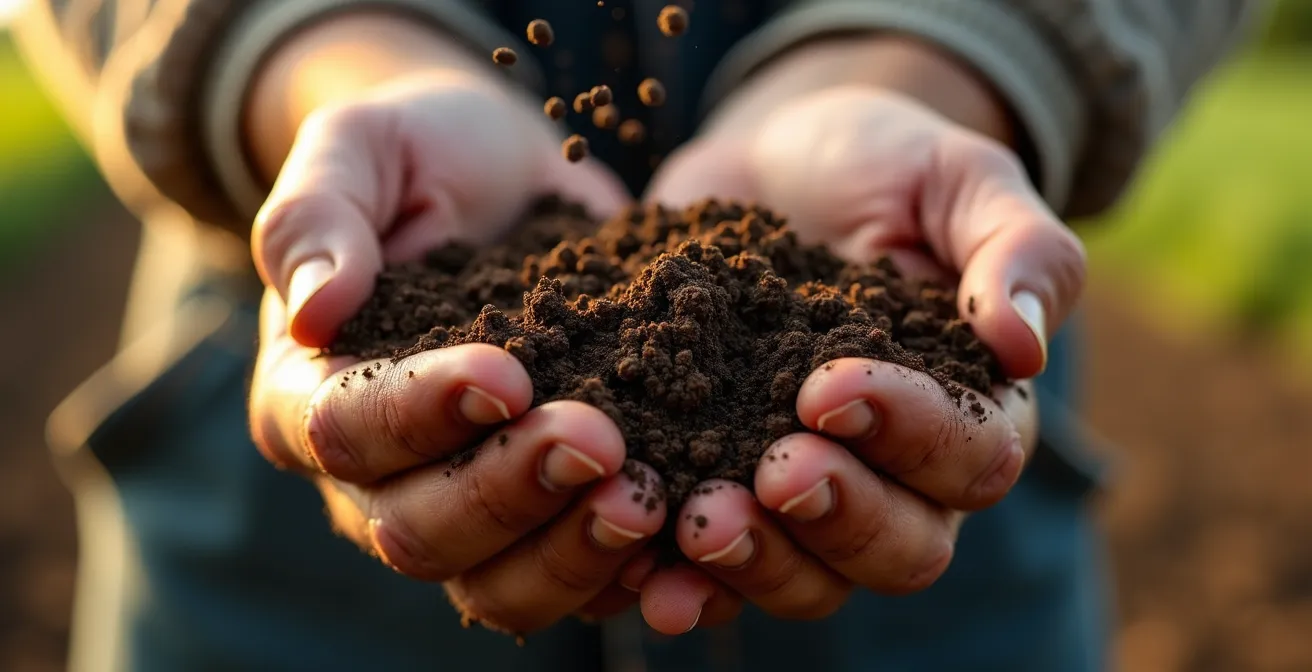
This is where organic farming offers a hidden but profound benefit. Healthy, living soil is one of the most microbially dense environments on the planet. Unlike chemically-treated soil, organic soil teems with a vast ecosystem of microorganisms. When we eat produce grown in this soil, especially if it’s minimally processed and sourced locally, we receive a “microbial dowry.” These soil-based organisms (SBOs) can help enrich the diversity of our own gut microbiome, the vast community of bacteria that plays a crucial role in digestion, immunity, and even mental health.
While we should always wash produce to remove harmful pathogens, the incidental exposure to the beneficial microbial life from healthy soil is a valuable input for our immune system. As some experts in microbiome health propose, this connection is fundamental.
Exposure to a diverse range of harmless soil-based organisms from organic farms helps train our immune system
– Dr. Yvonne Burkart, Discussion on organic food and microbiome health
Therefore, choosing organic isn’t just about avoiding what’s harmful (pesticides); it’s also about embracing what’s beneficial: a rich diversity of microbes that conventional, sterilized agriculture often eliminates.
Key Takeaways
- Strategic Spending: Focus your organic budget on the “Dirty Dozen” to achieve the greatest reduction in pesticide exposure for the lowest cost.
- Seasonality Over Labels: A flash-frozen organic vegetable or a seasonal local conventional one is often nutritionally superior to a “fresh” organic item that has traveled thousands of miles.
- Economic Impact: Buying directly from farmers ensures a much larger portion of your money supports the producer and builds a more resilient local food system.
How Does Buying Direct From Farmers Increase Local Economic Resilience?
The conversation around organic food often centers on personal health, but its impact extends to the health of our communities. A food system dominated by long, complex supply chains is inherently fragile. Disruptions, whether from fuel price spikes, climate events, or pandemics, can lead to empty shelves and price volatility. Building local economic resilience means strengthening shorter, more direct food supply chains that are less vulnerable to these global shocks.
When you buy directly from a local organic farmer, you are doing more than a simple transaction. You are investing in local land stewardship, preserving agricultural knowledge, and fostering biodiversity. Small-scale organic farms often cultivate heirloom varieties and less common crops that are not suited for the rigors of long-distance shipping. These diverse crops are a form of genetic insurance against widespread plant diseases and a changing climate. This is a critical benefit that industrial-scale monoculture cannot provide.
The organic market is a significant economic force, and directing that spending locally has a multiplier effect. With the Organic Trade Association reporting $63 billion in organic sales in 2021 in the U.S. alone, shifting even a fraction of that spending to direct-to-consumer channels can transform the economic landscape for small farmers. This fosters a decentralized network of food producers, creating a safety net that makes the entire community more secure and self-sufficient.
The decision to buy organic is not an all-or-nothing choice but a series of strategic calculations. By applying this risk-management framework, you can protect your health and invest in a more resilient food system, all while respecting the constraints of your personal budget. Start today by evaluating just one category of your next grocery bill—be it apples, greens, or berries—using this evidence-based approach to make the smartest choice for you.