
You think sleep is just for rest. The truth is, it’s an active, high-stakes sanitation cycle for your brain.
- Deep sleep triggers a ‘glymphatic flush’ that removes toxic proteins linked to cognitive decline and brain fog.
- Simple, evidence-based habits around light, temperature, and caffeine are non-negotiable triggers for this process.
Recommendation: Stop ‘getting by’ on less sleep and start architecting it for peak cognitive performance and long-term brain health.
For high-achieving professionals, the creeping sensation of brain fog is more than an annoyance; it’s a direct threat to performance. The usual response—another cup of coffee, a resolve to “focus harder”—misses the root cause entirely. We’ve been taught to view sleep as a passive state of recovery, a luxury to be shortened when deadlines loom. This perspective is not just outdated; it’s dangerous. The sluggishness, the inability to concentrate, and the memory lapses you experience are not just signs of tiredness. They are symptoms of a critical system failure: your brain’s nightly waste disposal process has been compromised.
The conversation around sleep is often limited to generic advice like “get eight hours” or “avoid screens.” While not wrong, this advice fails to address the sophisticated biological machinery at play. The real breakthrough in sleep neuroscience isn’t about the quantity of sleep, but its quality and structure. The key lies in understanding and optimizing a recently discovered network called the glymphatic system. This is your brain’s dedicated sanitation crew, a plumbing system that activates almost exclusively during deep sleep to flush out metabolic debris and neurotoxic waste that accumulates during waking hours.
This article reframes sleep from a passive requirement to an active, non-negotiable performance protocol. We will move beyond the platitudes and into the mechanisms. We are not just discussing *why* sleep is important, but *how* to specifically engineer your daily routines and environment to maximize the efficiency of your glymphatic system. Consider this your operator’s manual for the most critical maintenance cycle your brain performs. By understanding the triggers that control this system—from morning light to room temperature—you can transition from merely surviving on fragmented rest to strategically using sleep to enhance cognitive function, eliminate brain fog, and safeguard your long-term brain health.
This guide will provide a clear, evidence-based roadmap. We will deconstruct the essential components that govern your brain’s nightly cleaning cycle, offering actionable protocols to transform your sleep architecture and, by extension, your waking performance.
Summary: The 7-Hour Brain Wash: Engineering Your Nightly Toxin Cleanse
- Why Is Alzheimer’s Linked to Poor Sleep History?
- How to Use Morning Light to Fix Your Insomnia?
- 65°F or 72°F: Which Temperature Deepens REM Sleep?
- The Coffee Mistake: Why Noon Is Too Late for Espresso?
- When to Turn Off Screens: The 90-Minute Rule?
- How to Recover From Heavy Lifting After 40?
- Smart Thermostat or Habits: Which Saves More on Heating Bills?
- How to Rewire Your Brain for Focus in a Distracted World?
Why Is Alzheimer’s Linked to Poor Sleep History?
The connection between a lifetime of poor sleep and neurodegenerative diseases like Alzheimer’s is no longer speculative; it’s a matter of biological plumbing. During your waking hours, your brain’s high metabolic activity produces waste products, most notably the proteins beta-amyloid and tau. In a healthy brain, these are efficiently cleared out each night. However, when sleep is insufficient or of poor quality, these toxins remain, accumulating year after year. This buildup is a hallmark of Alzheimer’s pathology, leading to the formation of plaques and tangles that impair neuronal function and cause catastrophic cognitive decline.
This cleaning process is the primary job of the glymphatic system. Groundbreaking research from the University of Rochester Medical Center shows that this system becomes dramatically more active during deep non-REM sleep. During this phase, brain cells actually shrink, widening the interstitial space and allowing cerebrospinal fluid (CSF) to flow through and wash away toxins. When deep sleep is compromised, this entire sanitation process grinds to a halt. The link is terrifyingly direct: a chronic history of poor sleep means a chronic failure to clear neurotoxins, creating the exact biological environment in which Alzheimer’s disease can develop.

This image provides a conceptual look at how these toxic proteins can build up in brain tissue, disrupting the delicate neural architecture. Each night of fragmented sleep is a missed opportunity to perform this critical cleaning, a decision that carries profound long-term consequences. The question is no longer whether poor sleep is a risk factor, but rather how urgently we must act to optimize this nightly clearance to protect our cognitive future.
Understanding this connection transforms sleep from a simple matter of feeling rested into an urgent act of preventative brain maintenance. The stakes are not just about next-day performance but about lifelong cognitive health.
How to Use Morning Light to Fix Your Insomnia?
To fix your night, you must first fix your morning. The most powerful lever you have to control your sleep-wake cycle is not a pill, but the sun. Your brain’s master clock, the suprachiasmatic nucleus (SCN), is exquisitely sensitive to light. Exposing your eyes to bright light shortly after waking acts as a biological “ON” switch, sending a powerful signal that the day has begun. This action, known as circadian anchoring, sets a precise 24-hour timer. It suppresses any lingering melatonin, enhances daytime alertness, and, most critically, times the release of melatonin perfectly for about 14-16 hours later, ensuring you feel sleepy at the appropriate time.
Professionals who struggle with falling asleep often have a delayed or weak circadian rhythm. They may work in dimly lit indoor environments, robbing their brain of the strong morning signal it needs. An overcast day provides thousands of lux (a measure of light intensity), while a typical office provides a mere 300-500 lux. Without a strong morning light cue, your brain’s clock drifts, delaying the onset of sleep and creating a vicious cycle of insomnia and daytime fatigue. Using morning light is the most effective, non-pharmacological way to reset this clock and restore a robust sleep-wake cycle, directly improving the quality and timing of the deep sleep needed for glymphatic clearance.
Your Evidence-Based Morning Light Protocol
- Timing is Everything: Get 10-30 minutes of bright light exposure within 30-60 minutes of waking up. Consistency is key.
- Go Outside: Outdoor light is far superior to indoor light. Even on an overcast day, the light intensity is sufficient to set your circadian clock.
- No Sunglasses (Initially): To maximize the effect, look toward the sky (never directly at the sun) without sunglasses for the first few minutes to allow the crucial blue-green wavelengths to reach your retinal ganglion cells.
- Combine with an “OFF” Switch: A powerful morning “ON” switch is only effective when paired with an evening “OFF” switch. Dim the lights and avoid screens in the evening to allow melatonin to rise unimpeded.
- Maintain a 24-Hour Cycle: View light as a tool. Use it strategically in the morning to anchor your day and avoid it at night to protect your sleep.
This isn’t just about waking up; it’s about providing your biology with the fundamental signal it evolved to expect, thereby architecting a foundation for a night of deep, restorative sleep.
65°F or 72°F: Which Temperature Deepens REM Sleep?
While morning light sets the clock, temperature provides the trigger for deep, restorative sleep. Your body’s core temperature naturally needs to drop by about 2-3°F to initiate and maintain sleep. This temperature drop is a critical signal for your brain to transition into the deeper stages of non-REM sleep, where the majority of glymphatic system activity occurs. A sleeping environment that is too warm can actively fight against this natural process, leading to more frequent awakenings and a fragmented sleep architecture that severely limits brain cleaning.
The optimal room temperature for sleep is not a universal constant but generally falls within a cool range of 65-68°F (18-20°C). The goal is to create an environment that facilitates your body’s own thermoregulation efforts. A cooler room helps you shed body heat more effectively, accelerating the drop in core temperature. This process is also linked to neurotransmitter activity; during deep sleep, there is a decrease in norepinephrine, which helps relax blood vessels and facilitates the flow of CSF through the brain. An overly warm environment can interfere with this delicate hormonal balance, keeping you in lighter stages of sleep.
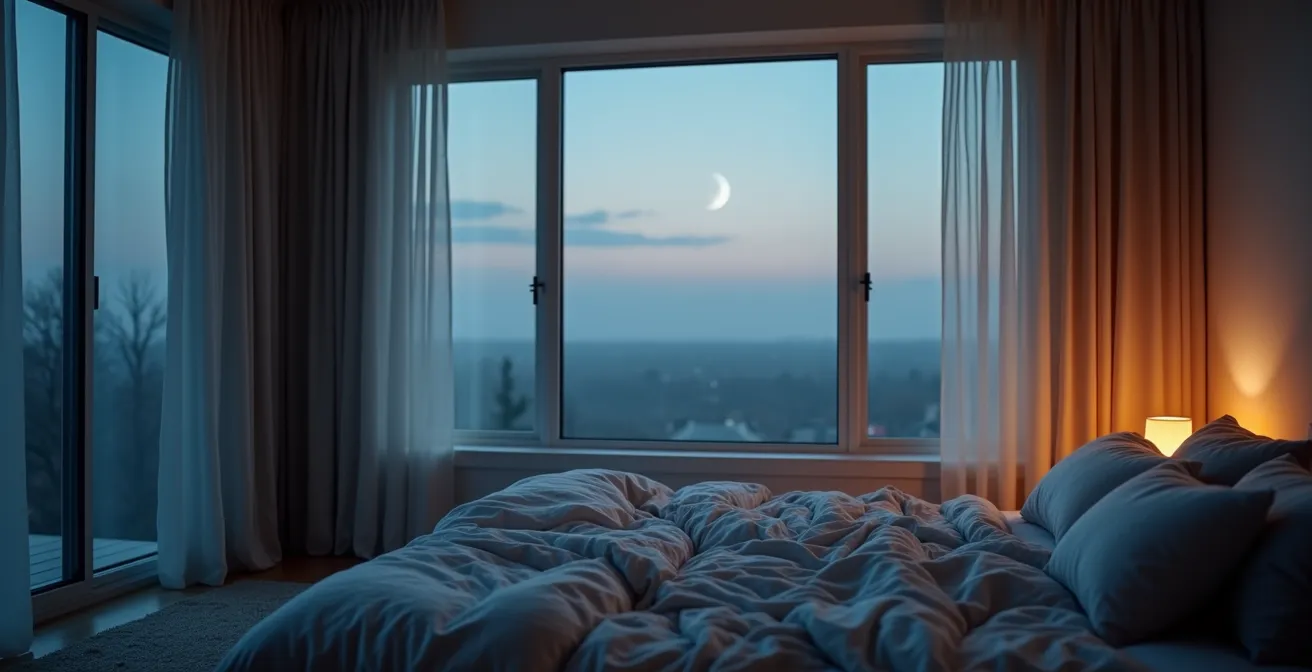
Think of your bedroom as a thermal cave, engineered to support this vital biological process. It’s less about a specific number on the thermostat and more about creating a cool, consistent microclimate. This is particularly crucial as we age. The Cleveland Clinic highlights that a common sleep change associated with aging is a decrease in slow-wave sleep, the very phase needed for glymphatic clearance. Therefore, optimizing external factors like temperature becomes even more critical for older adults to achieve the necessary sleep depth.
Experimenting within this cool range can be one of the most impactful changes you make to improve the restorative quality of your sleep and, consequently, your brain’s nightly sanitation.
The Coffee Mistake: Why Noon Is Too Late for Espresso?
For many professionals, caffeine is the fuel that powers the workday. However, its impact on sleep architecture is profoundly underestimated. The crucial mistake isn’t drinking coffee, but drinking it too late. Caffeine works by blocking adenosine receptors in your brain. Adenosine is a neurotransmitter that builds up throughout the day, creating “sleep pressure.” By blocking it, caffeine makes you feel alert, but the adenosine continues to accumulate in the background. The problem lies in caffeine’s long half-life, the time it takes for your body to eliminate 50% of the substance.
Caffeine has an average half-life of 5 to 6 hours. This means if you have an espresso at 2 PM, half of that caffeine is still active in your system at 7 PM. By midnight, a quarter of it is still circulating, actively disrupting your ability to enter and sustain the deep stages of non-REM sleep. You might fall asleep, but the quality of that sleep is severely compromised. The electrical brainwave patterns characteristic of deep sleep are suppressed, which in turn cripples the efficiency of the glymphatic system. You are effectively robbing your brain of its ability to perform its nightly cleanse.
As Dr. Gavin Britz of the Houston Methodist Neurological Institute explains, this system is fundamental to brain health:
During sleep, the glymphatic system helps the central nervous system clear out its metabolic waste using a network of channels and cerebrospinal fluid.
– Dr. Gavin Britz, Houston Methodist Neurological Institute
To protect this vital function, a strict caffeine curfew is non-negotiable. Based on its half-life, a noon or 1 PM cutoff is a safe guideline for most people. This allows your body nearly 10-12 hours to metabolize the majority of the caffeine before you go to bed, ensuring that adenosine can do its job and guide you into the deep, restorative sleep your brain desperately needs.
The choice isn’t to abandon caffeine, but to schedule it intelligently, treating it as a morning performance tool, not an all-day crutch.
When to Turn Off Screens: The 90-Minute Rule?
The most pervasive saboteur of modern sleep is the glowing screen. The intense blue light emitted by phones, tablets, and computers sends a powerful “daytime” signal directly to your brain’s master clock, even in a dark room. This light exposure, particularly in the hours before bed, aggressively suppresses the production of melatonin, the hormone that signals your body it’s time to sleep. Without a robust melatonin rise, your transition into sleep is delayed and the overall architecture of your sleep becomes fragmented and shallow.
The impact on your brain’s cleaning crew is devastating. The glymphatic system functions almost exclusively during deep sleep. If you are struggling to fall asleep or are only achieving light, broken sleep, you are effectively keeping the sanitation system offline. The scale of this disruption is shocking; neuroscience research reveals a 90% reduction in glymphatic clearance during wakefulness compared to sleep. Every minute you spend scrolling through emails or social media before bed is a minute stolen from this critical detoxification process, allowing metabolic waste to accumulate.
This is why the 90-Minute Rule is so critical. Establishing a screen-free buffer of at least 90 minutes before your intended bedtime is a non-negotiable protocol for protecting your melatonin production and sleep quality. This period allows your brain to transition from the high-frequency stimulation of the day to a state of calm readiness for sleep. It’s not just about avoiding blue light; it’s about “content tapering”—gradually reducing your cognitive load from complex work tasks to relaxing activities like light reading (on paper), listening to music, or gentle stretching. This combination of darkness and mental decompression is the signal your brain needs to initiate a night of deep, restorative, and cleansing sleep.
By defending this 90-minute window, you are directly enabling your brain to perform its most essential nightly maintenance.
How to Recover From Heavy Lifting After 40?
While the title specifies “heavy lifting,” the principle applies to any form of intense strain, whether it’s a demanding workout, a high-stakes presentation, or a day of deep cognitive work. All intense activity creates metabolic byproducts—not just in your muscles, but in your brain. For professionals over 40, the body’s natural recovery and clearance systems become less resilient. Therefore, optimizing the most powerful recovery tool you have—deep sleep—becomes paramount for both physical and mental restoration.
Intense physical or mental effort increases the brain’s metabolic rate, leading to a higher production of waste products like beta-amyloid. Failing to clear this waste is not a trivial matter. In fact, experimental research demonstrates that a single night of complete sleep deprivation in healthy adults is enough to cause a measurable increase in beta-amyloid in the brain. When you’re over 40, and your natural deep sleep may already be declining, the impact of even one night of poor sleep post-strain is magnified. You are not only failing to repair your body but are also actively contributing to the accumulation of neurotoxins.

This is where sleep architecture becomes your ultimate recovery strategy. The deep, slow-wave sleep stages are when your body releases growth hormone for tissue repair and when the glymphatic system kicks into high gear for brain cleaning. The efficiency of this process is remarkable, with some studies showing a doubling in the clearance of beta-amyloid during deep sleep compared to the awake state. For the professional over 40, this means sleep cannot be an afterthought; it must be a core component of your recovery protocol, as important as nutrition or stretching. Protecting your sleep, especially after days of high stress or intense physical activity, is the single most effective way to ensure you are clearing cellular debris and truly recovering, both in mind and body.
This strategic approach to rest is what separates short-term performance from long-term health and resilience.
Smart Thermostat or Habits: Which Saves More on Heating Bills?
While framed as a question of cost savings, the real debate between a smart thermostat and manual habits is one of consistency versus discipline in engineering your sleep environment. For the glymphatic system to function optimally, it requires consistent entry into deep sleep, night after night. As we’ve seen, temperature is a critical trigger for this process. The core question for a busy professional is: which method is more reliable for delivering the ideal temperature curve needed for deep sleep?
Manual habits—like turning down the thermostat before bed—are effective, but their success hinges entirely on human adherence. On a stressful day or when a routine is disrupted, it’s easy to forget. This leads to inconsistency, with the sleep environment being too warm on some nights, which can fragment sleep and impair glymphatic function. A smart thermostat, on the other hand, offers automation and precision. It can be programmed to begin lowering the temperature an hour before your scheduled bedtime, creating a consistent, gradual cool-down that perfectly supports your body’s natural drop in core temperature. It removes human error from the equation.
The choice is not merely about convenience; it’s about optimizing a biological process. The following table breaks down the core differences in the context of sleep optimization, moving beyond simple energy savings.
| Factor | Smart Thermostat | Manual Habits |
|---|---|---|
| Temperature Precision | ±0.5°F accuracy | ±2-3°F variation |
| Sleep Stage Optimization | Automatic temperature curve | Static temperature |
| Glymphatic Function Support | Optimized for deep sleep phases | May disrupt with fluctuations |
| Energy Efficiency | 15-23% savings average | 5-10% savings with discipline |
| Consistency | Automated daily | Depends on user adherence |
Ultimately, a smart thermostat is not just a device for saving on heating bills; it is a tool for automating and guaranteeing a key component of your sleep architecture, directly supporting your brain’s health.
Key Takeaways
- Deep sleep is not rest; it’s an active process where the glymphatic system flushes toxic proteins from your brain.
- Morning sunlight, cool bedroom temperatures, and evening darkness are the most powerful, non-negotiable triggers for high-quality sleep architecture.
- Caffeine and blue light from screens are potent sleep disruptors whose effects linger for hours, and they must be managed with strict, evidence-based cutoffs.
How to Rewire Your Brain for Focus in a Distracted World?
The quest to “rewire your brain for focus” in a world of constant distraction is often met with solutions like productivity apps or time management techniques. But these are merely surface-level fixes. True, sustained focus is not a skill you learn; it’s a biological state you enable. The foundation of that state is a brain that is free from the metabolic debris and neuroinflammatory agents that accumulate during a day of high cognitive load. In essence, you can’t rewire a “dirty” brain. The ultimate hack for focus is consistently achieving high-quality, cleansing sleep.
The entire process is a delicate chemical ballet conducted by neurotransmitters. One of the lead conductors is norepinephrine, the hormone of alertness and vigilance. During the day, it’s high, keeping you sharp. But for the glymphatic system to work, norepinephrine levels must plummet during deep sleep. This drop allows the brain’s blood vessels to relax in a coordinated rhythm, creating the pressure gradients that pump cerebrospinal fluid through the brain tissue to wash it clean. Any factor that keeps norepinephrine elevated at night—stress, late-night caffeine, or even certain sleep aids—directly sabotages this process.
Researcher Natalie Hauglund offers a powerful analogy for this intricate process, highlighting its orchestrated nature:
You can view norepinephrine as this conductor of an orchestra. There’s a harmony in the constriction and dilation of the arteries, which then drives the cerebrospinal fluid through the brain to remove the waste products.
– Natalie Hauglund, University of Copenhagen and University of Oxford
Rewiring your brain for focus, therefore, is not about fighting distraction during the day. It’s about religiously protecting the sanctity of your sleep at night. By implementing the protocols—anchoring your circadian rhythm with light, managing your temperature, and enforcing strict caffeine and screen curfews—you are ensuring this “orchestra” can perform its nightly symphony flawlessly. You are creating the biological conditions for a brain that starts each day clean, restored, and ready for deep, undistracted work.
Stop treating sleep as a passive activity. Start actively engineering your night for maximum cognitive recovery. Your focus tomorrow depends entirely on the choices you make tonight to enable your brain’s essential cleaning cycle.