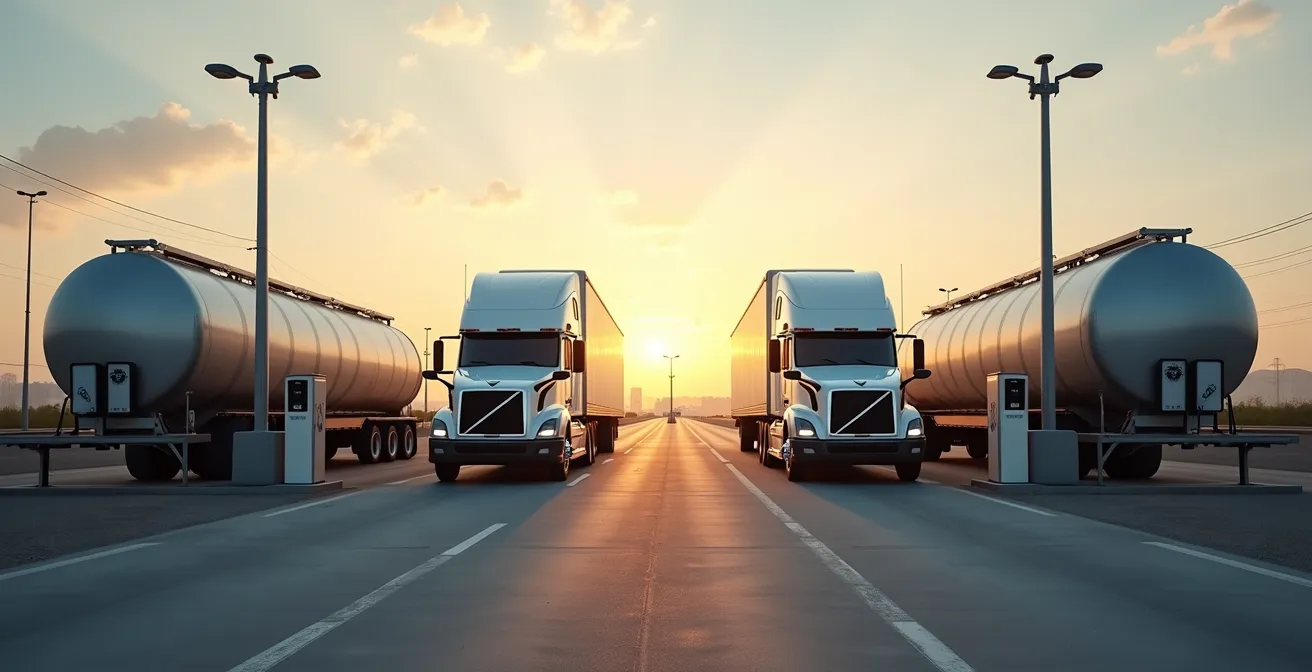
For long-haul trucking, the core decision is not battery vs. hydrogen, but electrons vs. molecules; the superior energy density of hydrogen molecules offers a structural advantage in payload and operational uptime that electrons cannot match.
- Battery-electric trucks sacrifice significant cargo weight for heavy batteries, directly impacting revenue per trip.
- Hydrogen FCEVs offer diesel-like refueling times (under 20 minutes) and greater range, eliminating costly downtime.
Recommendation: Fleet operators should model their Total Cost of Ownership (TCO) based on a molecular energy strategy, factoring in hydrogen’s role in systemic decarbonization to avoid investing in potentially stranded BEV assets for heavy-duty routes.
For logistics managers and fleet operators, the path to decarbonization is fraught with high-stakes investment decisions. The prevailing narrative often pits battery-electric vehicles (BEVs) against hydrogen fuel cell electric vehicles (FCEVs) in a simple head-to-head competition. Common wisdom points to the rapid charging improvements of BEVs and the current scarcity of hydrogen fueling stations as decisive factors. Many analysts focus on the well-to-wheel efficiency, where BEVs currently appear superior.
However, this perspective misses the fundamental physics and economics at play. The debate is not merely about storing electricity; it’s a strategic choice between two different forms of energy carriers: flowing electrons and dense molecules. For light-duty vehicles and short-haul routes, batteries are an elegant solution. But for the demanding world of long-haul trucking, where every kilogram of payload and every minute of operational time translates directly to the bottom line, the inherent limitations of electrons become a critical business constraint.
This analysis moves beyond the surface-level discussion. We will demonstrate that hydrogen’s advantage as a physical, energy-dense molecular carrier is a structural reality, not a temporary edge. This molecular form provides benefits in payload, refueling speed, and importantly, offers a pathway for systemic decarbonization across heavy industries like steel manufacturing. Viewing hydrogen through this strategic lens reveals why it is positioned to become the dominant long-term solution for heavy transport, protecting operators from investing in assets that may become operationally and economically obsolete.
To fully grasp the strategic implications for your fleet, this article breaks down the key operational, safety, and economic factors. The following sections will provide a clear, cost-focused framework for evaluating the long-term viability of hydrogen in heavy-duty logistics.
Summary: The Strategic Case for Hydrogen in Long-Haul Logistics
- Why Can a Hydrogen Truck Carry More Cargo Than an Electric One?
- How to Refuel a Hydrogen Truck Without Safety Risks?
- Blue or Green Hydrogen: Which Is Truly Zero Emission?
- The Route Mistake: Planning Hauls Where No Pumps Exist
- When Will Hydrogen Parity Occur Against Diesel?
- Why Do Blast Furnaces Need Molecules, Not Just Electrons?
- The Investment Mistake of Building Gas Plants for 2040
- How Can Green Hydrogen Decarbonize Steel Manufacturing?
Why Can a Hydrogen Truck Carry More Cargo Than an Electric One?
The central economic equation for any logistics operator is maximizing revenue-generating freight per vehicle. Here, the laws of physics give hydrogen a decisive, structural advantage over batteries. The issue is energy density: how much energy can be stored per unit of mass. Hydrogen as a compressed gas or liquid is vastly more energy-dense than today’s lithium-ion batteries. Consequently, a BEV truck must carry several tons of batteries to achieve a viable long-haul range, directly subtracting from its available payload capacity.
For a fleet operator, this isn’t an abstract scientific detail; it’s a direct impact on profitability. A truck that can legally carry 20 tons of cargo but must dedicate 5 tons to its own power source has effectively lost 25% of its revenue potential on every single trip. Hydrogen systems, comprising a fuel cell stack and lighter high-pressure tanks, weigh significantly less. This allows FCEVs to offer a payload capacity nearly identical to that of a conventional diesel truck, ensuring that decarbonization does not come at the cost of operational efficiency.
Case Study: Tevva’s Dual-Energy Approach
To bridge the technology gap, some manufacturers are adopting hybrid solutions. UK-based Tevva has launched a 7.5-tonne battery-electric truck with a standard range that can be extended to approximately 500 km by using a hydrogen fuel cell as a backup energy source. This “range extender” model demonstrates the value of hydrogen’s density, allowing drivers to complete a full day of work without the “range anxiety” or lengthy charging stops associated with pure BEVs, effectively marrying the benefits of both technologies.
While it is true that FCEVs are less efficient in a pure “well-to-wheel” energy conversion, this metric is misleading when viewed in isolation. A more operationally relevant metric for a logistics business is “revenue-ton-miles per day.” In this context, the FCEV’s ability to carry more cargo and refuel rapidly often yields a superior economic outcome, even if it consumes more primary energy.
How to Refuel a Hydrogen Truck Without Safety Risks?
For fleet managers, operational safety is non-negotiable. The prospect of handling a highly flammable gas like hydrogen naturally raises concerns. However, modern hydrogen refueling technology is engineered with multiple layers of redundancy and automated safety protocols that make the process as safe, if not safer, than refueling a diesel truck. The industry has decades of experience handling hydrogen in industrial settings, and these best practices have been codified into strict standards for vehicle fueling.
The refueling process is not a manual, high-risk operation. It is a highly automated, digitally controlled “handshake” between the vehicle and the dispenser. An infrared data link allows the station and the truck’s onboard systems to communicate continuously, monitoring temperature, pressure, and flow rate in real-time. Any anomaly outside of a predefined safety window will instantly and automatically halt the fueling process. This eliminates the risk of over-pressurization or leaks caused by human error.

Furthermore, drivers require no special protective equipment, and the nozzle design makes it physically impossible to disconnect while the system is pressurized. This combination of physical and digital safeguards ensures a high degree of safety. The entire process, from connection to full tank, takes around 15-20 minutes for a heavy-duty truck—a timeframe comparable to diesel and a stark contrast to the hours potentially required for BEV megawatt charging.
Action Plan: Verifying Hydrogen Refueling Safety Protocols
- Points of Contact: Identify all communication points in the refueling process, including the fill hose, the truck’s receptacle, and the automated system data link.
- Collecte: Inventory the existing safety features, such as automated pressure/temperature monitoring, emergency shut-off valves, and secure nozzle locks.
- Cohérence: Cross-reference the station’s protocols with established industry safety standards (e.g., SAE J2601) to ensure full compliance.
- Mémorabilité/émotion: Evaluate the driver training process to ensure it is clear, concise, and builds confidence in the automated safety systems.
- Plan d’intégration: Develop a clear action plan for drivers to follow in the unlikely event of a system fault, prioritizing safety and immediate communication.
Blue or Green Hydrogen: Which Is Truly Zero Emission?
A critical point of discussion for any ESG-focused (Environmental, Social, and Governance) investment is the origin of the hydrogen itself. Not all hydrogen is created equal. The distinction between “green” and “blue” hydrogen is fundamental to its claim as a zero-emission fuel. Blue hydrogen is produced from natural gas, with the associated carbon emissions captured and stored (CCS). While a significant improvement over unabated fossil fuels, it is not truly zero-emission, as carbon capture is never 100% effective and methane leakage can occur upstream.
Green hydrogen, by contrast, is the endgame. It is produced through electrolysis—splitting water into hydrogen and oxygen—using electricity generated exclusively from renewable sources like solar and wind. This process is genuinely zero-emission from production to consumption. An FCEV running on green hydrogen emits only water vapor, making it a true “tailpipe-free” solution. However, this purity comes with a trade-off: energy efficiency. As reported by Volvo Trucks in their hydrogen technology overview, the overall energy efficiency from power source to wheel is lower for an FCEV compared to a BEV.
Hydrogen can be produced when there is an excess of renewable energy (wind blowing, sun shining)
– Volvo Trucks Engineering Team, 7 Common Questions About Hydrogen Trucks
This quote highlights a key strategic value of green hydrogen. It acts as a form of energy storage, or a “molecular battery.” It allows us to capture and utilize surplus renewable energy that would otherwise be wasted (curtailed). This transforms hydrogen production from a simple fuel source into a vital grid-balancing tool, adding systemic value that goes beyond the vehicle itself. For a fleet operator, aligning with green hydrogen is not just an environmental choice but a strategic one, future-proofing the business against tightening emissions regulations and carbon pricing.
The Route Mistake: Planning Hauls Where No Pumps Exist
The most significant and valid criticism leveled against hydrogen trucking today is the lack of public refueling infrastructure. A state-of-the-art FCEV is useless if it cannot be refueled along its designated route. Attempting to deploy hydrogen trucks without a meticulously planned and guaranteed refueling network is a recipe for catastrophic operational failure. This is not a technology problem, but a classic chicken-and-egg dilemma: who invests first, the vehicle manufacturers or the infrastructure providers?
The current landscape is sparse. As of early 2024, there were only 53 publicly accessible hydrogen refueling stations in the US, with 52 of them located in California. This starkly illustrates that a nationwide, “go-anywhere” hydrogen trucking network is still years away. However, the strategy for initial deployment is not random coverage but the creation of strategic “hydrogen corridors” along major freight routes, where demand is concentrated and predictable.

Forward-thinking companies are not waiting; they are actively building these corridors. This approach mitigates the risk for early adopters by creating a closed-loop ecosystem where both trucks and fuel are available.
Case Study: Nikola’s Hydrogen Corridor Strategy
Nikola, through its HYLA brand, is a prime example of this strategy in action. The company received a $41.9 million grant to build six heavy-duty hydrogen refueling stations across Southern California. These stations are not just isolated pumps; they are designed as scalable hubs to support growing fleets. Nikola’s CEO aims to have nine public sites in California by mid-2024 and is collaborating with Voltera to establish 50 Hyla stations across North America’s key trucking routes in the next five years. This demonstrates a clear, funded strategy to solve the infrastructure problem on a corridor-by-corridor basis.
When Will Hydrogen Parity Occur Against Diesel?
The ultimate question for any cost-focused operator is one of economics: when will a hydrogen truck be cheaper to own and operate than a diesel one? Achieving Total Cost of Ownership (TCO) parity is the holy grail for all alternative fuel technologies. Currently, hydrogen trucks face two significant cost hurdles: high upfront capital expenditure (CapEx) and expensive fuel. The purchase price is a major barrier; based on UK ZERFD trial quotations from OEMs, hydrogen trucks can cost between £500,000-£700,000, roughly double that of their battery-electric counterparts.
However, purchase price is only one part of the TCO equation. Maintenance costs for FCEVs are projected to be significantly lower than for diesel engines, given the fewer moving parts. The most critical variable is the price of green hydrogen fuel. As production scales up and the cost of renewable electricity and electrolyzers falls, the price of hydrogen at the pump is expected to decrease dramatically over the coming decade.
The following table provides a high-level strategic overview of the projected TCO components and timelines. It’s important to note that these are projections and subject to market and policy developments.
| Cost Factor | Hydrogen FCEV | Battery Electric | Diesel |
|---|---|---|---|
| Purchase Price | 2x diesel cost | 1.5x diesel cost | Baseline |
| Fuel/Energy Cost | 2-4x diesel per mile | 0.5x diesel per mile | Baseline |
| Maintenance | Lower than diesel | Lowest | Highest |
| TCO Parity Timeline | 2050 projection | 2030 projection | Current baseline |
While some projections place BEV parity closer (around 2030), these models often don’t fully account for the hidden costs of megawatt charging infrastructure or the operational cost of downtime and reduced payload. For heavy-duty, long-haul applications, the TCO for hydrogen is expected to become competitive as fuel prices fall and carbon taxes on diesel rise. The strategic bet is on a future where the operational advantages of hydrogen—payload and uptime—translate into superior lifecycle economics.
Why Do Blast Furnaces Need Molecules, Not Just Electrons?
To fully appreciate the strategic importance of hydrogen, we must look beyond trucking and into heavy industry. The decarbonization of steel manufacturing provides the most compelling argument for why hydrogen as a molecular energy carrier is indispensable. A traditional blast furnace uses coke (a form of coal) not just as a source of heat, but as a chemical agent—a “reductant”—to remove oxygen from iron ore. This chemical reaction is the heart of steelmaking, and it fundamentally requires a physical molecule to bond with the oxygen.
Electrons, the currency of the electricity grid, cannot fulfill this chemical role. You cannot simply plug a blast furnace into a wall socket to make steel. This is the absolute limit of direct electrification. To decarbonize this process, a new, clean molecule is needed to replace the carbon molecule from coal. Hydrogen is the only viable, scalable, and zero-carbon candidate for this job. In a process known as Direct Reduced Iron (DRI), hydrogen gas is used as the reductant, and the only byproduct is water (H₂O), not carbon dioxide (CO₂).
Hydrogen is the only viable, scalable, zero-carbon molecule that can directly replace carbon from coal/coke in the chemical reaction of steelmaking.
– Industrial Decarbonization Expert, Green Steel Production Analysis
This industrial necessity creates a massive, stable demand for green hydrogen that will drive down production costs for everyone, including trucking fleets. The International Energy Agency’s net-zero scenario projects that hydrogen will need to supply 30% of heavy truck energy demand by 2050. This synergy between industrial and transport demand is what will create a robust, cost-effective hydrogen economy. A fleet operator investing in hydrogen is therefore not betting on a niche transport technology but aligning with a foundational shift in the entire industrial energy landscape.
The Investment Mistake of Building Gas Plants for 2040
One of the most significant risks in any long-term capital strategy is creating “stranded assets”—infrastructure that becomes obsolete or unprofitable before the end of its intended economic life. Building new natural gas power plants today, with an expected lifespan of 30-40 years, is a clear example of this risk in a world rapidly moving toward net-zero. A similar, though more subtle, risk exists in the choice of decarbonization pathway for heavy-duty transport.
A full-scale transition to battery-electric long-haul trucking would require an unprecedented investment in new grid infrastructure. The numbers are staggering. A partnership between Daimler Truck, Traton, and Volvo to build out a European network involves a €500 million investment for just 1,700 charging points. But the cost is only part of the story; the real constraint is grid capacity.
The Grid Capacity Challenge
Consider the power demand. A recent analysis highlighted that charging just 1,100 electric trucks simultaneously for 45 minutes using megawatt chargers would consume the entire output of a nuclear power plant. Replicating this at depots and truck stops across a country would necessitate a multi-trillion-dollar overhaul of the electrical grid. Committing fully to a BEV-only strategy for heavy freight risks sinking massive capital into charging infrastructure that may be underutilized or ultimately bypassed by more flexible technologies.
Hydrogen offers a more resilient pathway. It can be produced, stored, and transported physically, decoupling the fueling of vehicles from the instantaneous capacity of the grid. It can even be produced on-site at fueling hubs using dedicated renewables. This flexibility de-risks the infrastructure investment. By adopting a mixed or hydrogen-focused strategy for long-haul, fleet operators and governments can avoid creating the stranded assets of the 2040s: massive, underused charging depots tied to a grid that was never designed for such concentrated demand.
Key Takeaways
- Payload is King: Hydrogen’s superior energy density allows FCEVs to carry more revenue-generating cargo than heavy BEVs.
- Operational Uptime: Refueling an FCEV in under 20 minutes mirrors diesel operations, eliminating the costly downtime of BEV charging.
- Systemic Value: Hydrogen is not just a transport fuel but a critical molecule for decarbonizing heavy industry, ensuring long-term demand and cost reduction.
How Can Green Hydrogen Decarbonize Steel Manufacturing?
The ultimate vision for a hydrogen economy is one of integrated ecosystems, where production and consumption are co-located to create a virtuous cycle of efficiency and cost reduction. The decarbonization of steel manufacturing, as discussed, provides the anchor demand for this model. Green hydrogen produced on-site or nearby can be piped directly to a DRI plant to make green steel, while also being used to power the very trucks that transport the raw materials and finished products.
This creates a “hydrogen hub” where multiple sectors draw from a common, scaled-up infrastructure, driving down the unit cost of hydrogen for all users. We are already seeing the first examples of this integrated approach being built today, proving it is a commercially viable strategy, not a distant academic concept.
Case Study: Hyundai’s Integrated Hydrogen Ecosystem in Georgia
In Georgia, USA, Hyundai Motor Group is building a powerful demonstration of this concept at its Metaplant America. In partnership with Glovis America, the company is operating 21 of its XCIENT fuel cell trucks to support nearly half of the plant’s logistics. Crucially, these trucks are powered by hydrogen produced and dispensed from on-site infrastructure. This model closes the loop: green energy powers the plant, creates green hydrogen, which in turn fuels the zero-emission logistics that support the plant’s operations.
The real-world performance of these trucks is already proven. In Switzerland, a fleet of 48 Hyundai XCIENT trucks has been in commercial operation since 2020. As of late 2023, this fleet had collectively driven over 10 million kilometers, saving an estimated 6,300 tonnes of CO2 compared to diesel. This track record provides hard data on the reliability and environmental benefits of FCEV technology at scale. For a fleet operator, investing in hydrogen is an entry point into these emerging, resilient, and cost-efficient industrial ecosystems.
The decision between battery and hydrogen is not a simple choice, but a strategic fork in the road. For long-haul logistics, where payload, range, and uptime are the metrics that define profitability, the physical properties of hydrogen molecules offer a structural advantage. By evaluating the Total Cost of Ownership through the lens of operational reality and long-term industrial trends, fleet operators can make a future-proof investment that aligns with the broader shift towards a systemic, molecular-based energy economy. The next step is to move from analysis to action. Evaluate your own key routes and model the TCO for hydrogen against your current operations to identify the most promising corridors for an initial, strategic deployment.