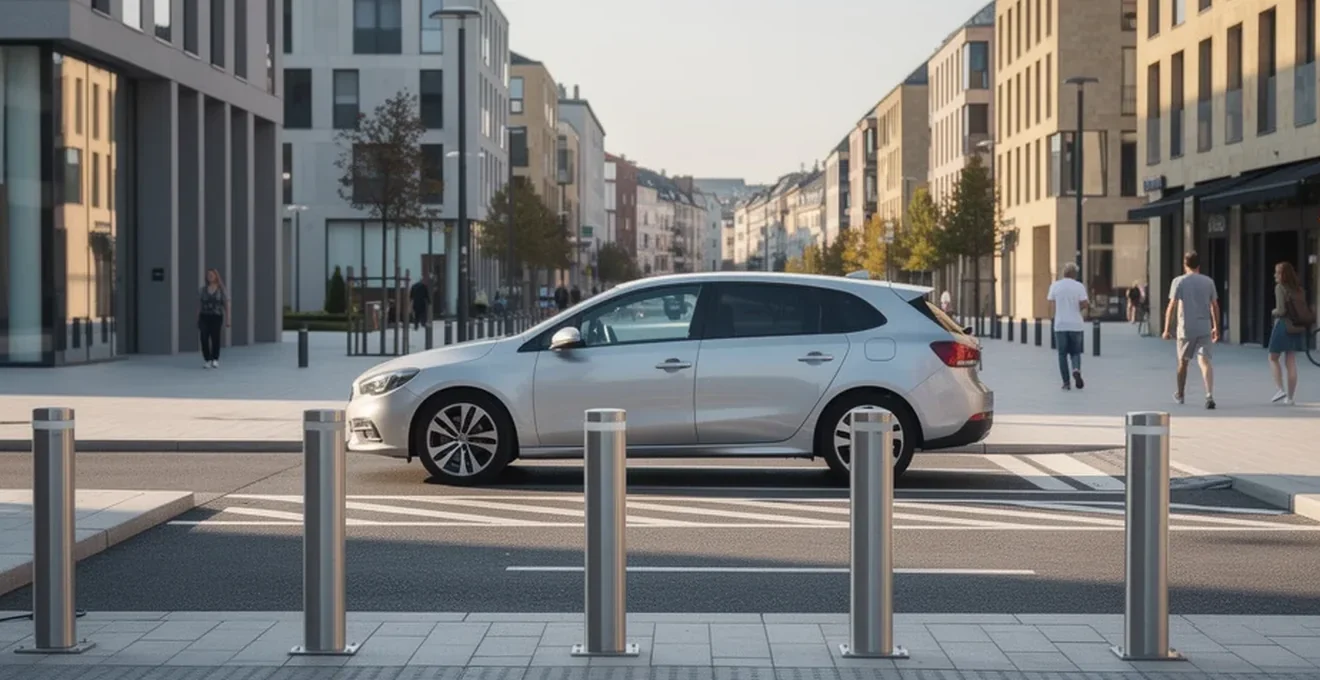
Public spaces are becoming more crowded, more contested and more complex to manage. Vehicles, pedestrians, cyclists and emergency services all compete for the same limited street space, and the consequences of getting this wrong can be severe. Roughly a third of road safety accidents happen in public and urban environments, where the interaction between people and vehicles is at its most intense. Managing this risk requires more than good intentions; it requires a coordinated combination of physical infrastructure, digital access control, hostile vehicle mitigation, thoughtful street design and clear regulatory compliance. This article sets out the practical building blocks of urban safety management, from bollards and rising kerbs through to emergency access provision, giving planners, contractors and site managers a clear view of how these elements fit together.
Bollards and rising kerbs: physical vehicle restriction systems
Bollards remain one of the most dependable tools for separating vehicles from pedestrians in urban environments. They are valued for their durability, their ability to blend into public realm design and their proven track record in preventing vehicle incursion onto footpaths, cycle routes and pedestrianised areas. Bollards designed specifically for bicycle path access, for example, help prevent illegal vehicle access onto walking and cycling routes, protecting pedestrians who might otherwise be at risk from vehicles straying onto shared infrastructure.
Hydraulic bollards for controlled access points
Where an access point needs to switch between open and closed states, hydraulic bollards offer a practical solution. They allow authorised vehicles, such as delivery vehicles, refuse collection or emergency services, to pass through a controlled point while keeping the area secured against unauthorised or hostile vehicle access at other times. This flexibility makes them well suited to pedestrianised town centres, event sites and locations where access needs vary throughout the day.
Fixed steel bollards versus retractable models
Fixed steel bollards provide constant, low-maintenance protection and are typically the more cost-effective option where access requirements do not change. Retractable or removable bollards, by contrast, suit locations that need occasional vehicle access, such as loading bays, market squares or streets that host periodic events. The choice between the two often comes down to how frequently the space needs to switch between pedestrian-only and vehicle-accessible use, and the level of risk present when the bollards are down or removed.
Automatic rising kerbs in pedestrianised zones
Automatic rising kerbs serve a similar purpose to bollards but are often used where a more discreet, street-level solution is preferred. They rise to block vehicle access and lower to permit it, and are commonly integrated with access control systems so that only authorised vehicles can trigger their retraction. In pedestrianised zones, this allows town centres to remain fully open to foot traffic for most of the day while still permitting controlled servicing access at set times.
PAS 68 and IWA 14-1 impact testing standards
Not every barrier or bollard is designed to stop a vehicle; many are intended simply to guide movement or create separation. Where a higher level of protection is required, crash-tested systems become important. These are engineered and tested against recognised impact standards to demonstrate they can withstand a vehicle impact at a defined speed and mass, providing a higher level of protection than standard containment products. Selecting a crash-rated system rather than a standard barrier is a key decision point in any hostile vehicle mitigation strategy, and should be based on a clear assessment of the risk level, pedestrian volumes and how the space is used.
ANPR and smart access control technologies
Digital safety and access technology increasingly works alongside physical infrastructure to manage who and what can enter a given space. Rather than relying solely on manned checkpoints or static barriers, many urban schemes now integrate camera-based recognition and permit systems that automate access decisions while maintaining a detailed record of vehicle movements.
Automatic number plate recognition camera networks
Automatic number plate recognition (ANPR) cameras allow local authorities and site operators to monitor and control vehicle access without physical checkpoints at every entry point. Networks of cameras can identify vehicles entering restricted zones, flag unauthorised access and provide data that supports enforcement and planning decisions. This kind of smart monitoring is a natural complement to physical barrier systems, adding a layer of digital oversight to traditional infrastructure.
Integration with ULEZ and low traffic neighbourhood schemes
ANPR technology underpins many of the traffic management schemes now common in UK towns and cities, including ultra-low emission zones and low traffic neighbourhoods. These schemes rely on accurate vehicle identification to enforce access restrictions and emissions standards, and their success depends on infrastructure that integrates cleanly with wider traffic management planning rather than functioning as an isolated system.
Rfid-based permit systems for resident access
In areas where local residents, businesses or essential services need guaranteed access despite wider vehicle restrictions, RFID-based permit systems offer a practical solution. These systems can be linked to automatic bollards or rising kerbs, allowing permitted vehicles to trigger access automatically while maintaining restrictions for all other traffic. This approach supports the kind of controlled, sufficient and well-positioned access routes that effective site and street management depends on.
Hostile vehicle mitigation in crowded public spaces
Not every project or public space requires full hostile vehicle mitigation (HVM) measures, but considering how barrier systems can contribute to a higher level of protection is an increasingly important part of planning for public-facing environments. HVM strategies exist to reduce the risk of a vehicle being used to cause harm in a pedestrian area, and they are particularly relevant in high-footfall locations such as events, city centres and transport hubs.
Counter-terrorism design principles from NPSA guidance
Effective HVM planning starts with a clear understanding of risk rather than a default assumption that every space needs maximum protection. Where pedestrian volumes are high or the environment is particularly public-facing, upgrading from standard temporary barriers to higher-performing, crash-tested systems can improve safety by increasing protection and creating more secure stand-off distances between vehicles and crowds.
Perimeter protection at stadiums and event venues
Event safety typically involves a combination of temporary barriers, traffic management measures and, in higher-risk or high-footfall situations, hostile vehicle mitigation systems. The level of protection required depends on the specific risk profile of the event and its environment. For large gatherings, crash-tested barrier systems alongside wider traffic management measures help create a controlled perimeter that reduces the likelihood of vehicle incursion into crowded areas.
Vehicle-as-a-weapon threat assessment methodology
Choosing the right barrier for a given location depends on several practical factors rather than a one-size-fits-all specification. Key considerations include:
- The level of risk present within the environment
- Pedestrian volumes and their proximity to live traffic
- Whether additional protection beyond standard containment is required
- How the chosen barriers will integrate with the wider traffic management solution
This structured approach ensures that barriers are not simply installed for the sake of compliance, but genuinely provide the right level of protection for the people using that space.
Case study: london bridge and borough market security upgrades
Proposed UK legislation, commonly referred to as Martyn’s Law or the Protect Duty, is expected to place greater responsibility on organisations to assess risks, plan for potential threats and put appropriate measures in place to protect the public in venues and public spaces. While the legislation does not prescribe specific products, it reinforces the importance of selecting solutions appropriate to the level of risk, including situations where more robust barrier systems or enhanced traffic management measures may be justified. For those responsible for events, infrastructure projects and temporary works, this means taking a more considered approach to how public spaces are managed and how the people within them are protected.
Pedestrianisation schemes and shared space design
Beyond physical barriers and digital access control, the underlying design of a street or public space plays a significant role in safety outcomes. Well-designed streets reduce the likelihood of conflict between pedestrians and vehicles before any barrier or camera system is even needed.
Woonerf principles and the shared space model
Walking is a basic human need, yet cities have often been designed around vehicle movement rather than pedestrian experience. Achieving genuine walkability means providing more than just space to walk; it requires attention to vehicular speed, noise, air quality and the overall comfort of the pedestrian experience. Cities that have successfully prioritised walking, including those that have adopted car-free or largely car-free approaches to their centres, have shown that redesigning streets in favour of pedestrians, with wider footpaths and narrower carriageways, can transform how a space is used and how safe it feels.
Tactile paving and dropped kerbs for accessibility compliance
Inclusive design must be considered from the outset rather than retrofitted. Traffic adaptations for people with disabilities are well established in many cities, but they need to be applied consistently. For pedestrians with visual impairments, textured or tactile crossings provide feedback that can be felt underfoot, while audible signals help indicate when it is safe to cross. For those with mobility challenges, pedestrian refuges on longer crossings allow a road to be crossed in two stages rather than one continuous crossing, reducing the time spent exposed to live traffic. Designing for the full range of pedestrian needs, including older people, children, wheelchair and mobility scooter users, benefits the whole community rather than a single group.
Traffic calming measures: chicanes, speed cushions and Build-Outs
Controlling vehicle speed is one of the most effective ways to reduce the severity of pedestrian accidents when they do occur. Speed humps, for instance, have been shown in research to reduce injuries and deaths among children struck by vehicles by a significant margin where they have been implemented in urban and public spaces. Alongside speed humps, measures such as chicanes and pedestrian build-outs narrow the effective carriageway and force drivers to slow down, particularly at points where pedestrian activity is concentrated, such as school entrances, crossings and town centre streets.
Regulatory frameworks governing urban traffic management
Urban traffic management does not operate in a legal vacuum. A framework of legislation governs how streets are managed, how signage and restrictions are applied, and how accessibility must be built into any streetscape intervention.
The traffic management act 2004 and local authority powers
Local authorities carry statutory responsibility for managing their road networks in a way that keeps traffic moving safely and minimises disruption. This includes coordinating works, permits and temporary traffic management schemes so that changes to a street’s layout, whether temporary or permanent, are properly planned, authorised and communicated. Supply, hire, installation and removal of temporary infrastructure should always be considered alongside this wider compliance picture, since even a well-designed barrier scheme can fall short if the underlying permits and approvals have not been secured.
Department for transport traffic signs regulations and general directions
Clear, consistent signage is central to safe traffic management. Standard road signs should be used wherever appropriate so that drivers, cyclists and pedestrians immediately understand the rules that apply to a given route or restriction. This is particularly important on construction sites and temporary works, where routes and rules can change frequently; workers, visitors and drivers all need to understand site traffic rules through induction training, clear instructions issued in advance of a visit, and consistent use of recognised signage throughout the works.
Equality act 2010 compliance in streetscape interventions
Any change to the street environment, whether a new barrier layout, a pedestrianisation scheme or a temporary traffic management measure, must be considered from the perspective of people with different abilities. Genuinely inclusive design means involving people with a range of access needs in the planning process from the outset, rather than treating accessibility as an afterthought. A society that designs with disabled people, older residents and other vulnerable groups in mind from the very beginning produces better outcomes than one that tries to retrofit separate provisions later.
Emergency service access within restricted zones
Restricting vehicle access to protect pedestrians must never come at the cost of blocking emergency services when they are needed most. Every access control scheme, whether it relies on bollards, rising kerbs or ANPR-controlled barriers, needs a clear, tested mechanism for emergency vehicle entry.
Fire service access routes under building regulations approved document B
Construction sites and permanently restricted urban areas alike must be organised so that vehicles, including emergency vehicles, can move around safely and reach their destination without delay. Routes need to be suitable for the vehicles using them, positioned sensibly, and sufficient in number and size to cope with demand. Poor planning in this area is a recognised root cause of many site and street traffic accidents, and the same principle applies to how emergency access is preserved within pedestrianised or vehicle-restricted zones: access cannot be an afterthought bolted on once the main scheme is finished.
Interoperable key systems for blue light override
Where physical barriers such as automatic bollards or rising kerbs control access to a restricted area, an override mechanism for emergency services is essential. This typically takes the form of a standardised key or control system recognised across blue light services, allowing fire, police and ambulance vehicles to lower or retract barriers quickly without needing bespoke arrangements for every site. Integrating this kind of override into the wider access control and digital monitoring system ensures that the same infrastructure protecting pedestrians from hostile or errant vehicles does not inadvertently become an obstacle when seconds matter.