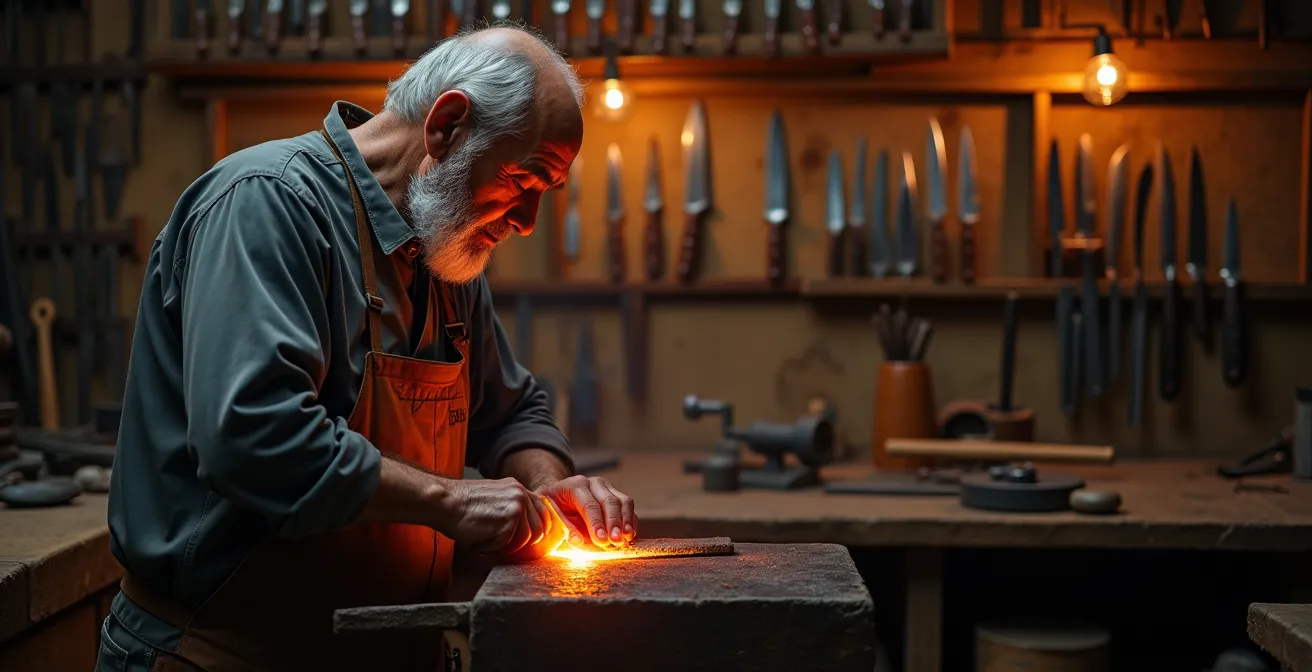
A handmade knife’s 10x price reflects its value not as a product, but as a piece of tangible cultural heritage, embodying thousands of hours of irreplaceable human skill.
- The price funds an entire ecosystem of mastery, where skills are passed down through years of dedicated apprenticeship, not learned in a few hours.
- Authentic craft has a narrative value—from the history of its materials to the hands of its maker—that factory production cannot replicate.
Recommendation: When you buy handcrafted goods, view the purchase as an act of patronage. You are not just acquiring an object; you are investing in the survival of a tradition and the livelihood of a master artisan.
When faced with a $500 handmade chef’s knife next to a $50 factory-made equivalent, the question is inevitable: what could possibly justify a tenfold price difference? The common answers point to superior steel, a sharper edge, or a more comfortable handle. While often true, these explanations only skim the surface. They treat the knife as a mere collection of physical attributes, missing the fundamental distinction that defines its true worth. The value isn’t just in the object; it’s in the story, the skill, and the survival of a tradition that the object represents.
This isn’t about simple manufacturing. It’s about an entire ecosystem of knowledge, apprenticeship, and dedication that a factory assembly line is designed to eliminate. The price of a handmade knife is the price of time—not just the hours spent forging the blade, but the years spent mastering the craft. It’s an investment in embodied knowledge, a concept that stands in direct opposition to the world of mass production and disposable goods. Understanding this shift in perspective is the key to appreciating why supporting true craftsmanship is an act of cultural preservation.
This video offers a glimpse into the intense, focused process of traditional Japanese knife forging, illustrating the dedication required to transform raw steel into a functional work of art.
To truly grasp the value embedded in a handcrafted object, we must deconstruct the elements that separate it from a factory product. This article will explore the years of mastery required, the story told by the materials, the ethics of purchasing, and the signs of true authenticity, revealing why a handmade item is not an expense, but an investment in heritage.
Summary: The True Cost of Craftsmanship
- Why Does It Take 10 Years to Learn to Weave Correctly?
- Why Is a Table Made of Reclaimed Wood Worth More Than a New One?
- How to Spot “Fake Local” Crafts Made in Factories?
- Buying at the Workshop or the Boutique: Where Does the Money Go?
- The Bargaining Mistake That Insults Master Craftsmen
- The Souvenir Mistake: Why Buying Imported Trinkets Hurts Heritage
- Which Fair Trade Certifications Actually Guarantee a Living Wage?
- How to Bring Ceramics Home Without Breaking Them?
Why Does It Take 10 Years to Learn to Weave Correctly?
The foundation of a handmade object’s value is embodied knowledge—skill that cannot be written in a manual or programmed into a machine. It is absorbed through years of observation, repetition, and mentorship. The idea that it takes a decade to master a craft like weaving isn’t an exaggeration; it’s a recognition that true proficiency involves subtleties of touch, tension, and intuition that only time can cultivate. This long journey is about more than just technique; it’s about becoming part of a lineage. As one case study reveals, Watanabe, an apprentice urushi (lacquer) forester, admitted that even after six years, he still hadn’t professionally mastered the “simple” task of sharpening his sickle. This demonstrates how deep the well of mastery runs in traditional fields.
The master-apprentice relationship is the vessel for this knowledge transfer. It’s a system built on loyalty and dedication, far removed from a typical employment contract. As the craft researchers at GOENNE note when discussing traditional Japanese apprenticeships, the commitment is profound. They highlight the reciprocal nature of this bond:
An apprentice who proves their dedication and loyalty over time is not only trained in technical skills but also gains an unwavering mentor. A master will support a devoted apprentice throughout their career, offering guidance and industry network.
– GOENNE Craft Research, Real Japanese Craft Apprenticeships vs. Tourist Cultural Immersion Programs
This system ensures not only that a skill survives but that it evolves with integrity. The 10x price of a handmade knife doesn’t just pay for the hours at the forge; it helps fund this entire cultural and educational ecosystem, allowing a master to dedicate time to a successor. It is the cost of keeping a human tradition alive in an automated world.
Why Is a Table Made of Reclaimed Wood Worth More Than a New One?
Just as a craftsman’s hands carry a story of decades of practice, the materials themselves can possess a narrative that imbues them with value. Reclaimed wood is a prime example. A dining table made from the floorboards of a 19th-century barn is more than just furniture; it is a piece of history. Its scars, nail holes, and weathered patina are not imperfections but marks of a previous life, a story that newly harvested lumber can never tell. This narrative value is a significant component of its higher price, transforming a functional object into a conversation piece.
This appreciation for history and sustainability is not a niche interest but a rapidly growing market force. A recent market analysis shows the sustainable furniture sector is booming, with the value of reclaimed wood projected to grow from $15.0 billion in 2024 to $36.0 billion by 2035. Consumers are increasingly willing to pay a premium for objects that align with their values. In this context, choosing reclaimed wood is a statement against deforestation and the disposable economy.
The Ecological Dividend of Reclaimed Wood Furniture
Companies and artisans who choose reclaimed wood are not just making a stylistic choice; they are making an ethical one. By repurposing existing resources, they avoid contributing to forest depletion. This aligns their brand with environmental stewardship and appeals to a customer base that prioritizes sustainability. The higher value of the final product reflects this “ecological dividend,” where the environmental benefit is a tangible part of the product’s worth, contributing to a more sustainable future.
Ultimately, the worth of a reclaimed wood table and a handmade knife stem from the same source: a rejection of the generic and a celebration of the unique. Whether the story is in the maker’s ten-thousand hours of practice or the wood’s hundred-year journey, the principle remains the same. Authenticity and history are commodities that factories cannot mass-produce, and discerning consumers are increasingly recognizing their intrinsic value.
How to Spot “Fake Local” Crafts Made in Factories?
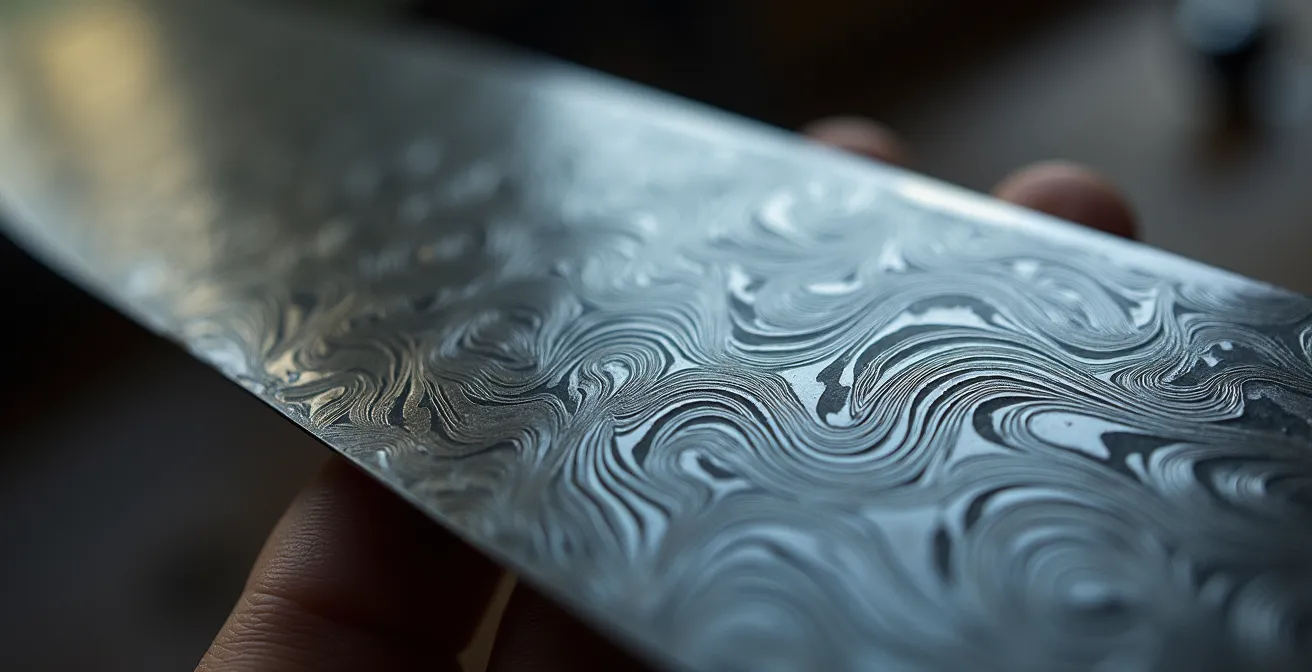
As the appreciation for authentic craftsmanship grows, so does the market for convincing forgeries. Nowhere is this more apparent than with Damascus steel knives. The beautiful, layered patterns of true pattern-welded steel are the result of a laborious process of forge-welding different types of steel together. Fakes, however, often just have a pattern acid-etched or laser-engraved onto the surface of a cheap, monolithic blade. To a discerning buyer, knowing the difference is crucial. It is the difference between owning a piece of metallurgical art and a decorated factory product.
The key to identifying a fake is to look for signs of industrial perfection and surface-level decoration. True Damascus has an organic, slightly imperfect flow to its patterns, and these layers should be visible through the entire thickness of the blade, not just on the sides. The image below contrasts the deep, integral patterns of an authentic blade with the flat, printed appearance of a factory fake.
Beyond a simple visual check, several practical tests can help you verify the authenticity of a supposed handcrafted item. These involve scrutinizing the pattern, feeling the texture, and even performing a small, discreet test on the material itself. The goal is to find evidence that the defining feature—in this case, the layers—is integral to the object’s structure, not just an aesthetic afterthought.
Your Checklist: 5 Tests to Identify Fake Damascus Steel Knives
- Pattern Inspection: Check if patterns seem too perfect, are barely visible, or appear ‘painted on’. These are all indicators of fake Damascus, which lacks the organic depth of a hand-forged blade.
- Fingernail Test: Run your fingernail across the pattern. Genuine Damascus has a smooth surface where layers are seamlessly welded, while fakes can feel either perfectly flat like glass or have an artificially raised, textured feel from the etching process.
- Edge Examination: If possible, lightly sand a small, inconspicuous area of the blade edge or spine with very fine-grit sandpaper. If the pattern disappears, it proves the design was merely etched onto the surface.
- Price Reality Check: If the price seems unusually low for a “Damascus” knife, it is almost certainly a fake. The skilled craftsmanship and quality materials required for genuine pattern-welding come at a significant cost.
- Layer Visibility: Examine the spine of the blade and the area near the handle (the ricasso). On an authentic Damascus blade, you should be able to see the faint lines of the layers running through the thickness of the steel.
Buying at the Workshop or the Boutique: Where Does the Money Go?
When you purchase a handcrafted object, you are not just a consumer; you are a patron. The channel through which you buy determines where your patronage flows. Buying from a gallery or a high-end boutique has its place, but purchasing directly from the artisan’s workshop offers a fundamentally different and often more rewarding experience. It transforms a simple transaction into a human connection. You get to meet the person whose skill and vision are embodied in the object, and you gain a deeper appreciation for the process.
This direct connection is a core part of the value proposition for many craft enthusiasts. As one member of the BladeForums community articulated, the appeal goes far beyond the physical object. The purchase becomes a relationship:
To me, the most important difference between production and custom knives are the people in the custom knifemaking community. It is a totally different and much more fulfilling experience to deal directly with the people that make your knives.
– BladeForums Community Member, Difference Between Custom and Production Knives Discussion
Financially, buying direct also ensures that the maximum amount of your money supports the creator. While boutiques and galleries provide valuable curation and marketing, they also take a significant commission, often 30-50%. When you buy from the workshop, you are directly funding the artisan’s ability to buy materials, maintain their tools, and, most importantly, dedicate the immense time required for their craft. Experienced knife makers on forums like BladeForums frequently note that while individual craftsmen may invest over 100 hours in a single knife, production companies are incentivized to minimize labor for maximum profit. Your direct purchase supports the former model over the latter.
The Bargaining Mistake That Insults Master Craftsmen
In many markets around the world, haggling is a standard and expected part of commerce. However, applying this practice to the work of a master artisan is a grave misunderstanding of the object’s value. To bargain over a handmade knife is to treat it like a mass-produced commodity, implying that its price is an arbitrary markup rather than a fair reflection of materials, time, and a lifetime of skill. It fundamentally disrespects the ecosystem of mastery that produced it.
The price set by a reputable maker is not a starting point for negotiation. It is a calculated figure that accounts for high-quality, often custom-made materials, the immense cost of energy for the forge, workshop overhead, and, most significantly, the countless hours of labor and expertise. As one experienced collector on BladeForums stated, quality has a non-negotiable price: “If you want quality from a reputable maker, it’s going to cost.” This price is what allows makers like Bob Kramer or Chad Nichols to create their breathtaking and unique work.
The Stark Economics of Pakistani vs. American Damascus
A discussion on BladeForums shed light on the vast economic disparity between mass-produced “Damascus” and the work of American master smiths. It was estimated that a sub-$100 Damascus knife from Pakistan has “about forty cents of material and ten dollars labour” invested in it. These knives often use inferior steels and skip crucial steps like proper heat treatment, resulting in a blade that is visually decorative but functionally poor. In contrast, a reputable American maker’s price reflects hundreds of dollars in quality materials and dozens of hours of highly skilled labor, ensuring a tool that is both beautiful and performs at the highest level.
Attempting to bargain with a master craftsman is asking them to devalue their own life’s work. It’s asking them to compete with a system that prioritizes volume over quality and cheap labor over skilled artistry. The correct approach is to see the price as a statement of worth. If it is beyond one’s budget, the respectful path is to admire the work and save for it, not to insult the maker by suggesting their time and skill are worth less.
The Souvenir Mistake: Why Buying Imported Trinkets Hurts Heritage
The choice between a handcrafted object and a mass-produced one extends far beyond high-end knives. It presents itself in every tourist market and gift shop worldwide. The “souvenir mistake” is buying a generic, factory-made trinket—often produced in another country entirely—instead of a locally made craft. While seemingly harmless, this decision has a corrosive effect on the very culture a traveler has come to experience. It diverts money away from the local economy and into the pockets of international manufacturers, starving the local artisans who are the true custodians of cultural heritage.
When you buy a plastic replica of a landmark or a t-shirt printed in a factory thousands of miles away, you are voting for a homogenized, globalized culture. You are rewarding a business model that profits from replacing authentic local expression with a cheap imitation. Every dollar spent on an imported souvenir is a dollar that does not go to the local potter, weaver, woodcarver, or jeweler. Over time, this economic pressure can lead to the decline and even extinction of traditional craft forms, as artisans are forced to abandon their skills for more viable work.
Choosing an authentic, locally made souvenir, even if it is smaller or more expensive, is a powerful act of economic patronage. It ensures your travel spending directly supports the community you are visiting. It helps preserve the skills and traditions that make a place unique. A hand-painted tile, a small woven basket, or a carved wooden figure carries a piece of that place’s soul. It has a story, a connection to a person, and an authenticity that a plastic keychain can never possess. By consciously seeking out these items, you move from being a passive tourist to an active supporter of cultural heritage.
Which Fair Trade Certifications Actually Guarantee a Living Wage?
For the conscious consumer who wants to ensure their purchase supports artisans ethically, the world of certifications can be confusing. Labels like “fair trade” are intended to signal that a product was made under equitable conditions, but not all certifications are created equal. The most meaningful ones go beyond simply paying a slightly higher price; they aim to guarantee a living wage, promote safe working conditions, and foster long-term, respectful relationships between producers and buyers.
While specific certifications vary by region and industry, the core principles of a strong fair trade model remain consistent. Look for organizations that emphasize transparency in their supply chain. Can you trace the product back to a specific workshop or cooperative? True fair trade is about relationships, not just transactions. Organizations like the Fair Trade Federation require their members to build long-term partnerships with artisan groups, ensuring stable income and allowing for collaborative product development.
Furthermore, the best systems often involve a “fair trade premium,” an additional sum of money paid into a communal fund for artisans to use on community development projects, such as improving healthcare, education, or local infrastructure. When evaluating a product, ask questions. Does the seller provide detailed information about the artisans? Do they talk about the impact of the purchase beyond simple economics? While a certification label can be a helpful starting point, a seller’s commitment to transparency and storytelling is often a more reliable indicator of a genuinely ethical partnership. In the absence of a familiar label, prioritizing direct-from-artisan purchases or buying from small businesses with clear, documented relationships with their producers is a powerful strategy.
Key Takeaways
- The value of a handcrafted object is primarily in the embodied knowledge and years of mastery of its creator, a factor that factory production is designed to eliminate.
- Authenticity has narrative value; materials with a history (like reclaimed wood) and a direct connection to the maker add a layer of worth that cannot be replicated.
- Viewing your purchase as an act of patronage, especially when buying direct, ensures you are supporting the artisan and the cultural ecosystem they represent, not just acquiring a product.
How to Bring Ceramics Home Without Breaking Them?
Having invested in a unique, handcrafted piece—whether it’s a delicate ceramic bowl or a perfectly balanced knife—you become its custodian. The final act of honoring the craft is ensuring the object survives its journey home. Fragile items like ceramics are particularly vulnerable, and a few careful steps can mean the difference between a cherished memento and a box of shards. The best-placed person to protect the object is the one who knows its every weakness: the artisan who created it.
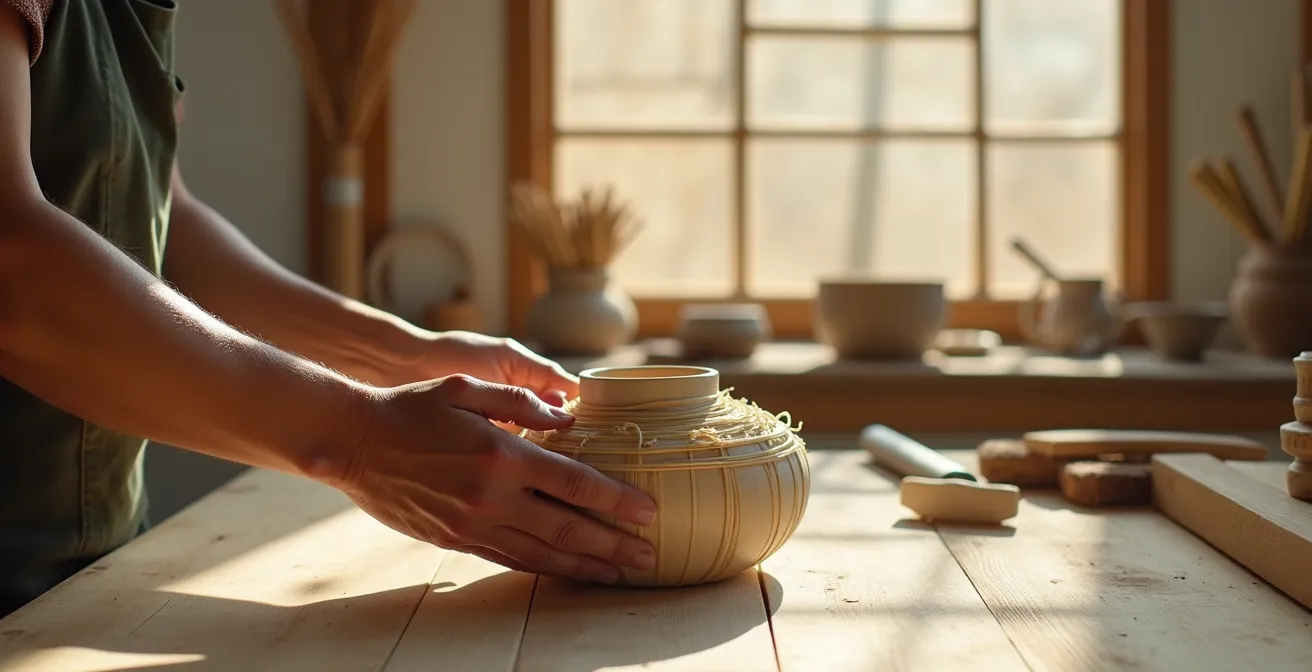
Whenever possible, ask the artisan to pack the piece for you. They have an intimate understanding of its structural weak points and will often use traditional, time-tested materials and techniques to protect it. The image below captures this moment of care, where the creator’s hands, which brought the object into being, are now the ones ensuring its preservation. This act closes the loop of the artisan’s responsibility for their work.
If you must pack it yourself, think in layers. Your goal is to create a system that can absorb shock and prevent movement. A multi-layered approach is the professional standard for transporting valuable artisanal goods:
- Request Professional Packing: Always ask the artisan to pack the item first. They know its unique vulnerabilities better than anyone.
- Use Multiple Layers: The core principle is layered protection. Start with a soft inner layer like bubble wrap directly against the item, place that inside a rigid box, and then place that box inside a larger, padded container.
- Mark Packages Clearly: Use ‘FRAGILE’ labels and directional arrows, and if traveling internationally, consider adding the local language equivalent.
- Consider Insurance: For particularly valuable or irreplaceable items, purchase travel insurance that specifically covers artisanal goods and high-value crafts.
- Document the Process: Take photos of the item and the packing process. This can be invaluable for any potential insurance claims.
- Hand-Carry When Possible: For smaller, irreplaceable pieces, the safest place is often in your carry-on luggage, under your direct control.
By taking these precautions, you are showing the ultimate respect for the object and the immense effort that went into its creation. You are ensuring that the story embodied in the craft will continue to be told for years to come.
The tenfold price difference between a handmade knife and its factory-made counterpart is not a markup; it is the honest cost of preserving humanity in the objects we use. It accounts for the decade of learning, the direct patronage of a master, the narrative embedded in the materials, and the rejection of a disposable economy. The next time you hold a handcrafted object, look beyond the price tag. You are not just buying a thing; you are holding a story. Choose to be a patron of that legacy.