
The true source of indoor air problems isn’t drywall itself, but the non-breathable, sealed building systems that trap moisture and toxins.
- Modern materials like cement render and acrylic paints create a plastic-bag effect, preventing walls from managing humidity.
- Natural, hygroscopic materials like hemp-lime and wood fiber actively “breathe,” buffering moisture and improving air quality.
Recommendation: Prioritize vapor-permeable materials in your building or renovation projects to create a healthier, self-regulating indoor environment.
You strive to create a healthy sanctuary for your family, yet unexplained allergies, persistent stuffiness, and lingering colds might suggest your home itself is part of the problem. Many homeowners immediately suspect common culprits like VOCs in new paint or mold on drywall in a damp basement. While these are valid concerns, they are often just symptoms of a much deeper, systemic issue rooted in modern construction philosophy.
The standard approach has been to seal our homes as tightly as possible for energy efficiency, wrapping them in impermeable layers. We address moisture and air quality with complex, mechanical ventilation systems. But what if this entire paradigm is flawed? What if the secret to a healthy home isn’t to seal it and then force it to breathe, but to build with materials that breathe naturally?
This article moves beyond the surface-level blame on drywall and delves into the science of building biology. We will uncover the critical, often-overlooked role of vapor permeability and how the “sealed box” approach of modern construction can inadvertently cultivate an unhealthy environment. By understanding this core principle, you can make informed choices about materials that work with nature, not against it, to actively manage moisture and safeguard your family’s health.
To help you navigate these crucial concepts, this guide explores why conventional methods fail and how breathable alternatives provide a robust solution for a truly healthy home. Discover the science behind walls that breathe and the materials that make it possible.
Summary: The Hidden Health Risks of Modern Construction
- Why Does Cement Render Cause Mold in Old Stone Houses?
- How to Build a Wall That Breathes Using Hemp and Lime?
- Straw Bale or Brick: Which Resists Fire Better Than You Think?
- The Varnish Mistake That Seals the Breathability of Wood
- How to Soundproof a Room Naturally Without Fiberglass?
- Hemp Wool or Polystyrene: Which Lasts Longer in Damp Climates?
- The Male Tree Mistake That Caused the Asthma Epidemic
- Which Insulation Material Best Prevents Summer Overheating?
Why Does Cement Render Cause Mold in Old Stone Houses?
Old stone houses were designed as a complete breathing system. Their porous stone and lime mortar allowed moisture vapor to pass freely from the interior to the exterior, preventing water from becoming trapped within the wall. The problem arises when modern, “durable” materials like Portland cement render are applied over these traditional structures. Cement is largely impermeable to water vapor. When warm, moist air from inside the house hits the cold stone, it condenses. With the cement render acting like a plastic sheet on the outside, this condensed moisture has no escape route. The wall becomes permanently damp, leading to crumbling mortar, damaged stone, and a perfect breeding ground for toxic mold.
This concept is quantified by a material’s vapor permeance, measured in “perms.” A material with a high perm rating is breathable; one with a low perm rating is a vapor barrier. While some vapor control is necessary, sealing a wall assembly too tightly is a critical mistake. For example, research from Building Science Corporation shows that while a standard wood-sheathed wall is vapor semi-permeable, replacing the siding with traditional hard-coat stucco can cause the assembly’s permeance to drop below 1.0 perm, making it a vapor barrier. This traps moisture and creates conditions for decay and mold, precisely the issue seen with cement on old stone.
To avoid this, building assemblies must be designed as a system where each layer is progressively more vapor-permeable from the inside out. For instance, building science experts recommend housewrap with a rating of 10-20 perms to allow trapped moisture a path to escape. Applying a non-breathable material like cement render to a breathable wall is a fundamental violation of this principle, guaranteeing moisture problems.
Ultimately, the goal is not to block moisture but to manage it intelligently, a principle that modern cement often ignores at great cost to the building’s health.
How to Build a Wall That Breathes Using Hemp and Lime?
The solution to the sealed-box problem is to use materials that are inherently hygroscopic and vapor-permeable. “Hygroscopic” means they can absorb and release moisture from the air, acting as a natural humidity buffer. A prime example of such a system is a wall built from hemp and lime, often known as “hempcrete.” This is not a structural material like concrete but an infill insulation cast around a timber frame. The magic lies in the interaction between the woody core of the hemp stalk (shiv) and the lime binder.
The hemp shiv is porous, creating millions of tiny air pockets that provide insulation. The lime binder is naturally antiseptic, mold-resistant, and, most importantly, highly vapor-permeable. Together, they form a monolithic wall that actively manages indoor humidity. When indoor humidity is high, the hemp-lime wall absorbs excess moisture. When the air becomes dry, it releases that moisture back into the room. This process, known as hygric buffering, stabilizes the indoor environment and drastically reduces the risk of condensation and mold growth, as the wall never has a perpetually damp layer.
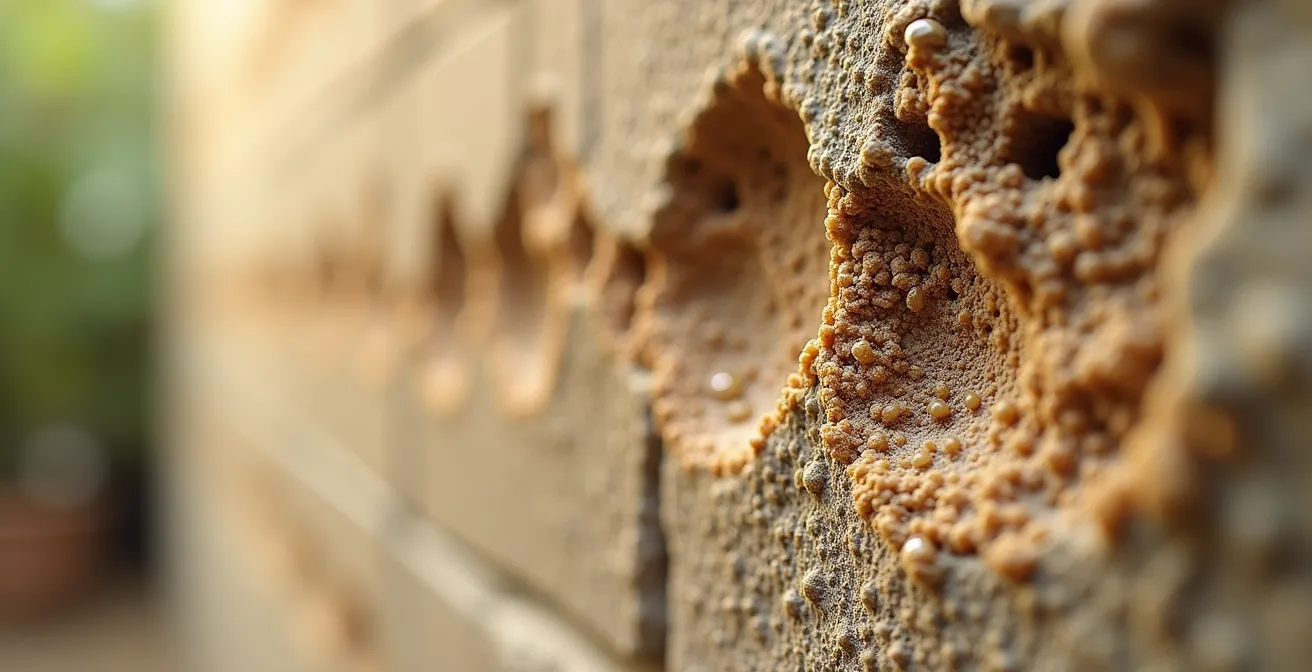
As this cross-section illustrates, the material’s structure is inherently porous, allowing vapor to move through it. This is a stark contrast to a layered drywall assembly, which often traps moisture between impermeable surfaces like a vapor barrier and low-perm paint. As noted by the experts at Healthy Materials Lab, HempLime products are naturally resistant to pests, mold, and fire, and their ability to regulate humidity and heat improves the overall indoor environment without the need for toxic additives.
By building a wall that breathes, you create a more resilient, passive system for maintaining a healthy and comfortable home, reducing reliance on complex mechanical ventilation.
Straw Bale or Brick: Which Resists Fire Better Than You Think?
When considering alternative building materials, a common and understandable concern is fire safety. Intuition might suggest that a wall made of straw is a significant fire hazard compared to a conventional brick wall. However, this is a misconception rooted in a misunderstanding of how straw bale walls are constructed. A properly built straw bale wall is not a loose pile of hay; the bales are densely compacted and then sealed on all sides with a thick layer of non-combustible plaster, typically lime or clay-based.
This dense compaction and plaster coating eliminate the oxygen needed for combustion. In a fire, the plaster protects the straw, and if a breach does occur, the dense bales char slowly rather than bursting into flame. In standardized fire tests, plastered straw bale walls consistently perform exceptionally well, often outlasting conventional construction. The comparison with other materials reveals a surprising hierarchy of fire resilience.
The following table, based on common industry data, compares the fire performance of plastered straw bale with standard brick and fire-rated (Type X) drywall. While brick has a high rating, its failure mode can be sudden and catastrophic, whereas straw bale’s failure is slow and predictable.
| Material | Fire Rating | Toxic Fumes | Failure Mode |
|---|---|---|---|
| Plastered Straw Bale | 90-120 minutes | Minimal | Slow charring |
| Standard Brick | 60-240 minutes | None | Catastrophic spalling |
| Type X Drywall | 60 minutes | Moderate VOCs | Paper combustion |
A key advantage of straw bale and other natural materials like hemp-lime is not just their fire resistance but also what happens during a fire: they release minimal to no toxic fumes. In contrast, many modern materials, including drywall, glues, and foams, can release a cocktail of hazardous chemicals when they burn, posing a significant danger to occupants and first responders.
Therefore, when properly constructed, a straw bale wall is not only a healthy, breathable building system but also a remarkably fire-safe one, challenging our conventional assumptions about material performance.
The Varnish Mistake That Seals the Breathability of Wood
Even when you choose breathable structural materials like wood, hemp-lime, or straw bale, the final finish can completely negate their benefits. Wood is a naturally hygroscopic and vapor-permeable material, able to help buffer indoor humidity. However, coating it with a standard polyurethane varnish or an acrylic-based paint is like wrapping it in plastic. These common finishes create an impermeable film, sealing the wood’s pores and trapping moisture. This can lead to the wood being unable to dry out if it gets wet, promoting rot and mold growth from within.
The impact of coatings is significant. Research from the University of Alaska Fairbanks shows that adding a second coat of paint can reduce water vapor transmission by more than 50%. This demonstrates how quickly a breathable surface can be compromised. The key is to choose finishes that maintain the wall assembly’s breathability. This involves looking for paints and plasters with a high “perm” rating, ensuring they don’t create a vapor barrier on the interior surface of your home.
To preserve a wall’s ability to breathe, you should opt for finishes that are themselves vapor-permeable. This creates a complete system where moisture can move freely through every layer. The following checklist provides a hierarchy of breathable finishes to guide your choices.
Action Plan: Choosing Breathable Wall Finishes
- Assess Points of Contact: Identify all interior wall and ceiling surfaces that will be finished. This includes drywall, plaster, and wood.
- Inventory Existing Finishes: If renovating, determine the current paint type. Is it a non-breathable acrylic or a more permeable mineral paint?
- Check for Coherence: Ensure your chosen finish is compatible with the wall’s substrate and overall breathability goals. A limewash is perfect for lime plaster but not for standard drywall.
- Evaluate Permeability: Review the technical data for your chosen finish. A good starting point is a low-VOC acrylic with a perm rating above 5. Better options are silicate or mineral-based paints (10+ perms). The best choice for maximum breathability is a natural clay or lime plaster (20+ perms).
- Plan for Integration: Choose a finish that aligns with your home’s system. If you have a fully breathable wall like hemp-lime, using an acrylic paint would be a critical mistake that undermines the entire system.
By selecting penetrating oils for wood and mineral-based or clay finishes for walls, you maintain the building envelope’s health-promoting functions.
How to Soundproof a Room Naturally Without Fiberglass?
Effective soundproofing is often associated with synthetic materials like fiberglass batts and mass-loaded vinyl. While effective, these materials can come with health drawbacks. Fiberglass insulation is made of tiny glass shards that can be an irritant to the skin, eyes, and respiratory system during installation. Many synthetic soundproofing products can also off-gas Volatile Organic Compounds (VOCs). However, excellent acoustic performance can be achieved using natural, non-toxic materials that often provide co-benefits like breathability and improved thermal performance.
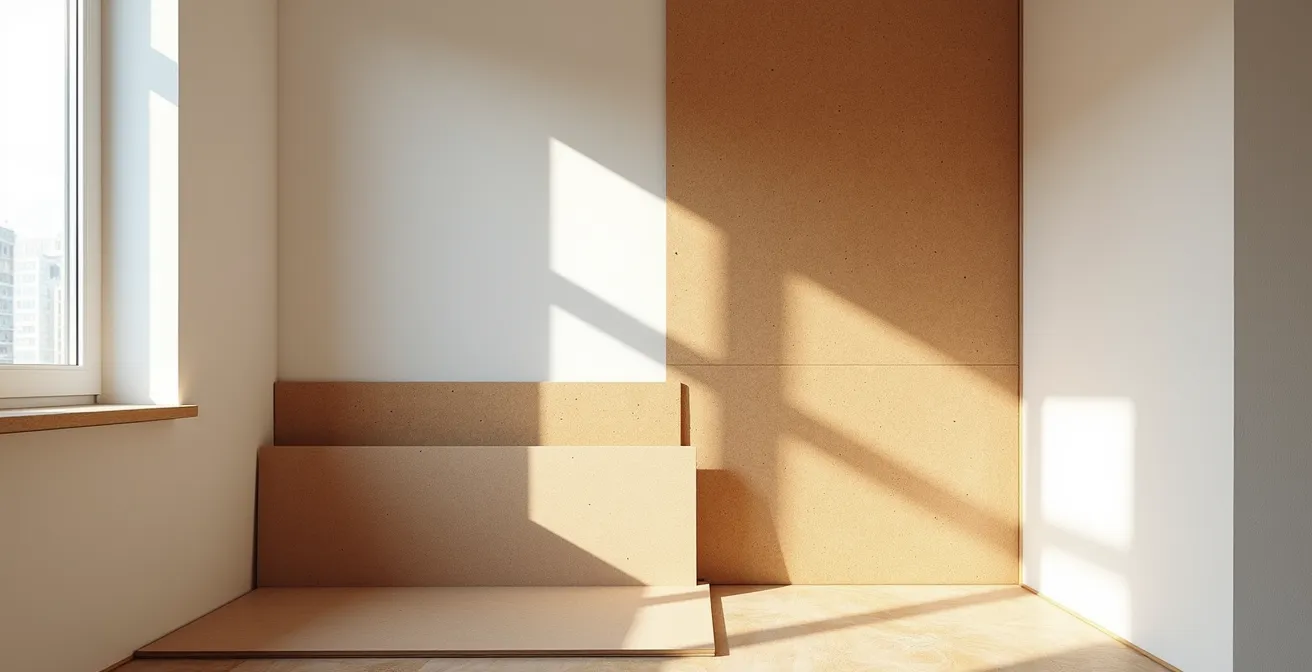
Natural materials soundproof a room through two main principles: adding mass and creating density variation. Dense materials like wood fiberboard and cork panels are effective at blocking airborne sound transmission. Softer, fibrous materials like hemp wool, sheep’s wool, or dense-packed cellulose excel at absorbing sound and reducing reverberation within a room. A combination of these materials in a wall assembly can provide soundproofing performance that meets or exceeds that of conventional methods. For example, a study on hemp-lime found that these hygroscopic and breathable materials also provide acoustic benefits through their monolithic and slightly soft nature.
This is critically important not just for comfort, but for health. A quiet environment reduces stress, but the materials used have a direct impact on air quality. Avoiding materials that can harbor mold is paramount. As integrative physician Dr. Neil Nathan explains, the toxins produced by mold can have severe neurological effects.
If the lungs are the first organ to meet the air, the brain is the first to interpret it. According to integrative physician Dr. Neil Nathan, author of Toxic: Heal Your Body from Mold Toxicity, many patients report cognitive changes before respiratory ones. They can’t think straight, words disappear mid-sentence… because mycotoxins produced by mold spores easily cross the blood brain barrier triggering neuroinflammation.
– Dr. Neil Nathan, Toxic: Heal Your Body from Mold Toxicity
By opting for natural soundproofing, you not only create a quieter space but also a healthier one, free from synthetic fibers and chemicals.
Hemp Wool or Polystyrene: Which Lasts Longer in Damp Climates?
In damp climates, the long-term performance and durability of insulation are put to the test. Conventional foam insulations like Expanded Polystyrene (EPS) are often chosen for their high R-value and resistance to absorbing liquid water. However, their very low vapor permeability can become a liability. If moisture does find its way into the wall assembly—through a small leak or condensation—polystyrene can trap it. This creates a permanently damp environment behind the foam board, leading to rot in wooden structural elements and the proliferation of mold, all hidden from view.
In contrast, hygroscopic natural insulations like hemp wool, sheep’s wool, or cork behave very differently. These materials can safely absorb and release large amounts of water vapor without losing their structural integrity or thermal performance. This “moisture buffering” capacity is a significant advantage in damp climates. Instead of trapping water, the insulation helps to manage it, wicking it through the wall assembly until it can safely dry to the exterior or interior. This process protects the surrounding structure from decay.
Research confirms this resilience. For example, studies on hemp-lime show that the material maintains its ability to buffer moisture even with significant temperature swings. Furthermore, in a wet state, as temperature increases, its thermal conductivity actually decreases as its water content drops, meaning it effectively dries itself out while improving its insulating properties. Polystyrene does not have this dynamic, self-regulating ability. While polystyrene may not rot itself, it can facilitate the decay of the entire wall around it by trapping moisture. Hemp wool, by managing moisture, protects the whole system.
For long-term durability in a damp climate, the resilience of a breathable, hygroscopic material like hemp wool far surpasses the false security offered by an impermeable foam like polystyrene.
The Male Tree Mistake That Caused the Asthma Epidemic
Sometimes, well-intentioned decisions can have disastrous, unintended health consequences. A classic example from urban planning is the “male tree mistake.” For decades, city planners and landscapers preferentially planted male trees because they don’t produce messy fruit or seed pods. The unforeseen result was a massive increase in airborne pollen, as only male trees produce it. This spike in environmental allergens has been linked to rising rates of asthma and allergies in urban populations. It’s a powerful lesson in how tampering with a natural system without understanding the holistic consequences can backfire.
An exact parallel is happening inside our homes. In the pursuit of energy efficiency, we adopted a philosophy of sealing our buildings as tightly as possible with impermeable, synthetic materials. Like the urban planners who only saw the “mess” of fruit, builders only saw the “waste” of energy. They failed to appreciate the vital, invisible function of a breathing building envelope: the passive management of moisture and the dilution of indoor pollutants. By sealing our homes, we have trapped a host of contaminants—VOCs from furniture, particulates from cooking, and mycotoxins from hidden mold—creating an “allergen load” indoors that can be far greater than what’s outside.
This phenomenon has led to what is known as Sick Building Syndrome (SBS), a condition where occupants experience acute health effects that appear to be linked to time spent in a building, but no specific illness or cause can be identified. Symptoms often include headaches, fatigue, dizziness, and respiratory issues. It’s a modern ailment born from modern construction. In fact, the World Health Organization estimated that up to 30% of new and remodeled office buildings in the West had indoor air problems causing these symptoms.
Just as urban planners are now reintroducing female trees to balance the ecosystem, builders and homeowners must reintroduce breathable materials to restore the health of our indoor ecosystems.
Key Takeaways
- Vapor permeability is the single most important factor for a healthy wall system; materials must allow moisture to escape.
- Modern sealed building envelopes often trap moisture and pollutants, leading to mold and poor indoor air quality (Sick Building Syndrome).
- Natural, hygroscopic materials like hemp, lime, and wood fiber actively manage humidity and provide superior, healthier performance.
Which Insulation Material Best Prevents Summer Overheating?
In the conversation about insulation, the focus is almost always on winter performance, measured by R-value. A high R-value indicates good resistance to heat conduction, keeping a home warm. However, this metric is a poor indicator of how a building will perform in the summer. Preventing summer overheating is less about resisting heat flow (R-value) and more about slowing it down. This is where the concepts of thermal mass and decrement delay become critical.
Thermal mass is a material’s ability to absorb and store heat. Decrement delay is the time it takes for heat to travel from the outside of the insulation to the inside. Lightweight insulations like fiberglass and polystyrene have very low thermal mass. On a hot summer day, heat quickly passes through them, and the interior of the house heats up almost in sync with the outdoor temperature. You are then forced to rely on air conditioning to stay comfortable.
In contrast, dense, natural insulations like wood fiberboard and hemp-lime have high thermal mass. They absorb the sun’s heat throughout the day. Because of their long decrement delay (often 8-12 hours), that heat doesn’t reach the interior living space until late in the evening, by which time outdoor temperatures have dropped. You can then ventilate the house with cool night air, “resetting” the walls for the next day. This passive cooling mechanism dramatically reduces or even eliminates the need for air conditioning.
| Material | R-Value (per inch) | Thermal Mass | Decrement Delay (hours) |
|---|---|---|---|
| Fiberglass | 3.5 | Low | 1-2 |
| Polystyrene Foam | 4.0 | Very Low | 0.5-1 |
| Wood Fiberboard | 3.0 | High | 8-12 |
| Hemp-Lime | 2.2-4.8 | Medium-High | 6-10 |
As the table shows, despite having a lower R-value than polystyrene, wood fiberboard’s performance in summer is vastly superior due to its high thermal mass and long decrement delay. Materials like hemp-lime also perform exceptionally well, demonstrating a low thermal conductivity around 0.2 W/(m.K) combined with beneficial mass.
For true climate resilience and comfort, prioritizing materials with high thermal mass is a far more intelligent strategy than chasing the highest possible R-value.